Near the Finnish Border, Russia is Quietly Building its Military
By Elliott Clark | 4 March 2026
Summary
Russia has been engaging in a notable military buildup near the Finnish border, with an increase in military personnel and the restoration of old military bases.
This new military activity gives credence to NATO’s concerns that Russia’s territorial ambitions may go beyond Ukraine, underlining the threat level posed by Putin’s Russia. However, these actions might be seen as an attempt by Russia to protect its nuclear arsenal within the region, which is similarly antagonistic.
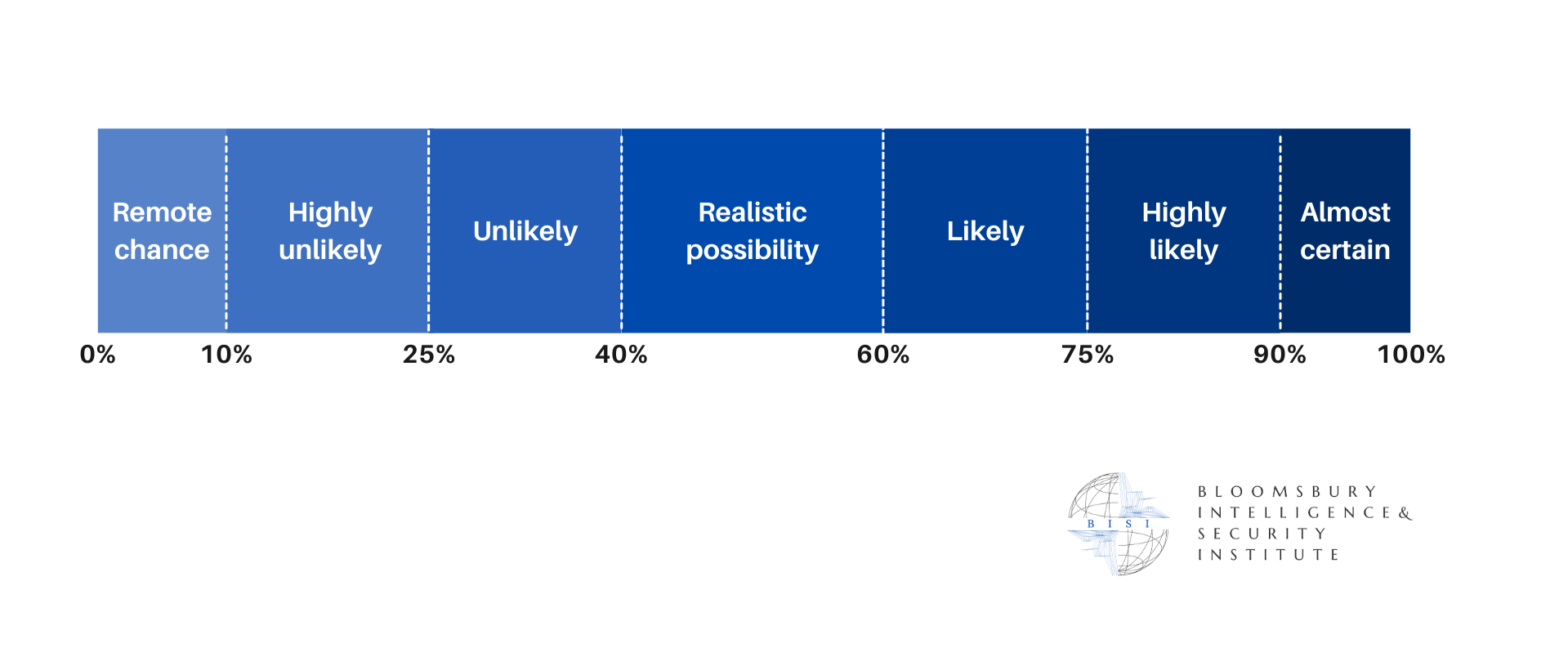
NATO is almost certainly going to look to strengthen its position in Finland, along the Baltic, to combat this threat. However, given that Russia‘s military focal point is Ukraine, this buildup is highly unlikely to result in a kinetic attack in the near term.
Context
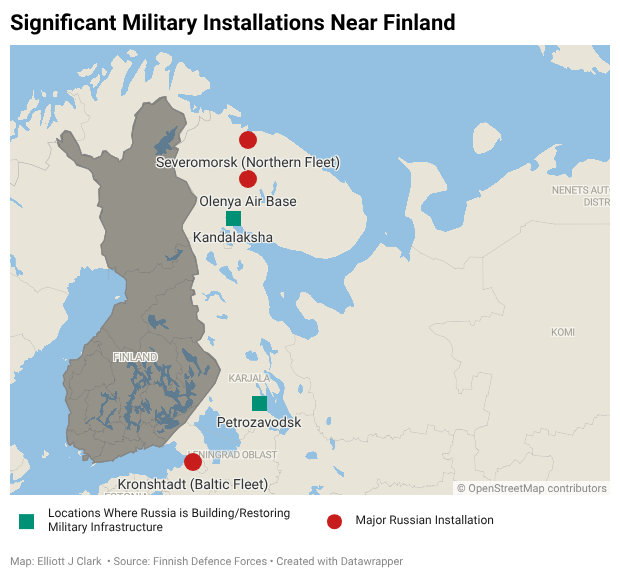
In recent years, Russia has engaged in notable acts of military activity near the Finnish border. Yle, a Finnish broadcaster, has revealed that a garrison is being built in Petrozavodsk, Karelia, enabling a significant expansion of Russian troops. Around 15,000 troops are expected to be based in Karelia, up from around 3,000. This follows the installation of a new artillery brigade in Kandalaksha, Murmansk in June 2025, underscoring Russia’s intention to consolidate its prowess in northern Europe. When Russia’s military reforms are completed, an estimated 80,000 troops will be stationed in the vicinity of Finland. This, however, is unlikely to take place until after the end of the Ukraine war due to the lack of manpower and equipment.
Implications
The prospect of Russia’s military expansion beyond Ukraine has long been regarded as a realistic possibility. However, as Russia’s priority remains on achieving victory in Ukraine, it is unlikely to result in any immediate conflict with NATO. Furthermore, in the unlikely event of peace between Russia and Ukraine, the Russian military would be able to target other states. This is underpinned by Russia’s strong capacity to absorb battlefield losses. Beyond this, the size of Russia’s military-industrial complex signifies a long-term capacity to make war.
Whilst an attack seems unlikely in the immediate term, Russia’s recent moves will almost certainly cause concern amongst Western policymakers given Europe’s reliance on the waning US for security cooperation and guarantees under President Donald Trump. European states, particularly the Baltic states, would almost certainly be better motivated to support Finland and other Russia-bordering states, This could be seen in the form of additional military supplies, troop deployments, or diplomatic pressure on Russia. The UK, for instance, will double its amount of troops in Norway from 1,000 to 2,000 over three years.
Furthermore, the increased Russian presence could be seen to be a response to protect its interests within the Arctic. The Kola Peninsula is home to Russia’s largest concentration of nuclear weapons, meaning that it is a vital part of Russia’s deterrence posture. At the same time, Russia sees the Northern Sea Route as critical to its economic prosperity and security. Russia’s need to protect and expand its nuclear defence systems has intensified since the expiration of the New START Treaty, thereby providing a non-expansionist rationale for increased military presence in this region. Furthermore, the troops numbers and quality of infrastructure involved suggest that offensive operations are unlikely. Instead, the area could be used for training exercises.
Coinciding with rising tensions in the Arctic, Russia’s actions will almost certainly result in renewed emphasis on winter warfare. Cold Response 26, a NATO winter warfare exercise involving 25,000 troops, finished in January 2026. Such programmes are almost certainly going to receive newfound support and increased numbers as Russia strengthens its presence within the region.
Finland, although a small nation, is increasingly a dominant player on the global stage. NATO has established a permanent presence for its Forward Land Forces in northern Finland, hosted by the Finnish Jaeger Brigade. At the same time, Finland will increase its defence spending to 3% of GDP by 2029, up from 2.3% at the moment. Finland would almost certainly use this newfound influence to ensure that allies maintain their support for strong measures against Russia and to galvanise others to do more. States that are solidly anti-Russian in rhetoric, but fail to adequately support their NATO allies, like the UK, are most likely to face more pressure due to these actions.
Forecast
Short-term (Now - 3 months)
Russia’s actions will almost certainly cause concern in Western policymaking circles, reinforcing the need to strengthen Europe.
Finland will almost certainly call upon its allies in NATO to act with more urgency in protecting Russia's bordering states by deploying more troops and increasing defence spending. NATO laggards will almost certainly face more criticism.
The Baltics and other neighbours of Russia, particularly Moldova, will almost certainly continue to perceive Russia as an aggressive world power and continue to strive for integration with the West.
Medium-term (3 - 12 months)
Baltics and Scandinavian nations will almost certainly continue to strengthen their defences with urgency by continuing their pathways to already high defence spending. They will almost certainly look to increase the size of the military and prepare their citizens for war.
It is highly likely that more troops and support will be garrisoned in the Baltics and Finland.
Long-term (>1 year)
Russia’s strengthening posture in the north will almost certainly be cemented in Western strategy, requiring consistent winter war training across time.
Sweden and Finland are almost certain to find their involvement in the alliance to be worthwhile, securing their membership in the long term.
Other NATO allies, like the United Kingdom, are highly likely to allocate more resources and manpower to the Scandinavian countries, particularly Finland.
Russia is almost certain to see the North as central to its strategic objective, resulting in a continued heavy military presence within the region.