2026 US Annual Threat Assessment: AI and Quantum as Drivers of National Security Strategy
By Carlotta Kozlowskyj | 21 April 2026

Summary
In March 2026, the United States (US) Intelligence Community (IC) released its 2026 Annual Threat Assessment (ATA), which identifies AI and quantum computing as central to its national security and China as its most prominent competitor
The ATA signals a structural shift in how the US frames technological rivalry as a geopolitical competition, in which AI, quantum computing and advanced semiconductors are the primary components of national power.
This assessment is likely to pressure the federal office to review its R&D budget cuts and investment in AI and chip manufacturing.
Context
On 18 March 2026, the Office of the Director of National Intelligence (ODNI) released the IC 2026 ATA, an official evaluation of the most significant national security threats to US citizens, the Homeland, and US interests worldwide. It offers a more in-depth intelligence analysis than the National Security Strategy (NSS) and National Defence Strategy (NDS).
For the first time, the ATA includes a dedicated section on technological challenges, covering AI, quantum technologies, and semiconductors, highlighting their increasing importance to national security. The report also identifies emerging technologies as directly shaping global power and influence, emphasising the need for the US to maintain its lead in AI and chip manufacturing and to secure first-mover advantage in quantum information science. China is identified as “the most capable competitor in the AI space”, with an explicit goal of displacing US leadership by 2030. AI and quantum technology are treated as force multipliers for adversary operations, linked directly to effects on critical infrastructure defence.
Implications
Most significantly, the 2026 ATA moves beyond the traditional threat assessment model, which evaluates what individual adversaries can do with specific capabilities, by treating AI as a structural force reshaping competition across all actors and domains at once. By framing AI and quantum computing as central determinants of strategic advantage, investment in R&D and domestic chip manufacturing becomes a national security imperative similar to defence spending. Especially for quantum computing, where, unlike for AI, the US does not, as of now, retain a meaningful advantage, it becomes central for the US government to prioritise its development as part of its national security strategy.
Nevertheless, the ATA’s framing is in conflict with the administration’s current policy, especially its cut to federal technology R&D, which directly contradicts the report’s assessment that AI and chip manufacturing leadership are central to guaranteeing US national security interests. Where the assessment called for increasing domestic capacity in advanced chip production, securing first-mover advantage in quantum technology, and sustaining AI investment, the institutional and funding framework is being reduced simultaneously. Critically, the internal mismatch between the IC threat assessment and the US government security prioritisation creates a gap between threat assessment and resource allocation, potentially creating a strategic liability that US adversaries could seek to exploit.
The ATA further reiterates for US allies and partners the imperative of deepening cooperation on AI governance standards, semiconductor supply chain and quantum-safe cryptography. However, the report’s framing also exposes the fragility of such arrangements. For instance, the suspension of the US-UK Tech Prosperity Deal in late 2025 as a result of bilateral trade disputes illustrates the vulnerability of technology partnerships to short-term economic interests.
The ATA report also makes two significant omissions. First is that there is no explicit mention of China’s most operationally consequential cyber intrusions into US critical infrastructure–Volt Typhoon and Salt Typhoon–and secondly, there is no reference to the role of AI in disinformation and election interference. Consequently, their absence undermines and understates the urgency attached to technological threats.
US Gov/Wikimedia
Forecast
Short-term (Now - 12 months)
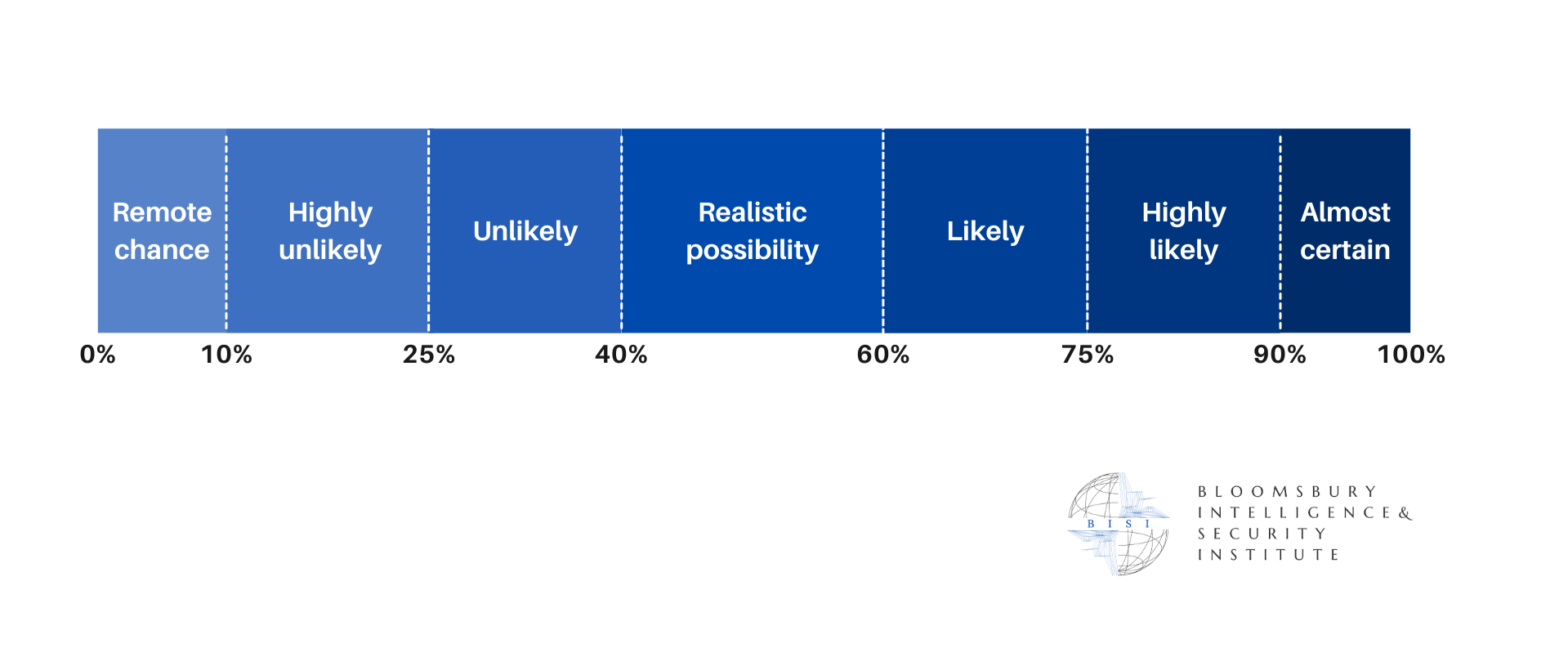
It is very likely that the ATA’s framing will draw Congress’s attention again to domestic chip manufacturing and AI investment, as concerns over Chinese technological competition remain salient.
It is likely that the divergence between the US and EU technological regulations, especially after the EU AI Act, will further fragment the global AI governance landscape.
It is likely that the divergence between the ATA’s framework and the current administration policy priorities will reduce the document’s operational influence, raising questions around the IC’s weight in executive decision-making.
Long-term (>1 year)
It is likely that if the US is unable to resolve the contradiction between its technological threat assessment and its federal R&D budget allocation, it will narrow its advantage in chip manufacturing, AI, and quantum computing.
There is a realistic possibility that China’s continuous development and investment in AI will undermine the US’s first-mover advantage in applied AI faster than the ATA’s framing suggests.
It is likely that continued underinvestment in domestic AI and semiconductor capacity will put the US in a reactive strategic posture, rather than leading technological innovation.