
By Aryamehr Fattahi | 22 December 2025
Summary
The United States (US)-United Kingdom (UK) Tech Prosperity Deal, signed 18 September 2025, secured GBP 31b (USD 42b) across artificial intelligence (AI), quantum computing, and nuclear energy, but was suspended on 16 December 2025 over disputes on the UK's Digital Services Tax, food safety standards, and Online Safety Act regulations.
The suspension exposes the fragility of the UK's post-Brexit strategy of attracting US investment while maintaining regulatory autonomy, as reliance on American hyperscalers for compute infrastructure creates vendor lock-in and data sovereignty risks, while the UK's attempt to position itself between US and EU regulatory frameworks increasingly resembles exposure to pressure from both directions.
The episode demonstrates asymmetric dependencies in the bilateral relationship, with the UK needing the deal for credibility signals about post-Brexit attractiveness while the US views Britain as one partner among many, and Washington's suspension sends a clear signal to France, Italy, Spain, and other countries maintaining digital services taxes that such levies carry tangible costs.
Negotiations resuming in January 2026 present a realistic possibility of targeted UK concessions on regulatory cooperation while maintaining the Digital Services Tax, though prolonged uncertainty is likely to affect investment timing, and the UK is almost certain to emphasise greater diversification of technology partnerships toward European and Asian partners in future negotiations.
Context
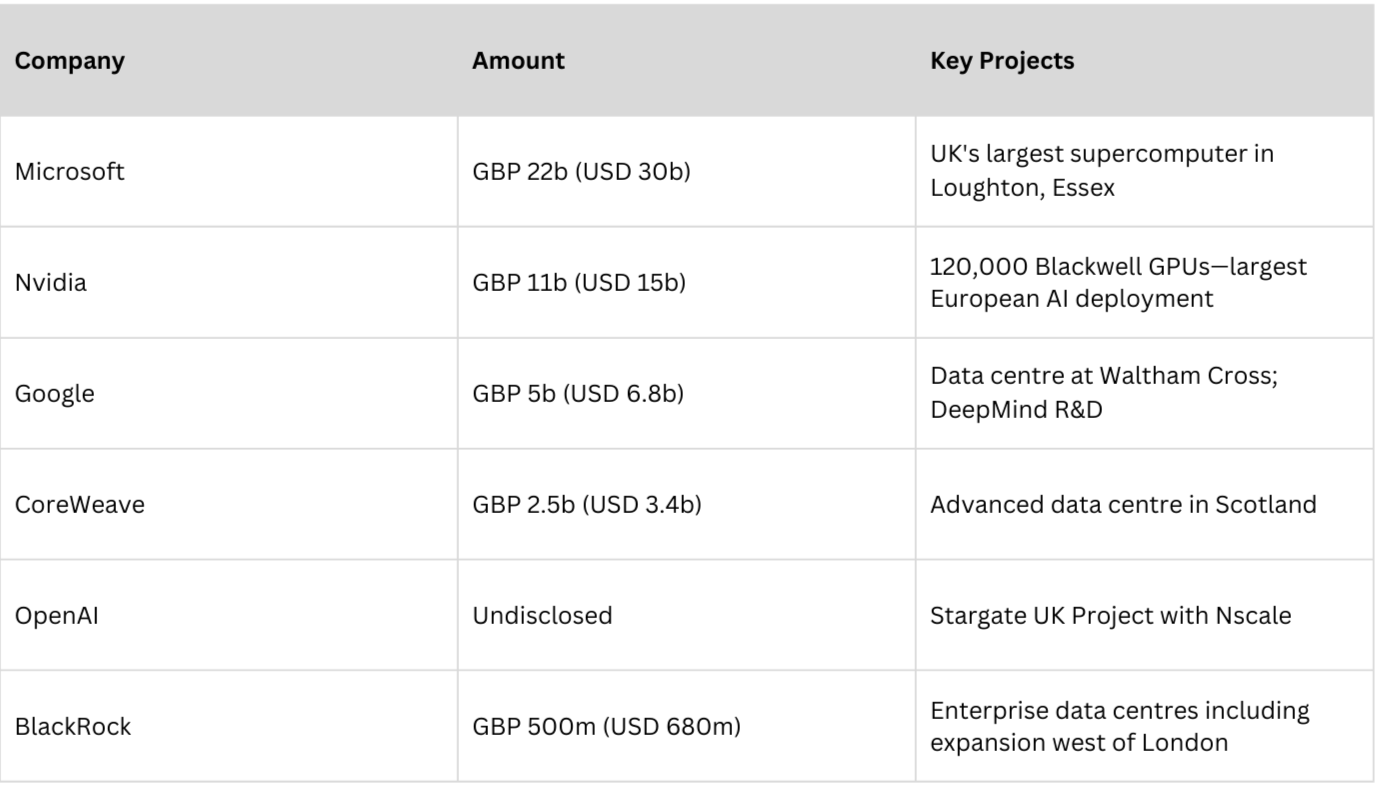
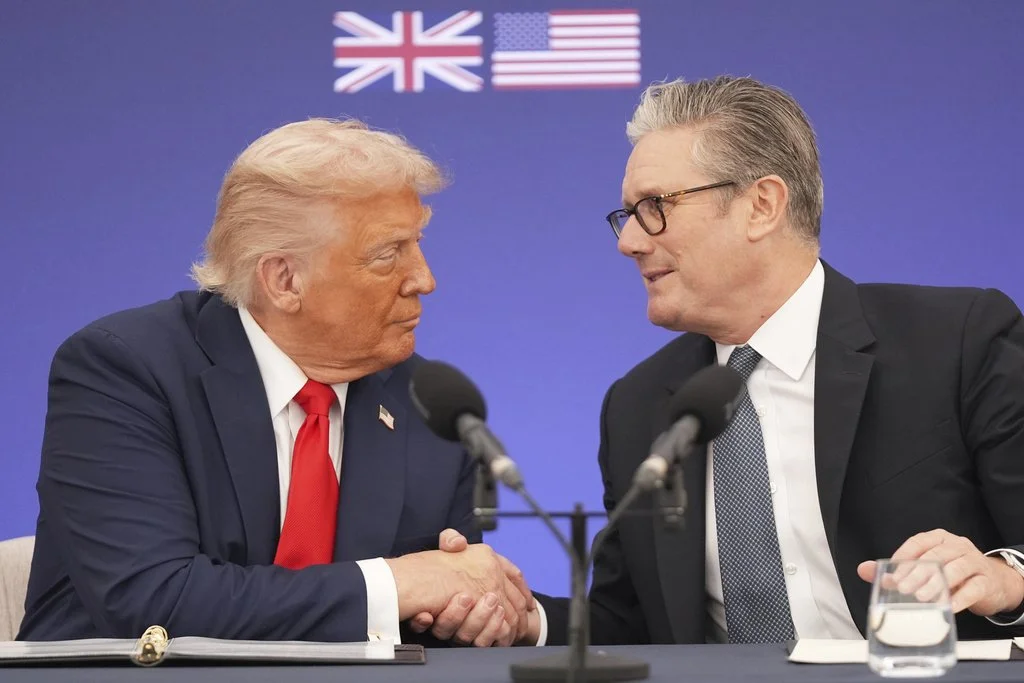
US President Donald Trump and UK Prime Minister Keir Starmer signed the Tech Prosperity Deal memorandum on 18 September 2025. The agreement represented the largest commercial package, GBP 31b (USD 42b), ever secured during a state visit, with corporate commitments including:
The deal also established frameworks for regulatory cooperation, including streamlined nuclear licensing that targets reactor design reviews within two years, joint development of quantum computing standards, and research partnerships between US and UK science agencies. Critically, the memorandum contained explicit conditionality that it would ‘become operative’ only ‘alongside substantive progress’ on a separate Economic Prosperity Deal addressing trade barriers.
The Suspension
However, Washington halted implementation during the week of 8-15 December 2025, with UK officials confirming the pause on 16 December 2025. 3 core disputes drove the decision:
The Digital Services Tax remains the most contentious issue. The 2% levy on technology company revenues, retained in Chancellor Rachel Reeves's November 2025 Autumn Budget, raises approximately GBP 800m annually from firms including Amazon, Google, and Meta, which are primarily US Tech giants. Trump has characterised such levies as ‘overseas extortion’ targeting American companies.
Food standards disputes represent a second pressure point. The UK maintains bans on chlorinated poultry and hormone-treated beef that effectively block significant American agricultural exports. While the May 2025 Economic Prosperity Deal included a concession allowing 13,000 metric tonnes of hormone-free US beef, broader market access remains blocked.
The Online Safety Act introduced a third friction point, with US officials reportedly concerned that provisions allowing large fines for facilitating harmful content and proposed chatbot restrictions announced in early December 2025 would constrain American AI companies operating in the UK. More specifically, the Online Safety Act imposes potential fines of up to 10% of qualifying worldwide revenue on platforms exceeding 34m UK monthly users.
Implications and Analysis
The suspension carries significant consequences across several dimensions, including the UK's strategic autonomy in emerging technologies, its regulatory positioning, and the broader bilateral relationship.
UK Technology Sovereignty at Risk
The suspension crystallises a strategic dilemma that experts identified from the deal's announcement. The arrangement risked positioning the UK as technologically dependent on American hyperscalers. This is important since the UK lacks frontier AI models of its own, with DeepMind, its most prominent AI company, being acquired by Google in 2014. Currently, US and Chinese firms control over 90% of global AI supercomputers.
By relying on American hyperscalers for compute infrastructure, the UK potentially exposes itself to vendor lock-in and data sovereignty risks. The US CLOUD Act allows American law enforcement to access data held by US companies regardless of geographic location. Yet the alternative, building indigenous capacity from scratch, appears unrealistic given capital constraints and talent flows. British technology companies achieving scale typically relocate to California, where growth capital is more abundant.
The deal represented an attempt to shortcut this dynamic by importing American infrastructure while retaining some regulatory autonomy. Its suspension reveals the fragility of that bargain.
The suspension also exposes a fundamental tension at the heart of Britain's post-Brexit economic strategy: the desire to attract US investment while maintaining regulatory autonomy. The Starmer government marketed the Tech Prosperity Deal as vindication of ‘Global Britain’, proof that the UK could secure transformative partnerships outside the European Union (EU). The December suspension complicates this narrative considerably.
Regulatory Positioning Becomes More Precarious
The suspension also complicates the UK's attempt to chart a middle course between American and European regulatory frameworks. The UK's principles-based approach to AI governance, relying on existing sector regulators rather than comprehensive legislation like the EU AI Act, aligns more closely with Washington's flexibility-oriented model. The decision not to sign the Paris Statement on AI alongside the EU symbolically reinforced this positioning.
However, the suspension demonstrates that regulatory alignment with the US carries its own costs. American expectations extend beyond AI governance to taxation and trade policy. The EU, meanwhile, maintains that data protection adequacy requires comprehensive alignment. The UK's positioning between these poles, previously framed as strategic flexibility, increasingly resembles exposure to pressure from both directions.
For businesses operating across jurisdictions, this regulatory uncertainty compounds compliance complexity. Companies developing AI systems for deployment in both the US and UK markets now face questions about whether UK rules will converge toward American permissiveness or European prescription, a determination that may ultimately depend on which relationship the UK prioritises.
The Online Safety Act also presents a distinct challenge. Platform regulation represents an area of genuine policy divergence with Washington. The Act reflects a British and European consensus that governments should actively regulate online harms; the Trump administration views such regulation as censorship and trade protectionism. This is not merely a negotiating position but a philosophical disagreement about the role of the state in digital markets.
Investment Commitments Face Execution Risk
The headline GBP 31b (USD 42b) in corporate commitments represented signed intentions rather than binding obligations. With the deal suspended, the pathway from announcement to operational infrastructure becomes less certain. The AI Growth Zones programme proceeds as a domestic initiative, but its attractiveness to foreign investors depends partly on the broader policy environment.
Some investments may prove insulated from the suspension. Microsoft's supercomputer project and Google's Waltham Cross data centre involve separate commercial agreements that could advance independently. Nuclear partnerships, including TerraPower's reactor evaluation and Centrica's advanced modular reactor plans, similarly operate through distinct commercial frameworks.
However, prolonged uncertainty almost certainly affects investment timing and scope. Technology partnerships becoming bargaining chips in broader economic negotiations creates precisely the policy instability that deters long-term capital commitment. Firms weighing expansion decisions may delay until the regulatory and diplomatic environment clarifies.
AI safety collaboration represents a particular concern. US-UK alignment on AI standards was seen as strategically valuable, creating a potential counterweight to Chinese and EU regulatory approaches. The suspension does not terminate this cooperation, but it removes the institutional architecture that was meant to deepen it.
The Special Relationship Faces a Stress Test
The suspension's broader significance lies in what it reveals about bilateral dynamics under the second Trump administration. UK officials characterised the development as hardball negotiations, a transactional approach where technology cooperation becomes leverage for concessions on taxation and agricultural access. This framing may prove accurate; similar agreements have previously been paused and revived.
Yet the episode highlights asymmetric dependencies. The UK sought the deal partly for the credibility signal that American investment would send about post-Brexit Britain's attractiveness. The US, by contrast, views the UK as one partner among many in a portfolio of bilateral arrangements, specifically important, but not irreplaceable. This dynamic constrains the UK's negotiating leverage on issues like the Digital Services Tax, where domestic political considerations favour retention.
The suspension also carries implications for cross-border research collaboration in AI, quantum computing, and civil nuclear sectors. Joint programmes between UK Research and Innovation and US counterparts may proceed independently of the commercial deal, but the diplomatic chill creates uncertainty about future cooperation.
The Digital Services Tax issue extends well beyond the UK. France, Italy, Spain, Austria, and other countries maintain similar levies, and the US has launched parallel Section 301 investigations. By suspending the UK deal, Washington signals to all allies that digital services taxes carry tangible costs. The UK serves as a test case; other countries will calibrate their positions based on how this dispute resolves.
The suspension occurs against a backdrop of intensifying US-China technology competition. Both Washington and London have emphasised the importance of allied coordination on AI, quantum computing, semiconductors, and critical minerals. The logic is straightforward: Democratic allies should pool resources and align standards to compete effectively with China's state-directed technology development. The current dispute undermines this framing. If the US and UK cannot resolve regulatory differences on digital taxation and platform governance, prospects for deeper technology alliance structures appear limited.
British public opinion has also shifted notably, with polling showing only 17% of Britons consider the US as their closest ally. A majority now view the UK-EU relationship as more important than UK-US ties. The suspension reinforces perceptions that Washington views Britain instrumentally rather than as a privileged partner deserving special consideration.
US Embassy in London
Forecast
Short-term (Now - 3 months)
January 2026 negotiations are likely to determine whether the deal can be revived in some form. A realistic possibility exists that the UK offers targeted concessions, perhaps on regulatory cooperation or specific non-tariff barriers, while maintaining the Digital Services Tax. Complete resolution within this timeframe is unlikely given the complexity of outstanding issues.
Medium-term (3-12 months)
If negotiations stall, there is a realistic possibility that US technology firms proceed with commercially advantageous investments independently while deferring those dependent on government cooperation. AI Growth Zones development is likely to continue, though potentially at reduced scale without anticipated anchor tenants.
Long-term (>1 year)
The episode almost certainly shapes future UK negotiating strategy, with greater emphasis on conditionality and diversification of technology partnerships toward European and Asian partners. The UK's positioning as a global AI hub depends significantly on whether it can demonstrate that regulatory autonomy and foreign investment are compatible.
