
Global RAM Shortage and Price Hikes: Causes, Consequences, and Outlook
By Aryamehr Fattahi | 05 January 2026
Summary
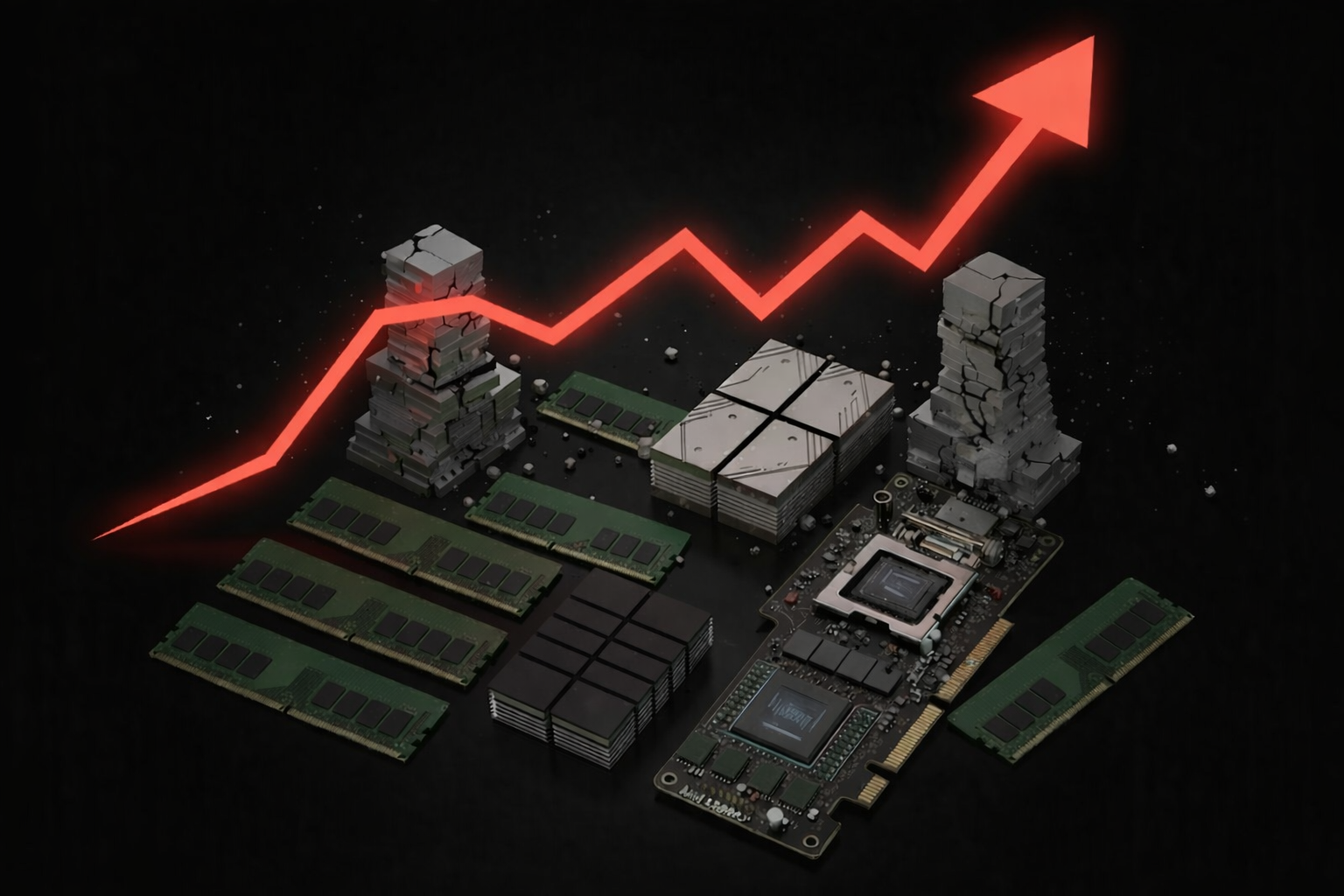
The global memory market is experiencing a structural crisis, driven by manufacturers reallocating wafer capacity from commodity Dynamic Random Access Memory (DRAM) to High-Bandwidth Memory (HBM) for Artificial Intelligence (AI) applications. As a result, DRAM prices have risen 171% year-over-year, and DDR5 spot prices have quadrupled since September 2025.
Consumer electronics, cloud infrastructure, and automotive sectors face divergent but significant impacts: PC prices are highly likely to rise 15-20% in Q1 2026, hyperscalers will likely pass through memory cost increases to enterprise customers, and automakers face a realistic possibility of production disruptions by 2028 as legacy DRAM production contracts.
Geopolitical fragmentation also compounds supply constraints, as United States export controls on HBM and Chinese retaliation targeting critical minerals accelerate ‘friend-shoring’ dynamics. Geographic concentration, with three manufacturers controlling 95% of DRAM production, creates systemic vulnerabilities extending to defence systems.
Memory prices are likely to remain elevated through 2027-2028, with partial normalisation a realistic possibility only when new fabrication facilities reach volume production; an oversupply scenario in 2028-2029 remains a realistic possibility if AI demand moderates as capacity expands.
Context
The current crisis stems from deliberate capacity reallocation rather than demand destruction or natural disaster. Each gigabyte of HBM consumes roughly 3x the wafer capacity of DDR5. Memory manufacturers have shifted their production towards HBM, as AI is projected to account for 20% of global wafer capacity by 2026.
DRAM prices have also surged 171% year-over-year, outpacing gold, while DDR5 spot prices have quadrupled since September 2025. DRAM and NAND prices doubled in a single month, though the DRAM shortage is more acute due to HBM cannibalisation of wafer capacity. Additionally, SK Hynix has overtaken Samsung Electronics in DRAM revenue for the first time since 1992, capturing 36% of the market compared to Samsung's 34%.
The reallocation is driven by AI infrastructure demand, with hyperscaler capital expenditure approaching USD 600b in 2026, a 36% year-over-year increase. United States (US) export controls on HBM to China have prompted Chinese retaliation targeting critical minerals, including gallium, germanium, and rare earth elements, adding a geopolitical fragmentation dynamic to market constraints.
Samsung Electronics plans a 50% HBM capacity surge in 2026, while both Samsung and SK Hynix will begin HBM4 mass production in February 2026. Micron Technology has announced a USD 200b US investment commitment, though meaningful production begins only in mid-2027. The memory price rally is likely to run past 2028 as Samsung and SK Hynix remain cautious on expansion. Memory manufacturers themselves are the primary beneficiaries, with Samsung and SK Hynix gross margins projected to exceed those of TSMC in Q4 2025, a historic reversal reflecting the scarcity premium.
Analysis and Implications
The shortage's effects vary significantly across sectors, shaped by memory intensity, pricing power, and supply chain flexibility. Four areas face distinct challenges and strategic considerations.
Consumer Electronics: Margin Compression and Configuration Trade-offs
PC manufacturers face immediate cost pressures, with Dell Technologies and Lenovo Group announcing 15-20% price increases from December 2025. Memory now accounts for 15-18% of PC production cost, double 2024 levels. The disproportionate impact on mid-tier manufacturers is notable: Premium brands with pricing power can pass through costs, while budget-focused original equipment manufacturers (OEMs) face margin compression that may prove unsustainable. This dynamic is likely to accelerate market consolidation, with smaller PC manufacturers at heightened risk of acquisition, exit or change in direction.
Gaming console economics reveal similar pressures. Console manufacturers face a strategic dilemma: Absorbing costs erodes already-thin hardware margins, while aggressive price increases risk demand destruction in a price-sensitive segment. Industry speculation that Sony Corporation and Microsoft Corporation may delay next-generation consoles to 2029-2030 reflects this calculus, waiting for capacity normalisation rather than launching into constrained supply.
Smartphone configuration downgrades represent a reversal of the storage and memory expansion trend that has characterised the market for a decade. The shift from 12GB+512GB to 8GB+256GB configurations, with some low-end models potentially returning to 4GB RAM, creates differentiation opportunities for manufacturers willing to absorb costs to maintain specifications. Chinese OEMs with vertically integrated supply chains or secured long-term contracts hold a competitive advantage in this environment.
Cloud and Data Centre: Cost Pass-Through and Capacity Constraints
Hyperscaler capital expenditure reflects both AI investment momentum and memory cost inflation. Substantial price increases absorbed on DRAM orders, combined with suppliers delivering less than ordered quantities, signal that even the largest buyers lack sufficient leverage to insulate themselves from supply constraints. The strategic implication is significant: Cloud economics that assumed commodity memory pricing are unlikely to hold.
Infrastructure-as-a-service pricing adjustments are highly likely as hyperscalers pass through costs. Enterprise customers with multi-year committed contracts can find themselves advantaged relative to on-demand purchasers, while organisations planning cloud migrations face higher-than-budgeted infrastructure costs. Emerging capacity constraints at major cloud providers suggest that service availability, not just pricing, is likely to become a differentiating factor.
Smaller cloud operators and colocation providers face existential pressure. Unable to secure preferential supply agreements or absorb costs at hyperscaler scale, mid-tier providers are likely to experience margin compression that accelerates industry consolidation. The memory shortage thus reinforces existing market concentration trends favouring the largest operators.
Automotive: Compressed Timelines and Supply Chain Restructuring
The automotive industry confronts a structural timeline mismatch. DDR4 and LPDDR4 production is still standard for most automotive applications. The 3-5 year automotive design cycle cannot accommodate a 2-year transition window, creating a realistic possibility of production disruptions or forced specification changes for 2028-2029 model years. For vehicle buyers, this raises the realistic possibility of longer delivery times, reduced feature availability, or price increases for 2028-2029 model years.
Electric vehicle (EV) manufacturers face amplified exposure compared to internal combustion engine (ICE) producers. Battery management systems, advanced driver-assistance systems, and infotainment platforms in EVs typically require substantially more memory content than equivalent ICE vehicles. As legacy automakers accelerate EV transitions to meet regulatory requirements, they simultaneously increase their vulnerability to memory supply constraints. This creates an asymmetric risk profile where the most aggressively electrifying manufacturers, often those with the strongest environmental commitments, face the greatest supply chain exposure.
The procurement strategy shift from tiered suppliers to direct manufacturer relationships represents a fundamental restructuring of automotive supply chains. Ford Motor Company, General Motors, and Toyota Motor Corporation striking direct contracts with chip manufacturers bypasses traditional Tier 1 and Tier 2 suppliers, reducing their strategic relevance. This disintermediation trend, accelerated by the 2021-2022 chip shortage and now reinforced by memory constraints, is likely to prove permanent rather than cyclical. Tier 1 suppliers such as Bosch, Continental, and Denso face declining leverage as OEMs cultivate direct semiconductor relationships, potentially compressing their margins and forcing business model adaptation toward higher-value integration services.
Regional variations in automotive memory exposure are also emerging. European manufacturers with higher average vehicle memory content face greater per-unit cost increases than volume-focused Asian producers. Meanwhile, Chinese automakers benefit from proximity to domestic memory production from ChangXin Memory Technologies (CXMT) and emerging DRAM capabilities, though these remain technologically behind Korean and US competitors. This geographic dimension will influence production location decisions and sourcing strategies over the medium term.
Geopolitical Dimensions: Concentration and Fragmentation
Geographic concentration presents systemic vulnerability that the current shortage exposes. Taiwan produces 92% of leading-edge chips below 7nm, while the top three memory manufacturers (SK Hynix, Samsung Electronics, and Micron Technology) control approximately 95% of global DRAM production. This structure grants manufacturers significant pricing power while creating single points of failure for global technology supply chains.
US export controls and Chinese mineral restrictions have introduced a fragmentation dynamic that compounds supply constraints. The December 2024 controls on HBM exports to China, combined with Chinese retaliation targeting gallium, germanium, and rare earth elements, suggest that geopolitical considerations will increasingly override pure market dynamics in semiconductor allocation. Companies with exposure to both US and Chinese markets face growing compliance complexity and potential supply disruptions from either direction. For multinational corporations, this fragmentation increases procurement complexity, requiring separate sourcing strategies for different market blocs and heightened compliance monitoring.
The emergence of distinct technology blocs carries longer-term implications for memory market structure. US CHIPS Act subsidies and European Chips Act funding are explicitly designed to reduce dependence on Asian manufacturing, yet meaningful domestic capacity remains years away. In the interim, the shortage accelerates ‘friend-shoring’ dynamics where supply relationships increasingly follow geopolitical alignment rather than pure cost optimisation. Korean manufacturers occupy a privileged position as US-allied suppliers with advanced capabilities, while Chinese domestic producers expand to serve markets excluded from Western supply chains.
The memory shortage also exposes the limitations of recent industrial policy interventions. Despite substantial US and European funding commitments, neither programme prioritised memory manufacturing at scale. The resulting gap leaves Western markets dependent on Korean production for the foreseeable future, with Micron's US expansion the sole significant domestic memory investment. This policy blind spot, focused heavily on logic chips while neglecting memory, is unlikely to be corrected before the current shortage cycle concludes, leaving a structural vulnerability that future geopolitical tensions could exploit.
The concentration of advanced memory production also creates vulnerabilities extending beyond commercial markets. Defence systems, ranging from fighter jets to satellite communications, rely on the same DRAM supply chains that are currently facing constraints. A Taiwan Strait contingency or targeted sabotage of key facilities could simultaneously disrupt civilian electronics and military readiness across NATO nations. The absence of strategic memory stockpiles in most Western nations, unlike oil reserves, leaves defence ministries with a limited buffer against supply shocks. Additionally, the dual-use nature of HBM in both commercial and military AI applications raises questions about the adequacy of export controls and allied coordination.
Forecast
Short-term (Now - 3 months)
DRAM and NAND prices are almost certain to continue rising through Q1 2026, with double-digit quarterly increases. PC and server price increases of 15-20% are highly likely across major vendors. Supplier lead times for LPDDR5X are likely to extend.
Medium-term (3-12 months)
Peak pricing is likely in mid-to-late 2026 as manufacturers maintain supply discipline. Cloud service pricing adjustments are highly likely as hyperscalers pass through costs. Automotive supply chain restructuring toward direct-to-fab relationships is likely to accelerate. Demand destruction in consumer segments remains a realistic possibility if prices exceed affordability thresholds, which could moderate the shortage earlier than supply-side factors alone would suggest.
Long-term (>1 year)
Partial supply normalisation is a realistic possibility by late 2027 as Micron's Idaho facility and SK Hynix's Yongin cluster reach volume production. Sustained elevated pricing through 2028 remains likely given manufacturers' prioritisation of profitability. An oversupply scenario in 2028-2029 is a realistic possibility if AI demand moderates as new capacity arrives simultaneously.
