
STC 'Promising Future' Operation Secures Oil-rich Hadhramaut in South Yemen
By Victoria Sainz | 22 December 2025
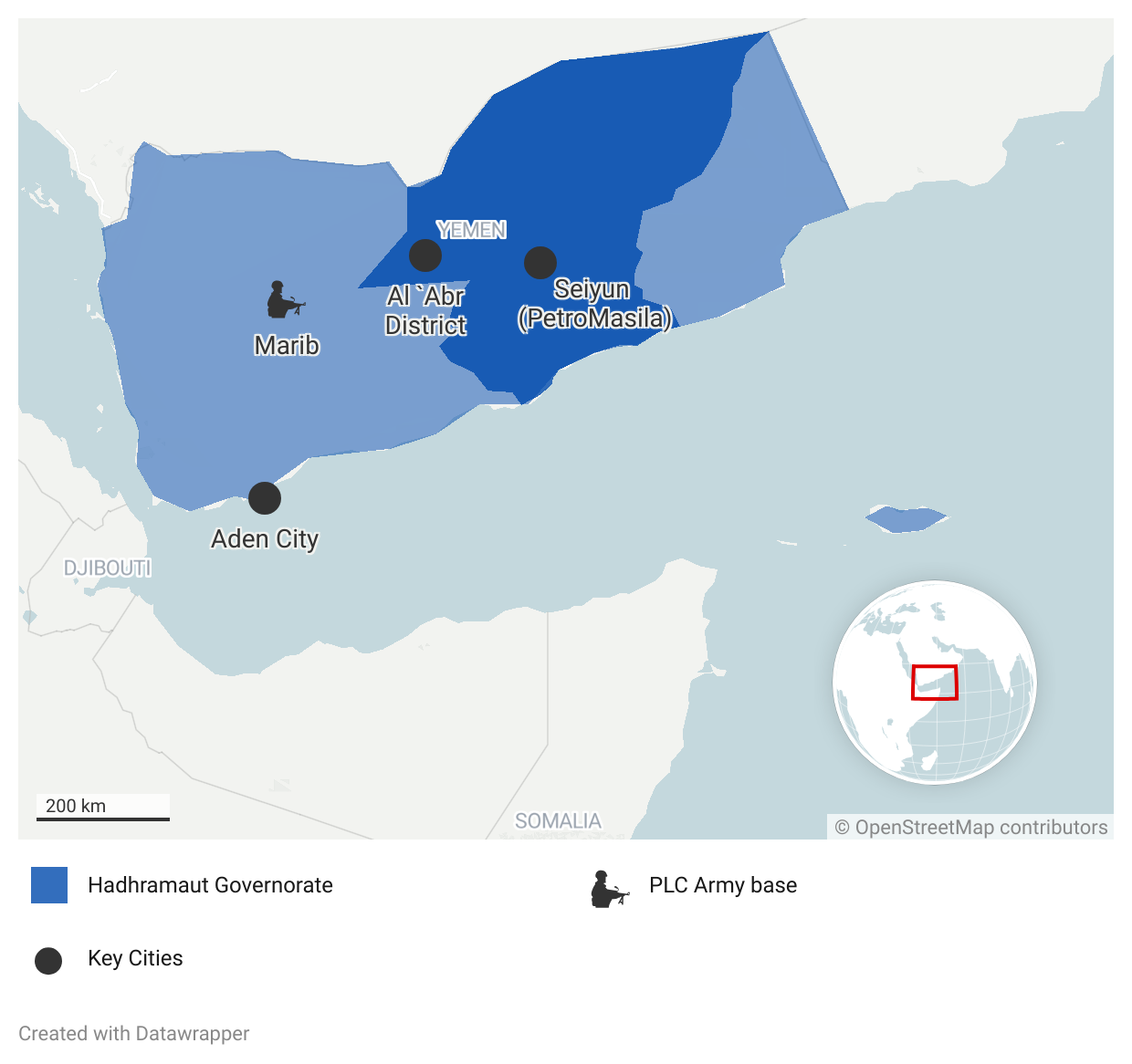
Summary
The UAE-backed Southern Transitional Council (STC) has seized control of oil-rich Hadhramaut and key infrastructure, completing its takeover of all former South Yemeni governorates and weakening the Saudi-backed Presidential Leadership Council (PLC).
Control over roughly 80% of Yemen’s oil reserves gives the STC decisive economic and political leverage, undermining national governance, disrupting energy production, and accelerating momentum towards southern self-rule
STC consolidation is highly likely in the short term, the emergence of a southern state is likely within a year, and a durable two-entity Yemen is highly likely in the long term.
Context
Yemen is shaped by an ongoing civil war and a fragile political arrangement in the South, where an uneasy alliance known as the Presidential Leadership Council (PLC) attempts to govern. This PLC includes both the Saudi-backed internationally recognised government and the UAE-backed Southern Transitional Council (STC), a separatist movement seeking independence for South Yemen.
The current escalation centers on the oil-rich Hadhramaut governorate, which constitutes approximately a third of Yemen’s territory and holds an estimated 80% of its oil reserves. The STC launched a military operation called “The Promising Future”, stating that it aimed to restore security and put an end to the exploitation of local resources. This operation led to armed clashes with the Yemeni army and tribal-linked forces demanding control over local oil revenue. The STC successfully seized control of key targets, including the presidential palace and international airport in Seiyun and PetroMasila, Yemen’s largest oil company.
These victories mean the STC now controls all eight governorates of the former South Yemen, significantly advancing their project towards statehood and prompting Saudi Arabia to withdraw its troops from the southern capital, Aden.
Implications
The STC’s control over all former South Yemeni governorates raises the prospect of a renewed two-state Yemen. This is a major setback for Saudi Arabia and further undermines the already fragile Presidential Leadership Council, strengthening the STC’s position to demand formal self-government. The situation challenges regional power balances and the UN’s historic opposition to Yemen’s separation.
The operation severely disrupted Yemen’s energy sector. Armed groups initially forced PetroMasila to stop production before the STC seized control of the facilities. In addition to oil infrastructure, the STC consolidated control over critical government and transport nodes in Seiyun and bombed the headquarters of the Yemeni army. Crucially, the seizure of the Al-’Abr region means the STC now commands all supply routes and logistical corridors connecting PLC-aligned army commands in Marib to the east and South Yemen. Furthermore, Oman’s temporal closure of its border with Yemen underscores regional concerns about spillover and instability.
Strategically, the operation reshapes the wider conflict with the Iranian-backed Houthis. The STC may seek Protectorate-style arrangements with governorates like Marib to prevent them from falling to Houthi control. Regional intelligence reports raised concerns about an alleged Emirati plan to secure key corridors by cutting Saudi supply lines that connect Hadhramaut to the Saudi border.
Economically, the STC’s control over Hadhramaut, and by extension, the bulk of Yemen’s oil reserve, grants it decisive leverage over the country’s financial future. By seizing PetroMasila, the STC positions itself as a gatekeeper of national revenue streams. This action also resolves the internal dispute where tribal forces entered oilfields demanding access to local oil wealth.
Forecast
Short-term (Now - 3 months)
STC consolidation of control over Hadhramaut and its oil infrastructure is highly likely, while a meaningful PLC or Saudi military response is highly unlikely.
A formal declaration of southern independence in this period is unlikely, as the STC prioritises stabilisation and leverage-building.
Medium-term (3-12 months)
The emergence of a de facto STC-led southern governing authority, controlling oil revenues and security, is highly likely.
International actors maintaining official support for Yemen’s unity while quietly adapting to southern autonomy is a realistic possibility.
Long-term (>1 year)
A two-entity Yemen (STC-controlled South and Houthi-controlled North) becoming entrenched is highly likely.
Reunification under a single central state is a remote chance, while formal southern independence is likely.
