The Southern Interconnection Gas Pipeline: A Politically Critical Node for Bosnia and Herzegovina
By Anna Toso | 15 June 2026
Summary
The parliament of Bosnia and Herzegovina (BiH) appointed a United States (US)- based firm to develop the European Union (EU)-funded gas pipeline that will connect its national energy system to the EU through Croatia.
While this infrastructure is a step towards gas supplier diversification and greater integration with the EU energy system, the fairness of the procurement process remains questionable and might hinder Bosnia's accession to the EU.
The domestic political polarisation between the country’s federal units is likely to translate into parallel fragmentation in BiH's energy policies.
Context
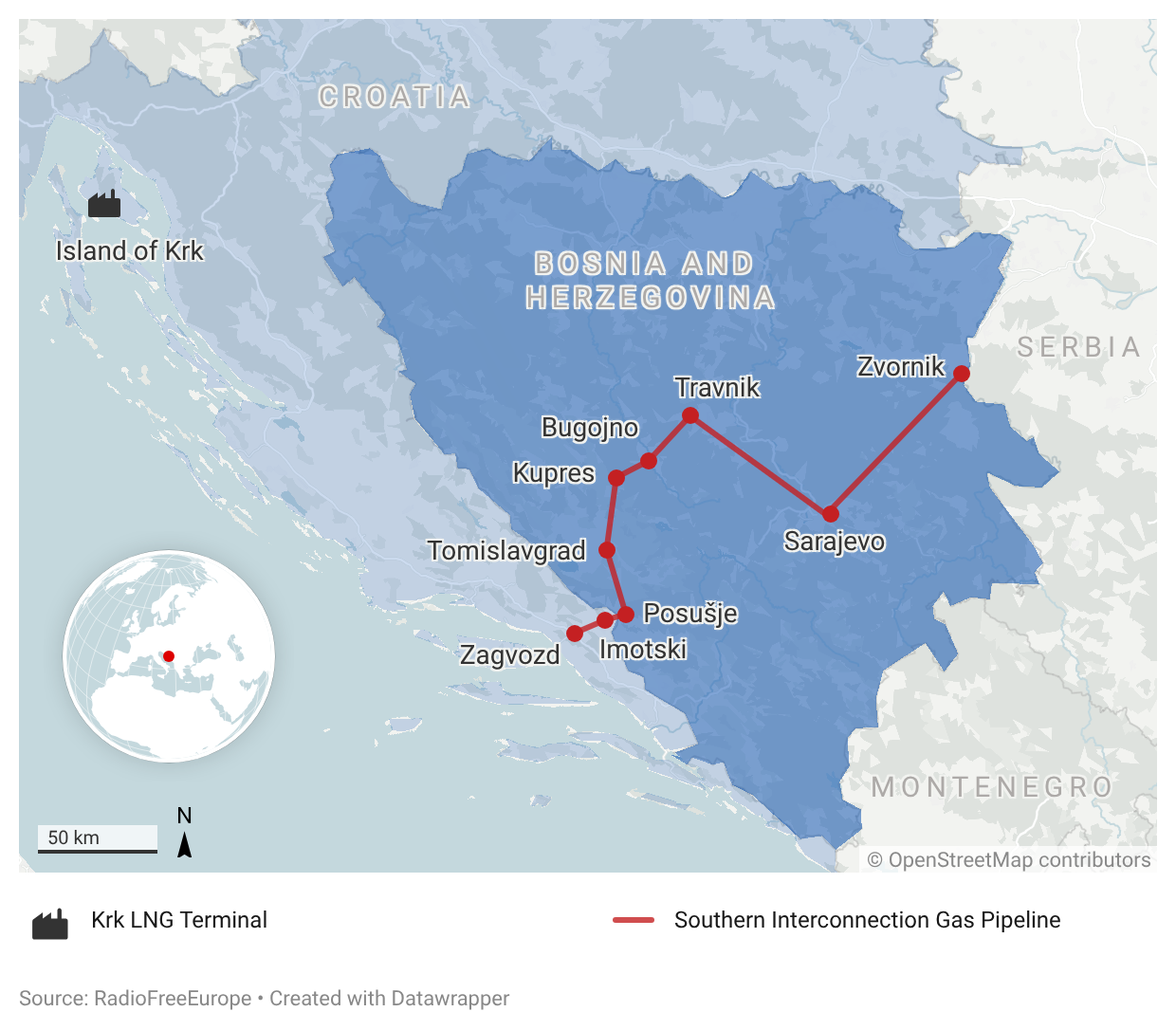
In March 2026, the Bosnian parliament awarded the public procurement for the construction of an economically and geopolitically strategic gas pipeline to a US-based firm, AAFS Infrastructure and Energy. The company was established in late 2025, has no prior experience in infrastructure development, and has links to individuals personally close to US President Donald Trump. This infrastructure, the Southern Interconnection Gas Pipeline, is a bidirectional conduit that will connect the gas transmission systems of BiH and Croatia, running 162km on Bosnian territory and 74km on Croatian soil. This pipeline would enable BiH to import liquefied natural gas (LNG) from the LNG conversion site on the Island of Krk via Croatia. The EU has funded the project for a total of EUR 2.05m (USD 2.39m) through the Western Balkans Investment Framework (WIBF) and EU CONNECTA, two financial and technical assistance programmes focused on the Western Balkans.
Implications
A Need for Gas Supplier Diversification
Reducing reliance on Russian gas is important for Bosnia to achieve energy independence and diversify its gas import sources. Bosnia suffers from gas supply shortages, especially during the coldest months. Currently, Sarajevo imports all of its natural gas consumption from Russia (96%), through the 40-year-old TurkStream route across Serbia and Bulgaria, and from Croatia (4%). This lack of supplier diversification creates a negative overdependency of the Bosnian energy system on a single country. Although BiH’s current energy supply is heavily dependent on coal, with only 2.6% coming from natural gas, in certain areas of the country gas plays an essential role. For example, natural gas fuels 49% of the district heating systems in Sarajevo's urban area. Moreover, the country will need to increase the share of natural gas in its energy mix and move away from Moscow’s supplies to align with the energy policy conditions for gaining EU membership, as the EU has committed to phasing out gas imports from Russia entirely by 2028.
On the one hand, the new pipeline could enable BiH to become a major transit node for energy distribution across Southeastern Europe. This infrastructure could attract further investment in the country's energy sector, especially given its compatibility with the potential transport of hydrogen. On the other hand, the ensuing likely increase in gas consumption in BiH might work against decarbonisation and negatively result in a deeper reliance on fossil fuels. Lastly, the Bosnian energy market is unlikely to reduce its dependence on Russian supplies in the short term, as the infrastructure will likely require almost a decade to become operational.
The Domestic Politics and International Geopolitics behind Unfair Procurement:
BiH acquired EU candidate member status in 2022. The construction of the Southern Interconnection pipeline, in principle, facilitates Sarajevo’s reform trajectory towards compliance with the EU standards and further integration with the regional energy market. However, in practice, questionable fairness marred the related public procurement process. The EU Ambassador to Bosnia and Transparency International denounced insufficient competition and transparency, with particular business and political benefits trumping the public interest. These developments jeopardise Sarajevo’s accession to the EU and risk stalling the provision of EUR 374m (USD 436.2m) in funds that are dependent on EU-compliant reforms.
In the Bosnian context, energy policy represents a potential hybrid tool for national politics and foreign geopolitical strategies. Domestically, the discussion around the Southern Interconnection Gas Pipeline has revived long-standing political disagreements. Specifically, the Republika Srpska – the Serb-majority federal entity within the country – shoulders the burden of Russia’s dominance in the Balkan energy market and opposes US involvement in this infrastructure. Meanwhile, representatives from the Federation of BiH – the federal entity with a majority of Bosnians and Croats – support diversifying energy suppliers. Nonetheless, also among the latter, there is internal disagreement over the pipeline constructor’s nomination. Initially, the state-owned company BH-Gas, based in Sarajevo, was appointed as the main investor. Only months later, in March 2026, the Parliament shifted the procurement responsibility to the American AAFS.
This choice underlines the influence of US commercial and geopolitical interests in the Balkans. Specifically, increasing US LNG imports into Eastern Europe would directly benefit American companies. Moreover, it would reduce Russia’s economic and political role in the Western Balkans. The US considers this step towards energy security and autonomy in the region to be a matter of national security. However, the prominence of these US commercial interests clashes with the EU’s regulatory priorities, calling for transparency and fair competition in public procurement.
Forecast
Medium-term (3 - 12 months)
The EU will likely push Bosnian lawmakers towards reforming the national energy system and its procurement processes to comply with the bloc’s standards, using its significant economic leverage over the provision of EU funds.
Long-term (>1 year)
Investments in infrastructure are unlikely to achieve effective diversification of energy supply in BiH without domestic political unity and a willingness to sign commercial agreements with contractors other than Russia.
There is a realistic possibility that the two federal entities will instead move towards developing separate energy networks with different contractors and dependencies.