The Shahed model: Cost Asymmetry and the Transformation of Air Warfare
By Rakotoarimanga Tinah | 27 April 2026
Summary
Following the joint US-Israeli strikes on Iran on 28 February 2026, Tehran launched an unprecedented retaliatory campaign of drones and ballistic missiles against all 6 Gulf Cooperation Council (GCC) states simultaneously, showing for the first time that low cost unmanned systems can work as an instrument of strategic coercion.
Shahed drones exploit a fundamental gap in Gulf air defence architecture because they’re flying low and slow, they approach targets below radar coverage designed for high-altitude ballistic missiles, generating a detection gap that THAAD and Patriot batteries, mostly optimised for fast and steep trajectory threats, can’t reliably close.
Pete Hegsteth said that US air defences will not be able to intercept all Iranian drones. The THAAD interceptors' cost is up to USD 15m each against only USD 40000 Sahed, so the cost exchange ratio is a structural threat to US interceptor stockpile sustainability to no near term procurement response that can fully address it.
Context
For the first time in history, Tehran has directly attacked every GCC member state in a single operation sequence. The primary equipment of that campaign has not been Iran’s ballistic missile but its mass produced Shahed series one way attack drones; the strategic significance does not lie in its technical sophistication but in its economics.
The Shahed-136 is 3.5 metres long, weighs approximately 200 kg, carries a 36 to 50 kg warhead and has a maximum range of over 2000km. His engine is reverse engineered from a German commercial piston aircraft engine, his electronics revealed by wreckage analysis, incorporates a Texas Instruments processor, a Polish made fuel pump and a Chinese voltage converter. It launches from a single angled rail mounted on a pickup truck, requires no fixed infrastructure and can be relocated within minutes of launch. This architecture is deliberately simple, it’s what makes the Shahed mass producible, decentralisable and resistant to destruction by conventional counter force operations.
Iran has launched over 2000 Shahed drones in the first 6 days of the conflict. By early April 2026, the UAE alone had engaged 438 ballistic missiles, 2012 drones and 19 cruise missiles. Qatar’s Ras Laffan LNG complex was struck on 2 March, knocking out 17% of LNG export capacity at an estimated cost of USD 20b in lost revenue. Kuwait’s Mina Al-Ahmadi refinery, UAE desalination facilities, the Habshan gas processing complex, Dubai international airport and a radar installation at the US Fifth Fleet’s primary base in Bahrain have all been struck. ADNOC chief executive Sultan Al Jaber described the campaign as ‘global economic warfare’, and Brent crude now trades at around USD 109 per barrel, up approximately 38% from before the war began.
Also, beginning in 2022, Iran supplied Shahed drones to Russia for use against Ukraine, forcing Ukraine to build its own counter-drone industry from nothing, producing interceptors at between USD 800 and USD 3000 per unit, two years ahead of any NATO equivalent.
On 27 March 2026, President Zelensky signed 10 year defence cooperation agreements with Saudi Arabia, Qatar and the UAE to export these systems precisely to the Gulf. By arming Russia with the Shahed 136, Iran had inadvertently financed the development of its own most cost effective countermeasure.
Implications
Iran is highly likely to sustain this war
The Shahed stockpile was estimated at between several thousand and over 10000 units. Despite more than 6000 Iranian targets struck by US and Israeli forces, Iran remains with a manufacturing capability and an ongoing stockpile.
Iran had likely dispersed and hardened production infrastructure underground in anticipation of strikes; its pre-conflict monthly production rate of 200 to 500 Shahed drones represents an investment of only USD 10m to USD 25m per month, roughly. The sanctions regime has not touched this budget line. Iran have the ability to build hundreds more every week, making the drone a long term threat independent of the conflict’s duration.
The structural resilience of the Shahed production
In contrast, Iran’s ballistic missile production has effectively stalled because each of them requires complex manufacturing, fixed infrastructure and specialised launchers; those parameters are easily targetable and are harder to reconstitute rapidly but the Shahed is not. Consequently, its production chain relies more on commercially available, widely circulated components subject to few effective export restrictions, making comprehensive supply chain disruption through sanctions or strikes structurally impractical.
The US reverse-engineered the system within months of first encountering it in Ukraine, deploying its own equivalent, the LUCAS drone, ahead of the February 2026 escalation. Russia developed a licensed variant, the Geran-2 drone, reducing unit costs from approximately USD 200000 for imported systems to around USD 70,000 through domestic production within 3 years, while expanding output capacity.
The proliferation risk
The components are on Amazon. The export controls that exist have not slowed Iranian production, Russian licensed production, or North Korean acquisition. The barrier to entry for this capability is now lower than it is for a medium-range ballistic missile. A relatively simple and decentralised production model enabled strikes that generated an estimated USD 20b in damage to a single LNG facility. The Ras Laffan strike alone cost more in damage than Iran's entire annual Shahed production budget.
The cost asymmetry and defence imbalance
The US intercept supply chain can’t keep up, the US Defence Secretary Pete Hegseth and the Chairman of the Joint Chiefs of Staff Dan Caine said that Iranian Shahed drones were proving more difficult to counter than expected and that US air defences would not be able to intercept them all.
The cost dynamic is central to the problem, for example, a THAAD missile system interceptor costs approximately USD 12m to 15m while a Patriot PAC-3 missile costs around USD 4m. By comparison, a Shahed drone costs roughly USD 40000.
In early March, Patriot systems in particular must be prioritised for ballistic missile defence using them against drones risks depleting stockpiles needed for higher tier threats. This concern has already translated into broader constraints. The European Commission confirmed that US missile stocks were becoming overstretched within weeks, with knock-on effects on military assistance to Ukraine. Similarly, the US could face munitions shortages affecting even offensive operations within the first month of the campaign.
Gulf air defences were built for fast, steep and predictable ballistic missiles. The Shahed is none of those things.
The Shahed drone presents the opposite challenge because it flies low and slow, often below radar coverage and can use terrain to reduce visibility. Its small size further complicates detection and when deployed in large numbers, these drones can overwhelm air defence systems by saturating radar and interception capacity.
This represents a vulnerability because it has already been demonstrated, for example, that a Shahed drone struck a radar installation at Naval Support Activity Bahrain. Iran’s use of drones alongside ballistic missiles is deliberate because drones force defenders to divide attention and resources, reducing the effectiveness of missile interception, while missiles create pressure on higher tier systems.
At the same time, Iran’s ballistic missile capability appears to have been constrained and strikes on launch infrastructure have disrupted production. Drones, in contrast, do not rely on fixed sites and can be launched from mobile platforms, making them far more difficult to suppress.
As a result, missile capabilities can be degraded through targeted strikes, and drone operations remain more resilient. This suggests that sustained, large scale drone attacks at low altitude are likely to play an increasingly central role as the conflict evolves, making them far more difficult to suppress.
Forecast
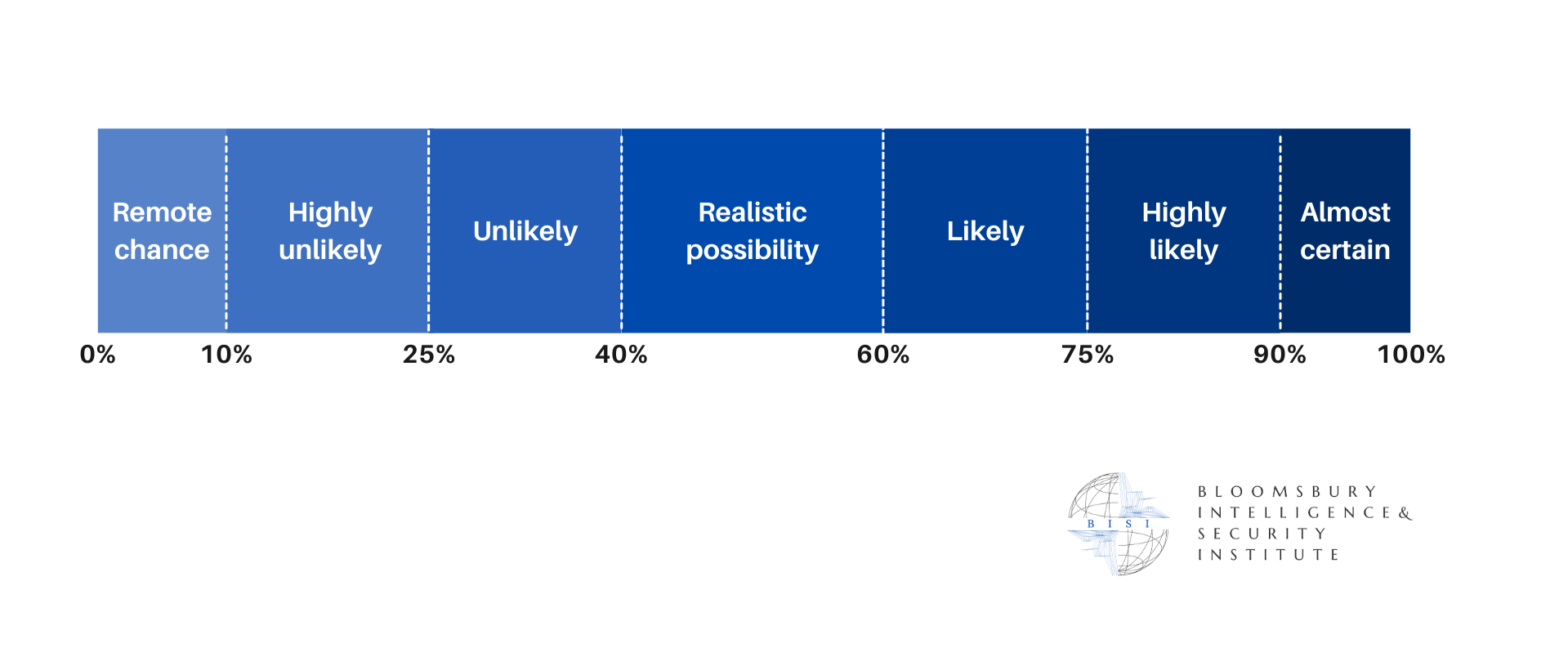
Short-term (Now - 3 months)
Iran’s drone campaign targeting GCC energy infrastructure and US military sites is highly likely to continue, with an increasing reliance on Shahed-series drones as ballistic missile stockpiles are reduced by US-Israeli strikes and production capacity remains constrained.
A negotiated ceasefire appears unlikely in the near term, given the significant gap between US and Iranian positions. As a result, Brent crude prices are likely to remain above USD 100 per barrel, while disruption to the GCC energy sector is expected to persist.
Depletion of Patriot PAC-3 missile stockpiles across GCC states is a realistic possibility within 3 months of sustained operations, given existing US production constraints. In response, the use of alternative counter drone measures is highly likely to accelerate, including Ukrainian Sting and Octopus interceptor drones, AH-64 Apache helicopters using cannon fire and rooftop anti aircraft artillery systems. However, integrating these systems at scale is unlikely to be achieved within this timeframe.
Medium-term (3 - 12 months)
The cost-effectiveness of low-altitude drone saturation is highly likely to push GCC defence away from expensive interceptors towards layered, scalable counter-UAS systems. With growth slowing to 0.4% in 2026 and up to USD 307b in potential deposit outflows, fiscal pressure will accelerate the shift towards cheaper solutions.
The Shahed production model is almost certain to proliferate in the medium term in other countries like Russia here.
The US and GCC states are highly likely to get fast Ukrainian counter-UAS systems, which are the only cost-effective solutions at scale against drone saturation. This is likely to strengthen Ukraine’s leverage, with Kyiv almost certain to seek concessions in return, including security guarantees and long-term defence industrial partnerships.
Long-term (>1 year)
The financial imbalance at the core of this conflict is likely to leave a durable imprint on US defence posture. The US is committing billions to contain a threat that Iran sustains for roughly USD 10m per month, and if operations continue beyond six months, scrutiny in Congress over the cost of maintaining this level of force projection in the Gulf will intensify. A reorientation of defence spending towards counter-UAS systems that can be produced in large numbers is likely within three to five years.
Gulf risk is already being reassessed, and that shift is unlikely to reverse when the conflict ends. Sovereign wealth funds managing around USD 5 trillion are beginning to revisit their overseas investment strategies. If critical infrastructure in the Gulf comes to be seen as a persistent drone target, the region's position as a reliable hub for global capital will weaken. The consequences would extend well beyond the Middle East, with potential pressure on oil price stability, food supply chains and sovereign credit ratings.