By Yuan Yan | 12 May 2026
Summary
Manus, a Chinese artificial intelligence (AI) startup that relocated to Singapore, became the first publicly blocked AI acquisition under China’s security review regime after Meta finalised a USD 2b deal.
The case reflects increased regulatory oversight from Beijing amid intensifying US–China tech competition.
China’s evolving approach to cross-border technology transfers is likely to raise compliance requirements, add complexity to offshore structures, and increase considerations for AI deals involving Chinese assets, intellectual property (IP), or talent.
Context
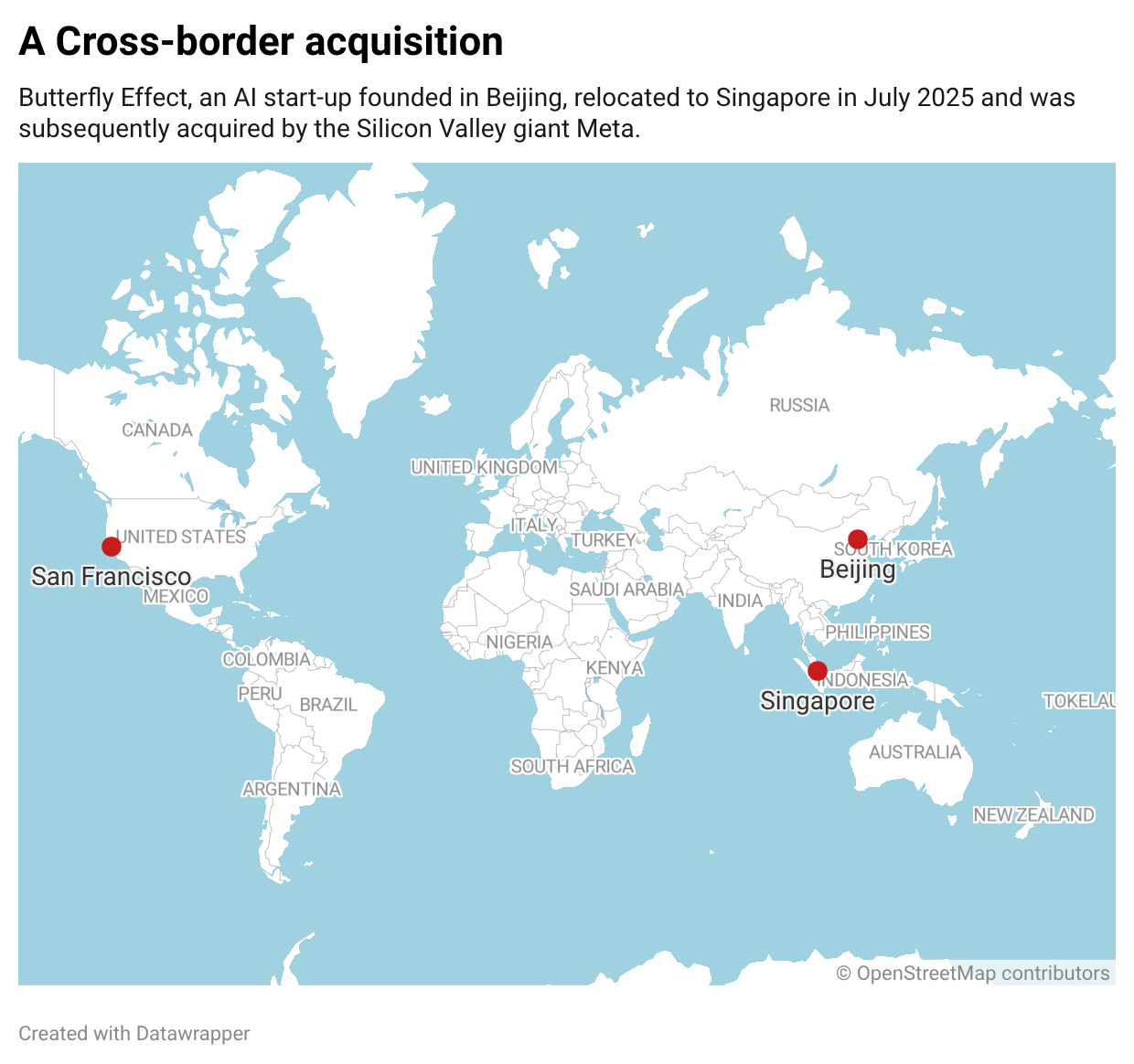
Launched in March 2025, Manus is a general-purpose AI agent capable of autonomously executing complex tasks, with its parent company, Butterfly Effect, based in Beijing and Wuhan. In April, the company raised USD 75m from Silicon Valley venture firm Benchmark, triggering a United States (US) Treasury probe over potential violations related to investments in sensitive technologies. In July, Manus relocated its headquarters to Singapore, reducing its China-based team from 120 to 40 employees. Meta announced a USD 2b acquisition of Manus in December to strengthen its AI agent capabilities, but neither side notified Chinese authorities when finalising the deal.
In January 2026, China’s Ministry of Commerce launched a probe into the acquisition, citing export control concerns and national security risks. In March, co-founders Xiao Hong (CEO) and chief scientist Ji Yichao were summoned to Beijing for talks and were subsequently barred from leaving the country. On 27 April, China’s National Development and Reform Commission (NDRC) blocked the acquisition. Meta has indicated it will comply with Beijing’s order for now, while the White House protested more vocally, stating it would defend America's technology sector against ‘undue foreign interference’.
Implications
While some observers believe the NDRC action is largely symbolic since capital and technology transfers were already complete, the enforcement is still likely to take shape in strict terms. In the Chinese regulatory framework, Manus must return Meta’s payment, and Meta must restore Manus’s technology ownership to the Chinese side and remove related products and data from its systems. Although capital and equity can be relatively straightforward to unwind, the challenge lies in Meta fully disentangling Manus from its ecosystem, and in Manus redefining its identity in the aftermath.
Significantly, the NDRC action was an unprecedented regulatory move targeting a sealed transaction. Since the implementation of the Measures for Security Review of Foreign Investment in 2020, this is the first publicly halted acquisition in the Chinese AI sector. The Manus case shows that moving headquarters and laying off the entire China team doesn’t change the fact that the AI startup’s product was built entirely in the country using local resources.
Initially, Manus’ relocation did not raise red flags in Beijing, as it is a common practice in China’s tech sector where startups use offshore structures to access global capital and ease regulatory pressure while retaining mainland engineering and intellectual ties. However, amid intensifying US–China AI competition and Meta’s involvement, this framework has shifted. Beijing increasingly regards such regulatory arbitrage as an effort to move strategic technology assets beyond state oversight and is strengthening its jurisdiction over cross-border transactions involving Chinese assets and technology under its national security review regime. The tightening control risks further isolating China's recovering tech sector from the American venture backing that has underpinned it for two decades.
Meanwhile, this case should not be overgeneralised. It is likely to be an outlier, given the alleged irregularities in transferring intellectual property from China to Singapore without proper approvals, and its eventual acquisition by a US strategic buyer. By contrast, companies like TikTok and the fast-fashion retailer Shein have also relocated their headquarters to Singapore but continue to be perceived as having Chinese ties—a key difference from Manus. Many other China-linked AI and robotics firms have completed cross-border mergers, acquisitions, or public listings without incident.
Advanced technologies like semiconductors and AI are increasingly treated through a national security lens in both the US and China. Washington tries to limit Chinese tech firms’ access to advanced American chips, and Beijing is committed to stopping US firms from acquiring Chinese AI talent and intellectual property. For companies navigating tensions between Washington and Beijing, Singapore’s role is particularly noteworthy. The city-state presents itself as a neutral, well-regulated hub, yet this neutrality is increasingly viewed in Beijing as a possible conduit for technology transfer to a strategic rival. As a result, the once-viable model of pairing Chinese origins with American capital via a Singapore base has become far more fraught. Although this does not signal the end of Chinese companies relocating to Singapore, it does raise the bar for compliance in the long term.
Forecast
Short-term (Now - 3 months)
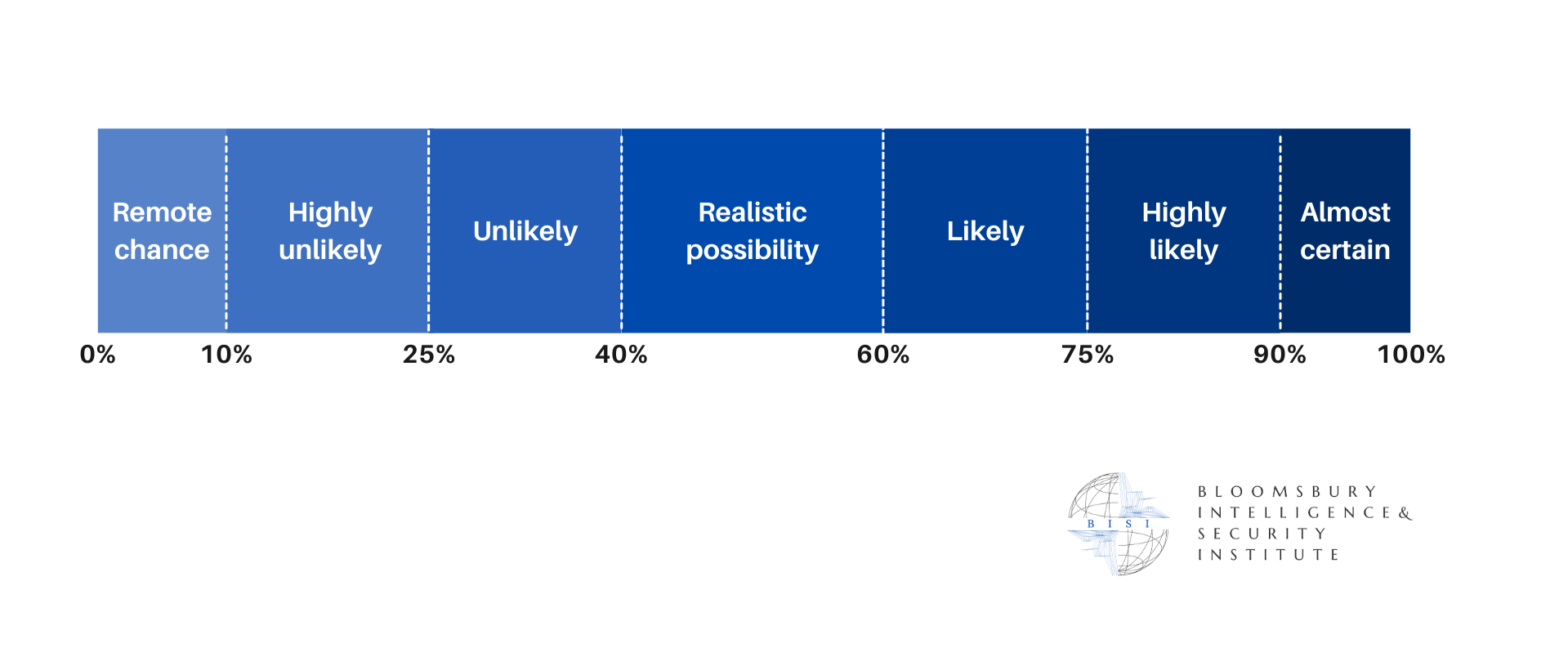
Mark Zuckerberg will likely seek assistance from the US President Donald Trump during his anticipated visit to China, though there is only a remote chance that the issue will feature prominently in Xi–Trump discussions given its relatively limited significance.
It is highly likely that the USD 2b payment will be returned, and Manus’s products and data will be removed from Meta’s systems gradually, if not at once.
There is a real possibility that Manus will cease operations. New acquirers or investors are unlikely to approach it, and a return to the Chinese market would expose it to intense competition.
Medium-term (3 - 12 months)
Investors who stay in China are almost certain to intensify their due diligence, focusing more on corporate structures, IP ownership, and where that IP is actually created.
Firms are highly likely to experience an operational shift, clarifying where management is based, where R&D takes place, how data is handled, and whether Chinese regulatory approvals are required.
Long-term (>1 year)
The Manus case is likely to undermine cross-border investment and encourage deal structures that avoid perceived Chinese jurisdictional triggers.
With Western strategic acquisitions now facing higher regulatory risk, there is a realistic possibility for Chinese tech companies to look toward Hong Kong initial public offerings and to consider strategic buyers from China and the Middle East.
The US–China AI race is highly likely to intensify, and cases like Manus are likely to become the norm rather than the exception on both sides.