By Trishnakhi Parashar | 26 October 2026
Summary
Artificial Intelligence (AI) infrastructure is expanding at a growing pace in the Gulf states as authorities seek to diversify their economies and attract foreign investment.
More than USD 250b has been reportedly earmarked for AI, data centres and digital ecosystems, with the region’s data-centre capacity expected to nearly triple, rising from 1 GW in 2025 to 3.3 GW by 2030.
Nevertheless, long-term dependence on imported technology and exposure to regional instability, compounded by water scarcity, seasonal power stress, and reliance on desalination, remain major reasons that could erode economic returns and constrain AI infrastructure expansion.
Context
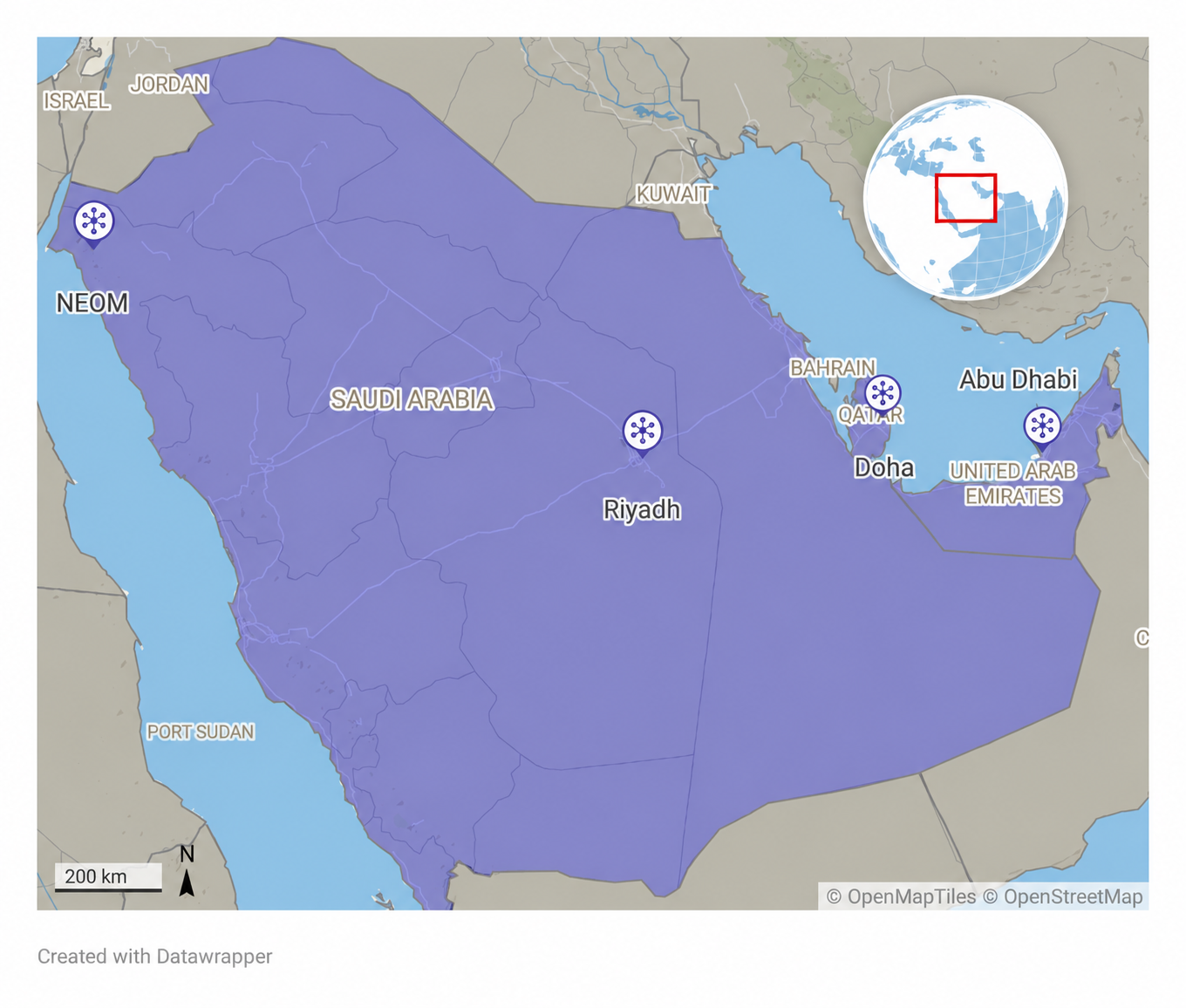
The Gulf states are directing investment towards data centres, cloud computing and AI development to reduce their long-standing reliance on hydrocarbon revenues and attract international technology companies. Saudi Arabia and the United Arab Emirates (UAE) are leading large-scale data centre projects, and Qatar is advancing a USD 20b USD AI infrastructure partnership. In December 2025, Qatar established Qai, a national AI company under the Qatar Investment Authority to develop and invest in AI infrastructure on a national and global scale. Moreover, Qai recently partnered with MEEZA to deploy advanced GPU infrastructure within the state.
Saudi Arabia reportedly launched Project Transcendence, a USD 100b AI and data infrastructure initiative in 2024 to accelerate domestic AI capabilities and investment in digital infrastructure. In May 2025, the state backed Public Investment Fund (PIF) subsequently led to the creation of HUMAIN, a full-stack AI company that is steadily expanding its sovereign AI capabilities and aims to scale its data centre capacity to 1.9 GW by 2030 and 6-6.6 GW by 2034.
The UAE’s Stargate AI project, involving Abu Dhabi based AI firm G42 alongside international tech partners, remains underway, although its original configuration has reportedly been revised. Initially envisioned as a single site, 5 GW data centre project in Abu Dhabi, it is now leaning towards a network of data centres spread across the country, with additional protection against drone and missile attacks. The shift follows March attacks that damaged Amazon facilities in the UAE and Bahrain, and an Iranian warning in April that Stargate itself could be a target.
As these states embark on an ambitious transition, questions have emerged about whether the economic benefits will outweigh the associated costs and risks. Apart from the turmoil arising from the conflict, the Gulf’s AI trajectory faces fundamental resource and infrastructure limitations. Data centres generate immense heat and usually require uninterrupted electricity to operate servers and cooling systems, putting additional pressure on power infrastructure, particularly during hot Middle Eastern summers. Large AI data centres can generally consume up to 5m gallons of water per day, a burden that weighs heavily in a region of acute water scarcity. Reliance on energy intensive desalination further complicates the process of expanding AI infrastructure. In spite of substantial financial strength and sustained efforts to overcome all obstacles and build AI capabilities, Gulf states remain dependent on foreign technology. Advanced semiconductors, specialised computing equipment and essential software remain concentrated among a limited number of international suppliers.
Implications
AI infrastructure is becoming an important instrument for Gulf authorities, and it has also contributed to strengthening their international standing. Domestically, states are utilising advanced AI systems to enhance state security apparatuses, strengthen surveillance and monitoring, etc. Regionally, the Gulf authorities are fuelling intra-regional competition, as Saudi Arabia’s HUMAIN, the UAE’s G42 and Qatar’s Qai each advance national AI ambitions through investment in computing infrastructure, technology partnerships and domestic AI capabilities. Internationally, acquiring cutting-edge computing power requires strict compliance with Western export controls, possibly forcing states like the UAE and Saudi Arabia to strategically distance themselves from China to maintain access to American semiconductors. This dynamic may also allow states that secure sustained access to advanced technology to project regional influence, although their ambitions will remain shaped by external technology providers.
The expansion of AI infrastructure will place greater demands on operational capacity, forcing a total restructuring of regional workforces, supply chains, and power infrastructure. Many firms continue to face AI hallucinations, requiring staff to check automated outputs and prevent costly errors. A shortage of skilled professionals also means businesses must recruit foreign talent, train local employees and adapt existing workflows to manage AI effectively. In the Gulf, these requirements also coincide with water scarcity, periods of exceptionally high temperatures and seasonal increases in electricity consumption, which, in a way, are likely to place pressure on operational settings.
Moreover, all the challenges are compounded by regional instability, which can expose data centres and their supporting electricity and telecommunications networks to disruptions. Recent incidents in March and April have already offered a glimpse of potential risks, proving that the water and power systems supporting data centres are as strategically valuable as the facilities themselves, yet equally vulnerable. Along with the physical facilities, undersea fibre optic cables and data transmission routes have become high-priority targets during regional conflicts. Drone incursions and sophisticated state-linked cyberattacks could potentially disrupt data flows and compromise sensitive information. Public services and private industries are transitioning from manual operations to real-time automated workflows, although reliance on foreign technology may also complicate efforts to secure sensitive data and maintain operational continuity.
Saudi Arabia, the UAE, and Qatar are progressively positioning AI and digital infrastructure as components of their economic diversification strategies. This reflects efforts to accelerate post-oil diversification, attract massive foreign direct investment, and potentially widen regional wealth disparities. However, the economic returns from AI investment will depend on how effectively Gulf states connect infrastructure development with wider productive activity. Such developments are likely to act as a magnet for global tech giants, transforming these states into a global digital logistics hub for data storage and processing. Data centres can potentially boost domestic AI capabilities, support digital businesses and improve access to advanced computing; however, their construction costs and continuing electricity and cooling requirements are substantial. Moreover, heavy reliance on imported capital equipment, particularly advanced chips and Western cloud licensing, creates a persistent capital outflow, meaning a significant portion of AI revenue recirculates back to foreign tech providers.
Forecast
Short-term (Now - 3 months)
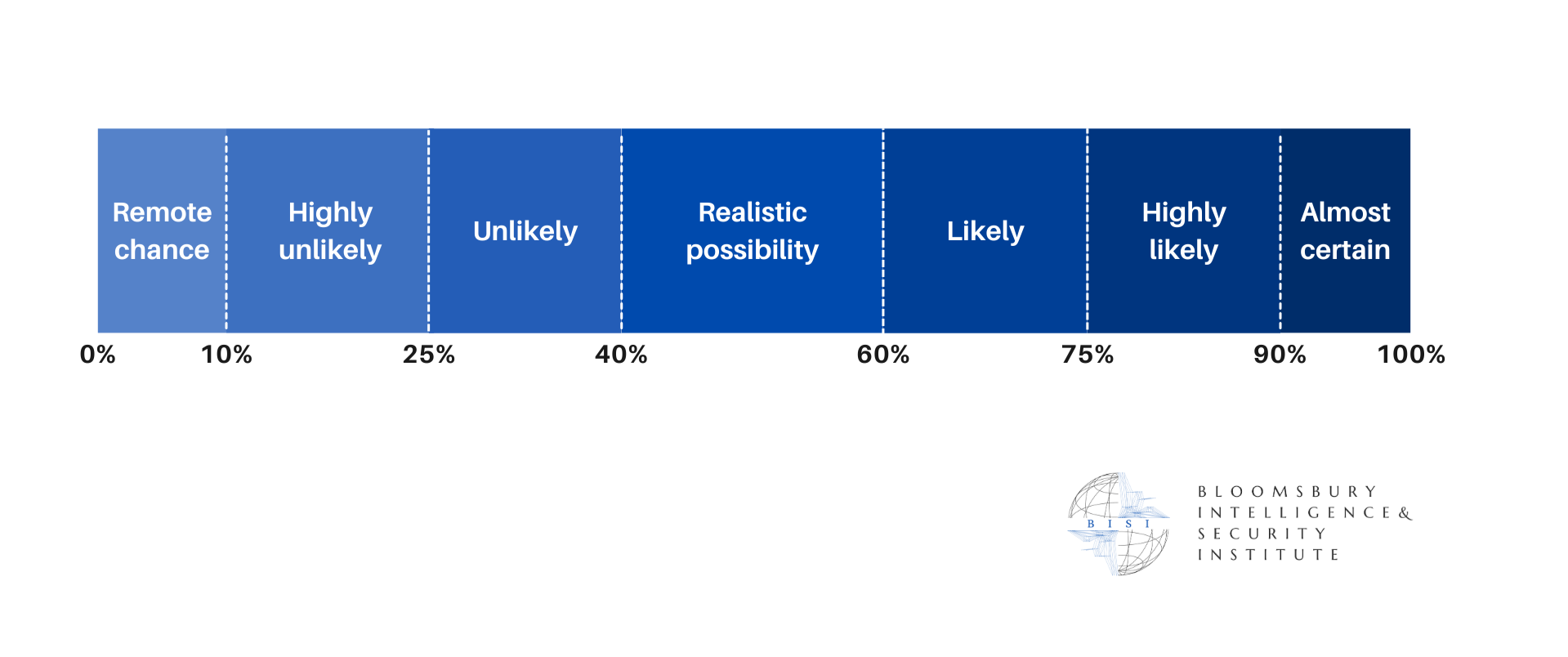
In the short term, the Gulf states are highly likely to continue investing in AI development projects and technology partnerships.
Stronger protection of critical infrastructure is highly likely. This means Gulf states are likely to take additional measures to protect essential infrastructure, raising construction, security and operating costs and subsequently making AI infrastructure projects more expensive to develop.
Medium-term (3 - 12 months)
These states are likely to encourage greater use of AI across government services, finances, logistics and industrial operations to generate more demand for newly developed computing capacity.
Authorities are likely to pursue a broader range of technology partnerships and invest in domestic facilities.
Long-term (>1 year)
Data centres will highly likely face unprecedented pressure from both soaring operating costs and tightening environmental regulations. Consequently, operators are likely to prioritise energy-efficient cooling, water reuse and improved power management.
AI infrastructure is likely to support growth in cloud computing, digital services and AI-enabled industries.