By Gabriel Perkins | 22 June 2026
Summary
The capture of Venezuelan President Nicolás Maduro by United States forces on 3 January 2026 has altered the strategic context of the Essequibo dispute. This came months before the International Court of Justice (ICJ) concluded merits hearings in the boundary case between Venezuela and Guyana on 11 May 2026.
The intervention has reduced the short-term risk of Venezuelan military action against the oil-rich region, yet the territorial claim predates Maduro, leaving it dormant rather than resolved.
A favourable ruling for Guyana is likely from the ICJ around August 2026. However, the claim is unlikely to be permanently settled and could be revived by a future government in Caracas.
Context
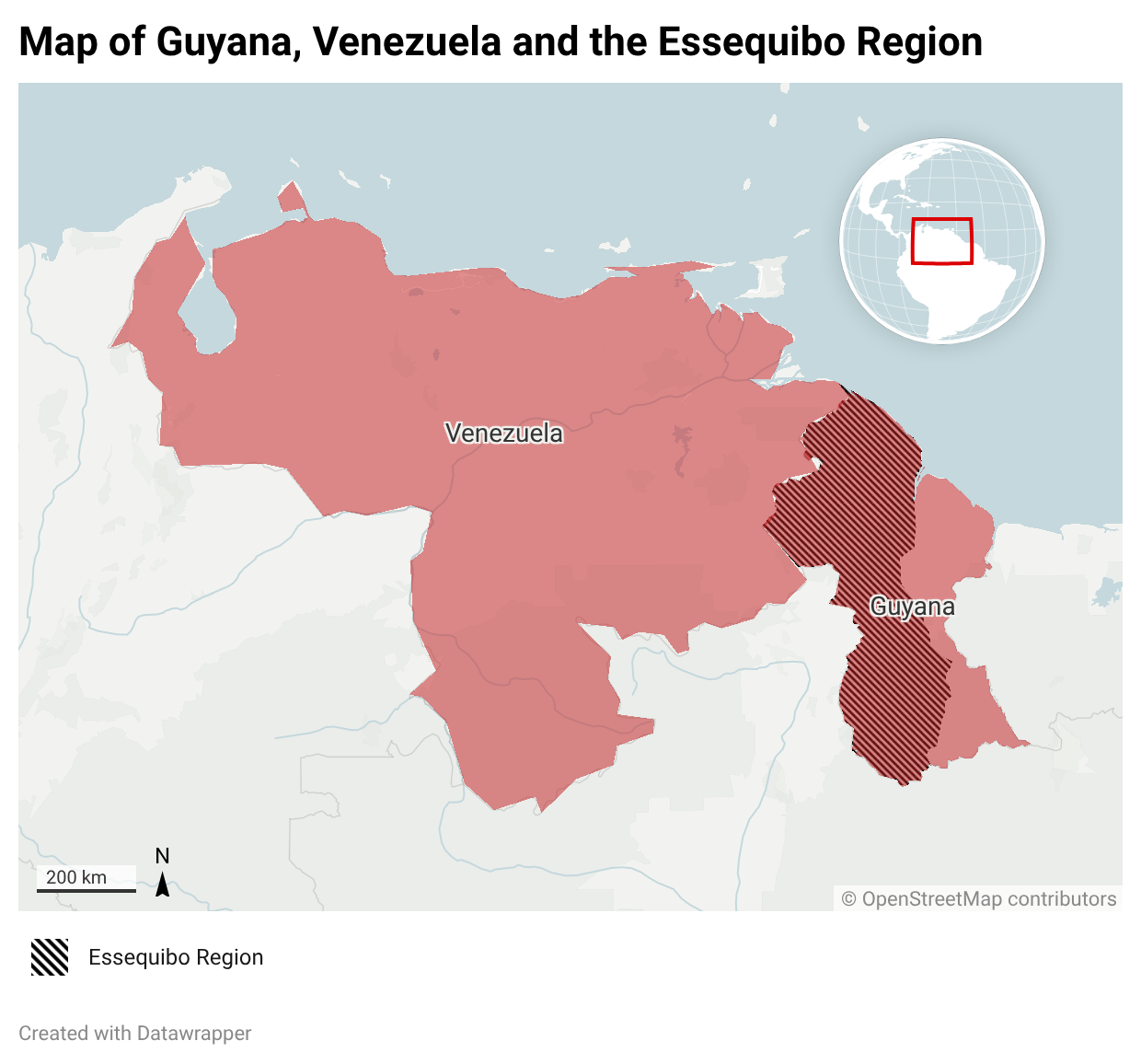
On 3 January 2026, United States (US) forces captured Venezuelan President Nicolás Maduro in a large-scale military operation in Caracas and transferred him to New York to face charges of narco-terrorism. Vice President Delcy Rodríguez assumed the interim presidency after the Supreme Tribunal declared Maduro’s removal a forced absence. The intervention reshaped the strategic context of the territorial dispute between Venezuela and Guyana over the Essequibo region. The Essequibo, an area of approximately 160,000 sq km amounting to roughly two thirds of Guyana's territory, has been contested since the 19th century, when Venezuela claimed all land west of the Essequibo River as an inheritance from Spanish colonial rule. The dispute had intensified under Maduro. Maduro held a referendum in 2023 in which he approved his claim to sovereignty over the Essequibo Region. After this, in March 2025, a Venezuelan navy vessel approached ExxonMobil’s production assets in Guyana’s exclusive economic zone (EEZ). The International Court of Justice (ICJ) then held merits hearings from 4 to 11 May 2026 in the case Guyana filed in 2018, which seeks to uphold the 1899 Arbitral Award, the ruling of an international tribunal seated in Paris that awarded the bulk of the disputed territory to the then British Guiana and fixed the present boundary between the two states. A ruling is expected around August 2026. Venezuela continues to reject the Court’s jurisdiction on the matter. Guyana holds that the 1899 Arbitral Award settled the boundary definitively, while Venezuela maintains the award is invalid and argues the 1966 Geneva Agreement requires the parties to reach a negotiated settlement, which is one of the underlying factors that contribute to its rejection of the International Court of Justice.
Implications
The most direct effect of the US intervention on the dispute is that it has led to de-escalation. Venezuela has put its threats of invasion and further interventionary action on hold as the government's focus at the moment is survival under severe US pressure and scrutiny. US Secretary of State Marco Rubio had previously warned Venezuela not to attack Guyana or ExxonMobil interests, further constraining Venezuela’s ability to pursue further interventionary action.
Although the issue has gone dormant, it does not mean it is resolved. Venezuela’s claim to the region predates Maduro. Rodríguez, who was Maduro’s vice-president, denounced the US operation in Venezuela and rejected being controlled externally. This indicates that the position in relation to the Essequibo is unlikely to be abandoned despite a change of leadership.
For Guyana, the situation has improved, but Guyana has grown more dependent. The administration of President Irfaan Ali activated a national security plan following the US strikes and maintains close coordination with the US, whose forces now carry significant regional power. ExxonMobil produces over 900k barrels per day offshore, an output that supports Guyana’s position as one of the world’s fastest-growing economies. This aligns US commercial interests with their sovereignty.
The wider regional reaction is more cautious. The Bureau of CARICOM Heads of Government affirmed its commitment to the sovereignty and territorial integrity of states and called for peaceful dialogue through diplomatic channels to ensure Venezuela's stability. This exposes a tension within the region between defending a member state's borders and resisting interventionary military operations by a great power.
The strategic benefit for the US extends beyond Guyana. Neighbouring Suriname is developing the same offshore reserves, with Chevron, TotalEnergies, Shell, and Petronas starting to drill in the Stabroek block. The US neutralising Venezuela’s claim to the Essequibo, therefore, secures not one but a cluster of emerging energy producers along the Guiana basin. The US’s intervention effectively supports a regional energy frontier, deepening the alignment between US commercial interests and the territorial integrity of several small states at once.

Babak Fakhamzadeh/Flickr
Forecast
Short-term (Now - 3 months)
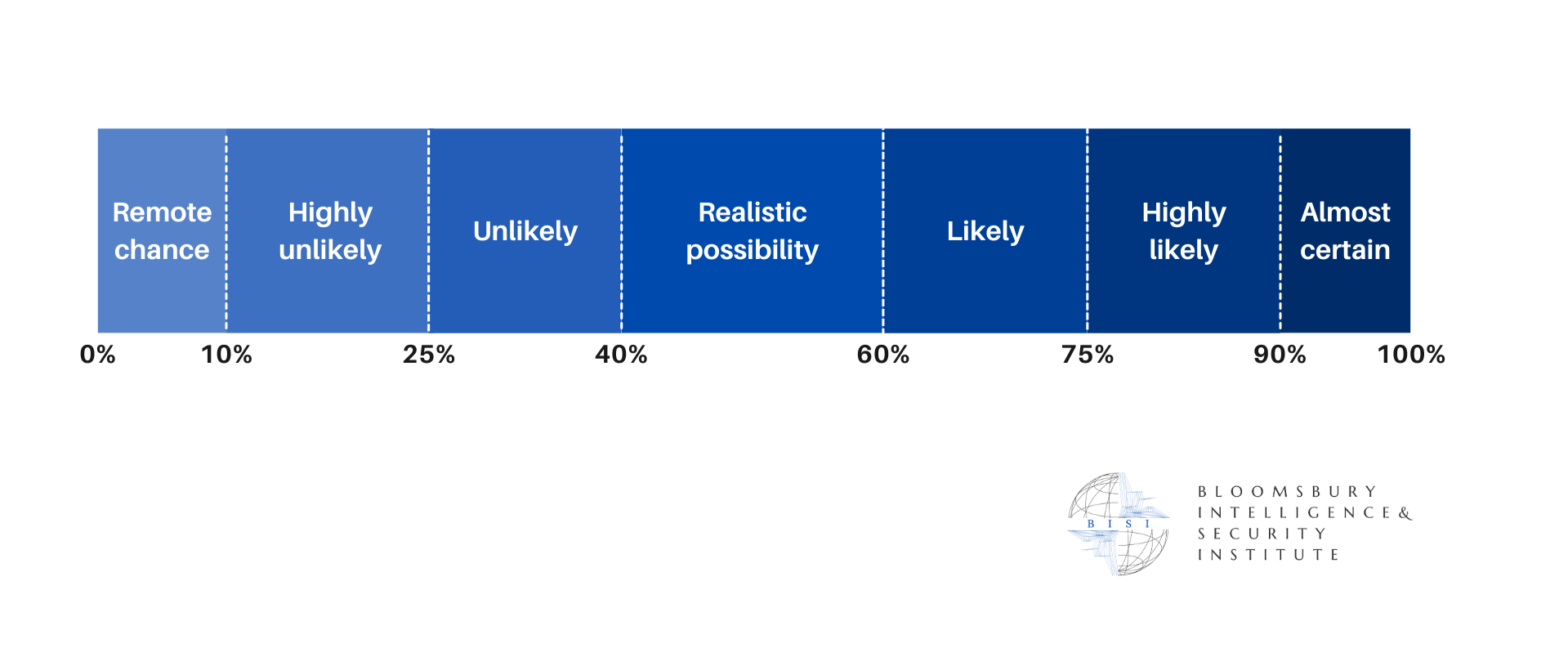
It is highly likely that Venezuela will avoid conventional military action against Essequibo while the interim government remains dependent on US tolerance and focused on its own survival. There is a realistic possibility, however, of continued grey-zone pressure through criminal proxies and irregular incursions in the contested interior.
Medium-term (3 - 12 months)
It is likely that the ICJ will rule in Guyana's favour on the validity of the 1899 award. Caracas is almost certain to reject the judgment and retain the claim in domestic law, leaving the dispute legally settled but politically open.
Long-term (>1 year)
It is unlikely that the claim will be permanently relinquished, given its nationalist support. A future government in Caracas, particularly one seeking to rebuild legitimacy or reduce dependence on Washington, could revive it, making the durability of the post-Maduro settlement the decisive variable.