
South Africa Hosts BRICS Members for Maritime Military Exercises
By Sarah Ambrose | 26 January 2026
Summary
In January 2026, South Africa hosted the Will for Peace 2026 naval war games with other BRICS Plus members, aiming to promote maritime trade safety.
The exercises faced controversy from Western countries due to the participation of sanctioned states such as Russia and the BRICS Plus members’ ongoing trade with Iran.
Due to US President Donald Trump’s stance against the BRICS Plus alliance, it is almost certain that South Africa will face increased tariffs for hosting the war games.
Context
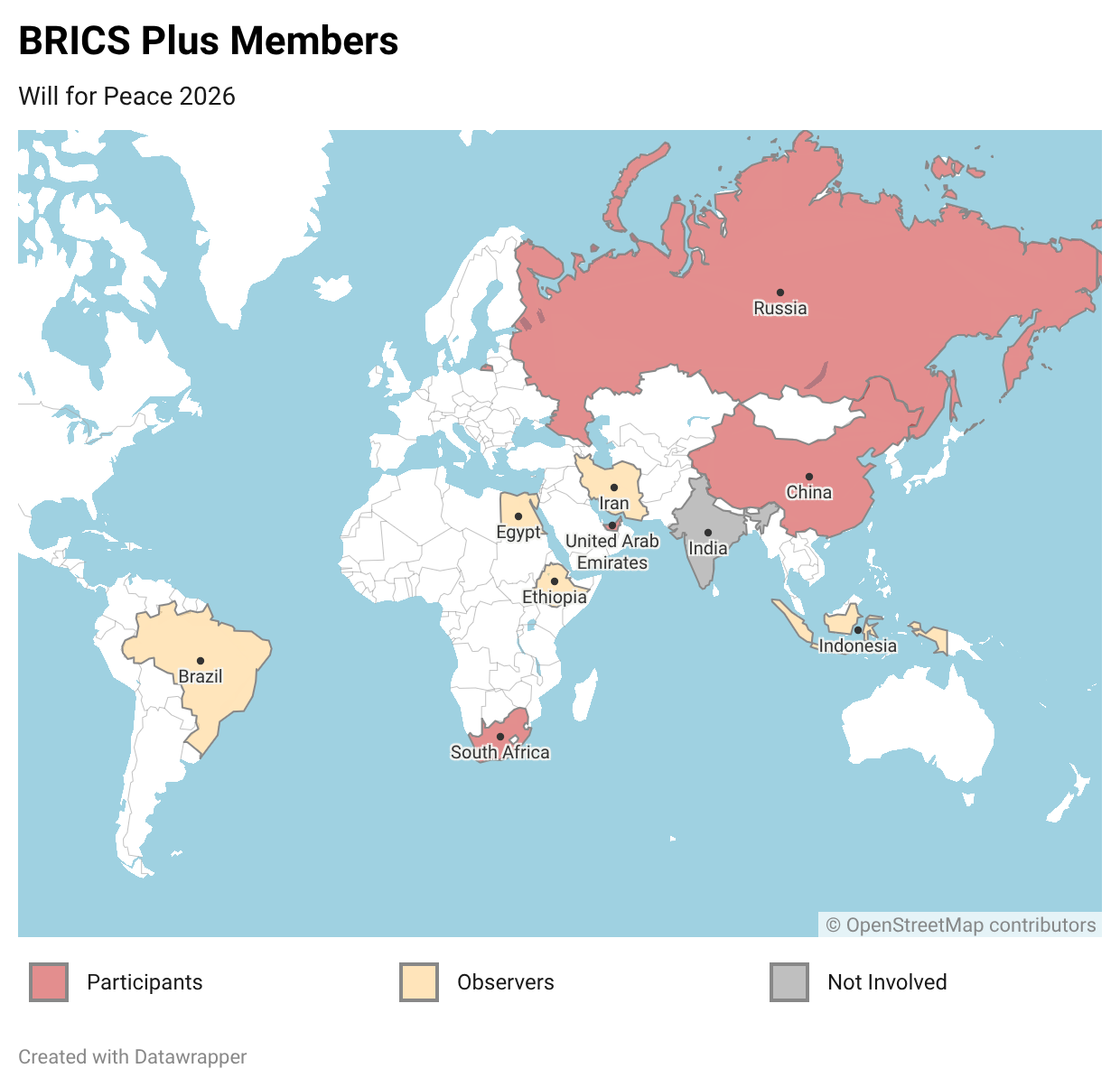
Starting on 10 January 2026, South Africa hosted week-long wargames and joint naval training exercises for members of the BRICS Plus bloc, called “Will for Peace 2026”. Participants included Russia, China, Iran, and the United Arab Emirates, with Brazil, Indonesia, Egypt, and Ethiopia acting as observers. The exercises were led by China, with the stated goal of promoting shipping and economic maritime activity safety. Following criticism from the United States (US), South Africa requested that Iran step back as an observer and withdraw their 3 warships from the drills. The training exercises had originally been scheduled for November 2025, but were postponed due to the G20 Summit hosted in South Africa at the same time. Although largely maintaining a status of political non-alignment, South Africa has participated in naval exercises with China and Russia periodically since 2019.
Implications
South Africa’s hosting of the war games coincides with its growing tensions with the US. US President Donald Trump has denounced the BRICS Plus alliance and accused it of pursuing “anti-American” policies. Since Trump’s inauguration in January 2025, relations with South Africa have declined; Trump froze aid to South Africa, imposed 30% tariffs, and refused to attend the G20 Summit. The US is South Africa’s second largest trading partner, behind China. Hosting the war games will likely further drive a wedge between the US and South Africa, especially due to the participation of numerous US adversaries. The Will for Peace exercises also signify the fortification of South Africa’s relationship with China, which the country has been increasing commitment to in recent years.
Through the BRICS Plus alliance, South Africa aims to take on a greater role in the global economy while gaining opportunities for investments in energy and infrastructure, largely from China. Hosting the Will for Peace exercises signifies South Africa’s commitment to strengthening its relationship with the rest of the alliance and seeking support outside of major Western powers. South Africa aspires to become a stronger regional power, promoting the Global South through alliances like BRICS Plus and engaging in the Southern African Development Community (SADC). A closer alliance with states such as Russia and Iran poses the risk of economic isolation due to the large number of tariffs, embargoes, and sanctions imposed against them. On 13 January, Trump announced a new 25% tariff on any country doing business with Iran, which will largely target BRICS Plus members. The energy sector will be highly impacted by these tariffs, as Iran’s top 5 exports are all fuel-related and it is one of the world’s largest oil exporters.
While BRICS Plus is not a military alliance, the naval exercises prioritising maritime trade signify a potential risk of broader conflict over oil shipments. In the first weeks of January 2025, the US has seized several Russian-flagged oil tankers in the Atlantic Ocean and Caribbean Sea for allegedly transporting embargoed oil. The recent war games aimed to strengthen joint efforts to combat threats to maritime trade, according to the Chinese military. Should the US continue to target Russian ships, it risks the possibility of additional BRICS Plus states becoming involved to protect their ally’s maritime trade routes.
Forecast
Short-term (Now - 3 months)
It is almost certain that South Africa will face increased tariffs from the US in the next few weeks for its role in the BRICS Plus exercises.
Medium-term (3-12 months)
There is a realistic possibility that other BRICS Plus members will take action to protect Russian oil trade routes within the next year.
Long-term (>1 year)
It is highly unlikely that a full military alliance will develop between major BRICS Plus powers, outside of protecting mutual economic interests.
