Revised Economic Forecasts for Russia
By Lily Donahue | 8 June 2026

Summary
Russia's Economic Development Ministry has published a surprisingly candid forecast, with GDP expectations cut and investment projections slashed, promoting an economy riddled with temporary shocks as the new normal.
Despite a brief oil price spike driven by the war in Iran, Russia has seen little lasting benefit. Revenues remain below 2025 levels as tax windfalls are being recycled back to oil companies.
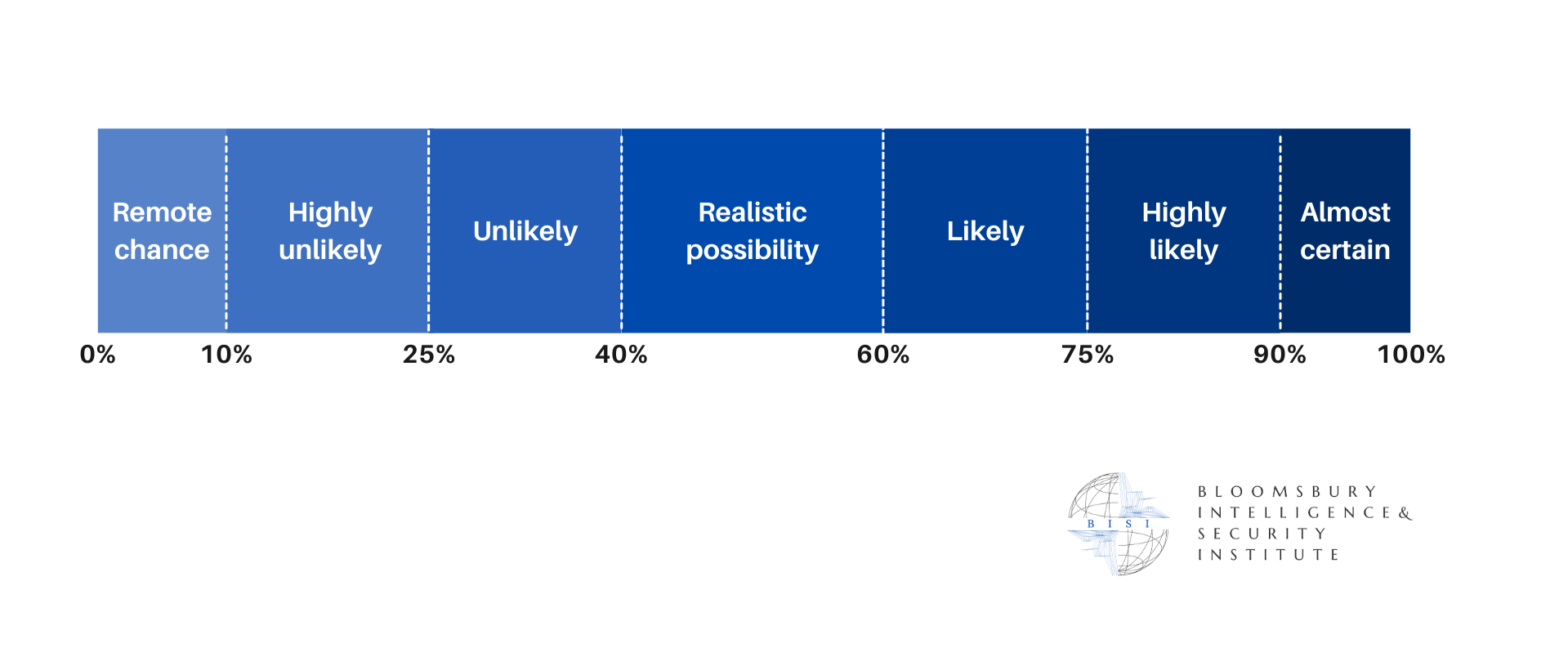
Russia is unlikely to face economic collapse, but a structural revenue shortfall of USD 25–30b looks increasingly probable as oil prices fall and the ruble strengthens.
Context
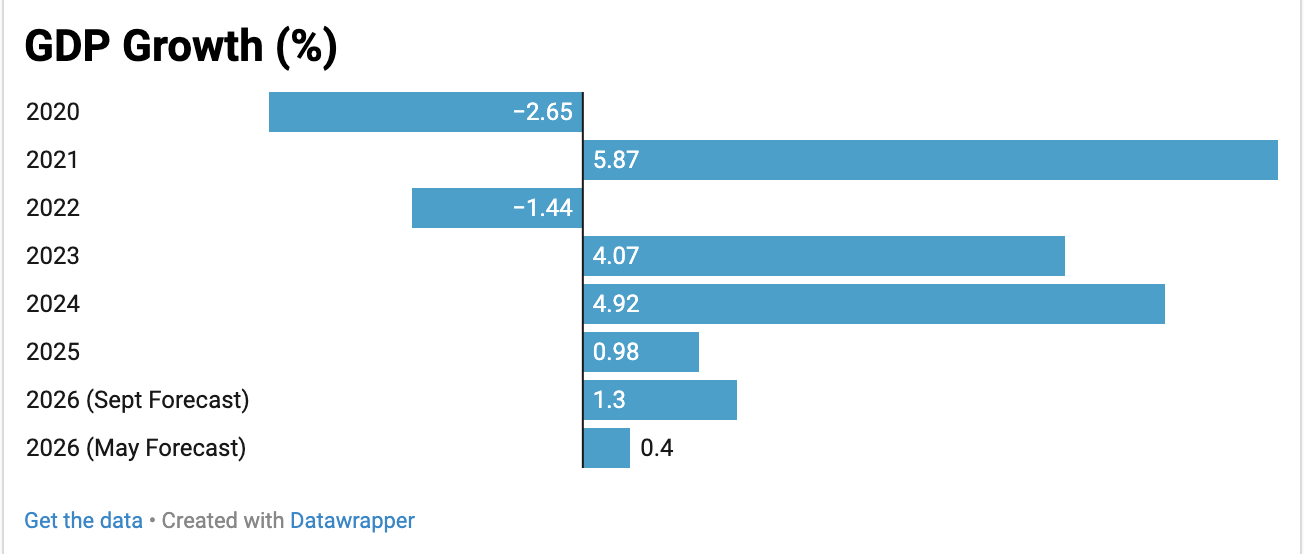
The Russian Economic Development Ministry published new financial forecasts on 12 May, with every major indicator downgraded for the next 2 years, including a 69% decrease in GDP and investment predicted to shrink by 3 times as much as previously believed.
Russian President Vladimir Putin expressed frustration with the economy’s sluggishness in April. Though he justified losses by erroneously pointing to “calendar effects, weather conditions, and seasonal factors as the reasons for this negative performance,” Putin was careful to apportion blame to financial ministers - a transparent attempt to insulate the Presidential office from responsibility. While Maxim Reshetnikov, the Minister of Economic Development, aimed to ease concerns by speaking of a “period of fine-tuning” and situating the current economic malaise within a broader context, as immediate collapse remains highly unlikely. Reshetnikov was careful to note that economic patterns are “cyclical” and, as such, can be expected to improve. Any quotidian pendulum swing, however, would not last into 2028, meaning the released figures do not match the explanation.
Implications
While the war in Iran was initially expected to be a boom for the Russian economy, such hopes have fallen flat. Although oil prices skyrocketed to over USD 100 per barrel, Russia hasn’t enjoyed a corresponding windfall. While oil and gas revenues were the highest they had been since October, they still did not reach 2025’s heights.
Russian oil taxes, collected through the mineral extraction tax, doubled, but nearly half went back to the oil companies in a bid to keep domestic prices low. When energy revenues are strong, Moscow typically purchases foreign currency to stabilise the economy. The finance ministry is expected to buy USD 1.5b through May, but this is largely a catch-up measure, compensating for purchases skipped in March and April; it does not reflect any meaningful economic momentum.
Deputy Prime Minister Aleksander Novak admitted that while the war “is creating the conditions for increased export revenues for oil and gas,” the benefit was “not long-term.” Novak estimated the price per barrel at USD 59 in 2026, falling to USD 50 for 2027 through 2029.
Small businesses, already struggling, will remain burdened by higher taxes and difficulty securing credit. Indeed, 68.7% of small and medium-sized businesses reported loss of revenue in 2026; it is likely many will shutter. For the Russian economy, which has historically bolstered state-owned companies and depended on raw goods exports, this is something of business as usual - it is, arguably, a “kind of economic structure [which] helps dictators maintain power.”
The Russian economy, though unsustainable, has enough sustenance to maintain the war in Ukraine. Banking remains steady; unemployment is low. There is little reason to expect any collapse. The figures, however, remain notable because they point to a “new baseline scenario,” in which Moscow may wilt, but remain standing.
Richard Hurd/Flickr
Forecast
Long-term (>1 year)
It is likely Russia will face an energy revenue shortfall of some 25 to 30 billion USD. A stronger ruble and falling oil price has cut the value of Urals crude by roughly a quarter. While the taxation system will likely protect - or soften any blows to - domestic oil prices, the offset remains significant.
It is highly unlikely the Russian economy will collapse; its sustainability and health, however, remain corrupted.