Private algorithms and public force: AI-driven decision cycles in the Gulf
By Rakotoarimanga Tinah | 23 March 2026

Summary
Gulf states are rapidly integrating artificial intelligence (AI) into their defence and security systems through partnerships with private technology firms, particularly in the United Arab Emirates (UAE).
As governments increasingly rely on privately developed algorithms and computing infrastructure, elements of military decision making are gradually shifting towards technological systems that remain largely outside direct state control.
With AI infrastructure becoming strategically important, competition over data, computing capacity and technology partnerships is likely to intensify, creating new operational and security risks across the Gulf.
Context
AI is becoming an increasingly important strategic capability across the Gulf, where governments are investing heavily in digital infrastructure, surveillance technologies, and advanced computing. The UAE has placed itself at the centre of this effort through a national strategy designed to integrate AI across government, economic, and security sectors. This strategy relies on close partnerships between state institutions and private technology firms developing large-scale data infrastructure, machine learning systems, and high-performance computing capacity.
This approach reflects a broader shift in how military capability is developed in the region, wherein governments are increasingly working with private companies rather than solely relying on state-owned defence industries. Specifically, private companies can be employed for data analysis, predictive surveillance, and decision-support tools. They also use platforms that process large volumes of sensor data and intelligence inputs in order to support threat detection, operational planning and battlefield awareness. Such systems can therefore significantly accelerate intelligence analysis and shorten the time needed to identify and respond to potential threats. AI-enabled platforms are also able to combine satellite imagery, signals intelligence and open source information into integrated analytical frameworks capable of identifying patterns or anomalies that might otherwise go unnoticed.
This acceleration also introduces new risks; systems designed to prioritise speed can reduce the time available for political deliberation during crises, and in such conditions, leaders may increasingly rely on algorithmic assessments produced by systems whose internal logic is not always transparent to policymakers.
The infrastructure supporting AI is becoming strategically important in its own right: data centres, cloud computing facilities and advanced semiconductor supply chains are essential for training and operating large-scale AI systems.
If Gulf states invest heavily in these capabilities, which is the case here, those infrastructures are gradually emerging as a valuable asset in navigating regional competition, particularly as competition between Gulf states, especially between the UAE and Saudi Arabia, over technological leadership becomes increasingly shaped by their respective alignments and dependencies within the broader US-China competition.
Implications
The result is a security landscape in which the boundary between public authority and private technological power is becoming less clear. Governments still direct defence policy and military operations, but many of the technical systems supporting intelligence analysis and operational planning are designed and maintained by private actors operating across global technology networks.
The integration of AI into security and intelligence architectures is, in turn, likely to accelerate operational decision cycles across Gulf institutions. While AI-enabled systems can provide near real-time threat detection and analysis, thus improving situational awareness, they can also reduce the time available for political deliberation during crises. Indeed, as automated decision-support tools increasingly shape threat assessments, leaders may face pressure to make high-stakes decisions within increasingly narrow timeframes. In this sense, AI does not simply enhance military capability; it changes the tempo of strategic decision-making and may push crisis management toward faster and potentially less stable dynamics.
Reliance on privately developed AI systems also introduces new forms of dependency between governments and technology firms. Many of the capabilities now emerging in the Gulf rely on machine learning models, cloud infrastructure, and data-processing systems designed by private companies operating within global technology ecosystems. These firms often control the algorithmic architecture, training data, and computing resources required to maintain and update AI systems. As a result, governments may depend on external actors for key elements of intelligence analysis or operational planning.
The rapid expansion of AI capabilities is further transforming digital infrastructure into a strategic asset. Data centres, cloud computing facilities, high-performance computing clusters, and advanced semiconductor supply chains are becoming essential components of modern security architectures.
These infrastructures support the storage, processing, and training of large-scale machine learning systems that underpin contemporary AI capabilities. As Gulf states invest heavily in developing regional AI hubs, such infrastructure is increasingly treated as a critical national capacity. Control over computing power and access to advanced chips is therefore emerging as a new dimension of geopolitical competition, where technological infrastructure becomes closely linked to military capability and strategic influence.
Forecast
Short-term (Now - 12 months)
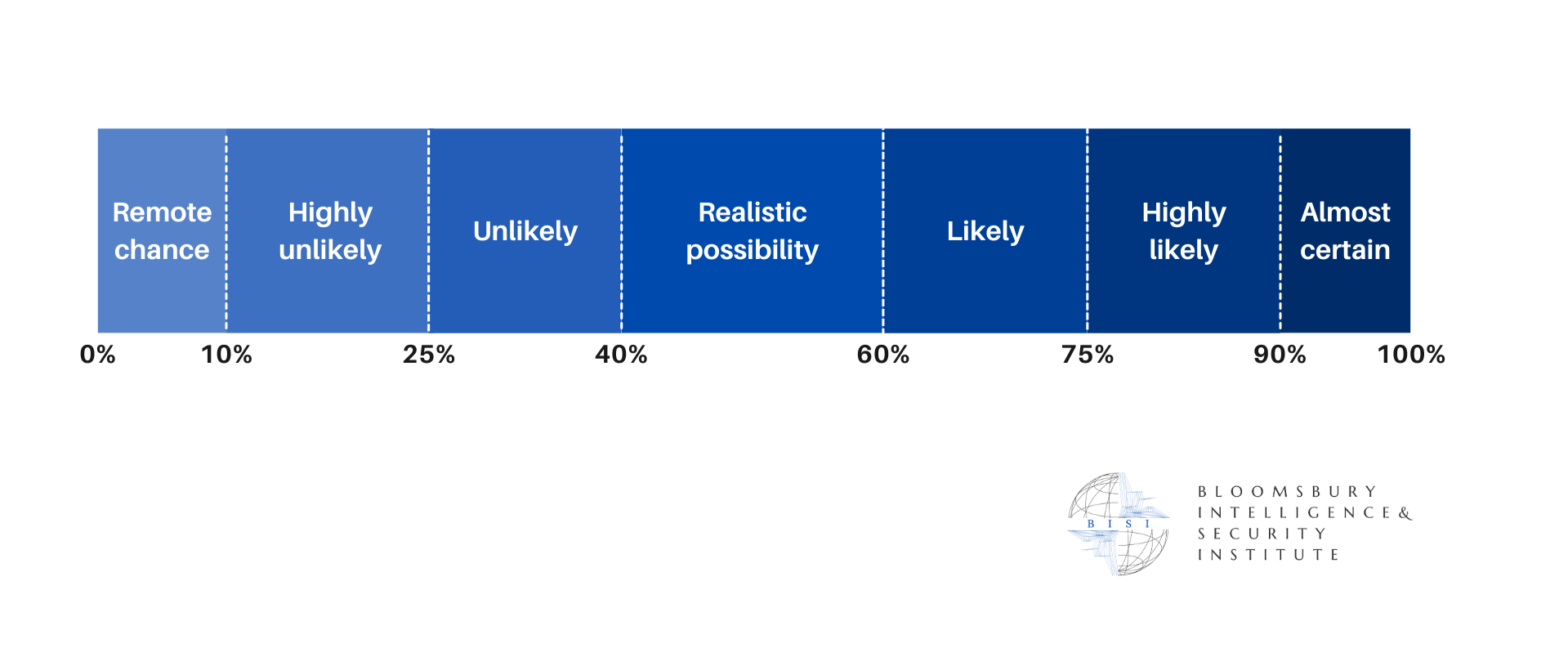
Gulf states are likely to expand partnerships with domestic and international technology firms to accelerate the development of AI infrastructure and integrate algorithmic decision support tools into intelligence, surveillance, and internal security institutions.
Investment is likely to increasingly target cloud computing, data infrastructure, and AI-enabled analytical platforms capable of processing large volumes of security related data in near real time.
Governments across the region are likely to increase investment in cloud computing, data infrastructure and high performance computing capabilities alongside expanded funding for data centres and semiconductor supply chains, recognising these technologies as essential foundations for large scale AI deployment in defence and security sectors.
Long-term (>1 year)
Governance challenges surrounding military AI systems are highly likely to emerge as a central issue in regional and international security debates.
As defence institutions rely more heavily on privately developed algorithms, concerns regarding transparency, accountability, and effective human oversight in security decision making are likely to grow.