How Do Disruptions in the Hormuz Strait Affect Europe? A Spotlight on Italy
By Anna Toso | 23 March 2026
Lens Envy/Flickr
Summary
The American-Israeli military operations against Iran have severely disrupted the supply of oil and natural gas, alongside commercial passage through the Strait of Hormuz. In the European Union (EU), Italy is one of the most exposed countries due to its exports to the region and reliance on Qatari Liquefied Natural Gas (LNG).
Although the EU is not facing physical shortages in oil and gas supplies, the gas price spikes and the commercial disruptions have significant consequences for Italy and other European economies.
Depending on the duration and severity of the economic crisis following the instability in the Middle East, the current Italian administration is likely to experience economic and political challenges in the coming months, due to the pressure on exporting firms and the relevant share of gas in its energy mix.
Context
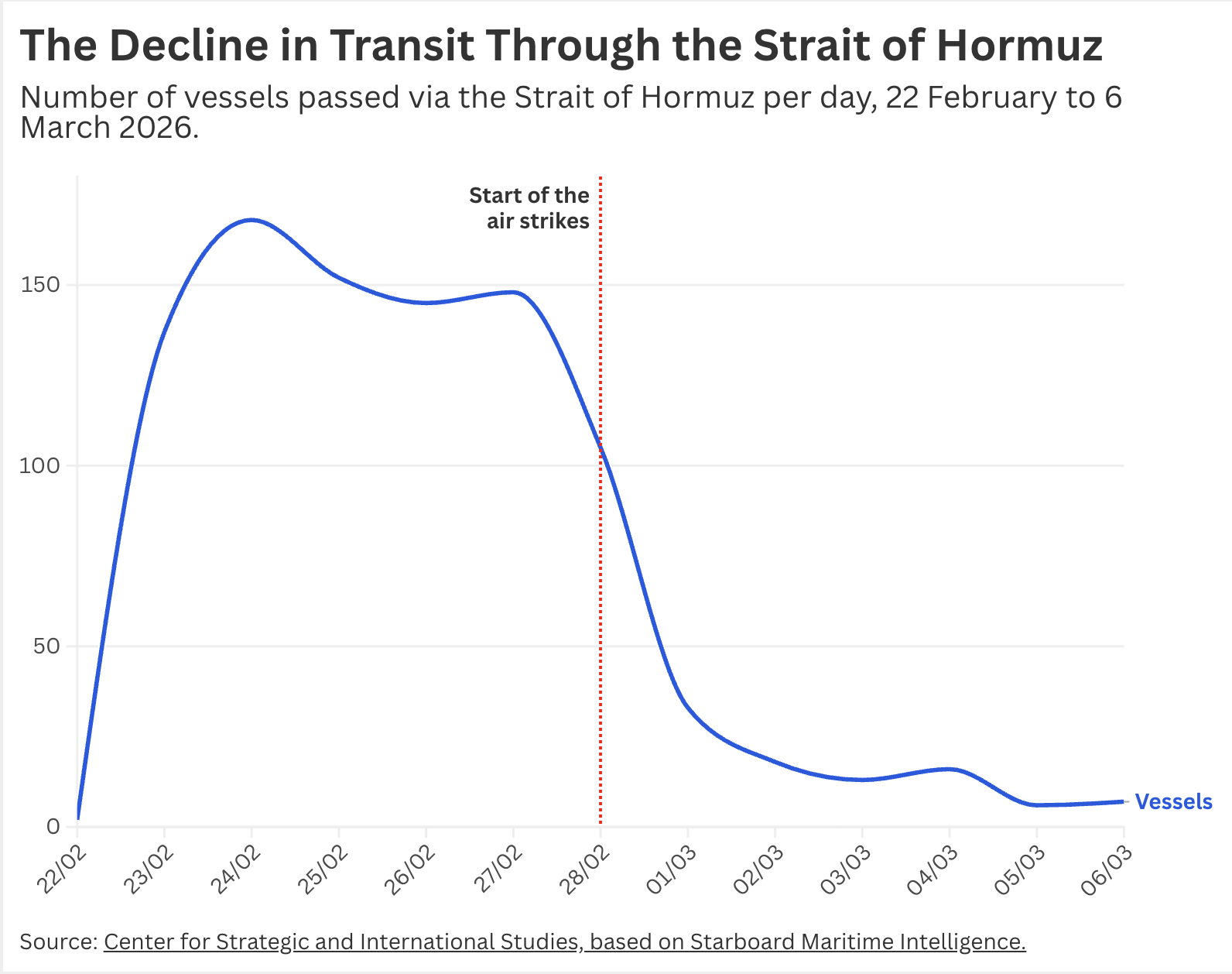
On 28 February, the United States (US) and Israel launched joint air strikes against Iran. So far, the American and Israeli strikes have killed Iran’s supreme leader, numerous senior military officials, and over 1,200 victims, mostly civilians. Targets included defence and institutional sites, Iranian nuclear programme facilities, and oil depots. Meanwhile, Iran responded with missiles and drones at US military sites, oil & gas and logistics facilities, and civilian infrastructures across Bahrain, Iraq, Kuwait, Oman, Qatar, Saudi Arabia, and the United Arab Emirates (UAE) and threatened to attack financial centres linked to the US and Israel.
This rapid escalation halted transit through the Strait of Hormuz, with worldwide economic, operational, and political implications. 20% of the global oil and gas supply, the transportation of fertilisers, aluminium, and sugar crucially rely on this checkpoint. In a few days, commercial activity through the Strait has reduced by 90%, and insurance rates have risen from 0.25% to 1.25% of the shipped goods’ value.
Shut-downs cause global disruptions
Saudi Arabia temporarily paused the operations of the world’s largest oil refinery, Saudi Aramco’s Ras Tanura, due to debris-induced fires. Brent crude oil, an international price benchmark, exceeded USD 100.00 a barrel on 9 March, the highest peak since 2023. Meanwhile, Qatar suspended LNG production due to drone attacks on facilities in Ras Laffan and Mesaieed of the state-owned company QatarEnergy, a major LNG producer worldwide. The production of urea, polymers, methanol, and aluminium was also discontinued. Qatar is the second largest producer of LNG after the US and supplies approximately 15% of Europe’s total LNG imports. Since there are no immediate logistically viable alternatives to Qatar’s LNG, its supply shutdown is raising prices on international markets.
Impacts on the Energy Market
In the short term, the physical availability of gas and oil to the EU is not directly jeopardised. Nonetheless, supply shocks, volatility, and speculation in the global energy markets produce tangible consequences. On 3 March, benchmark gas prices in Europe peaked at EUR 65.79 (USD 76.19) per MWh, more than doubling the past 3-year average of EUR 30.00 (USD 34.74) per MWh and surpassing the +39% registered in Asian markets. Natural gas represents over one-third of Italy’s energy consumption, and LNG accounts for 25% of its gas imports. In 2024, Italy imported 45% of its LNG supply from Qatar, underscoring a significant direct exposure. This limited diversification heightens the Italian economic exposure to global supply shocks. North African producers such as Algeria and Libya could become alternative suppliers, allowing short-distance transport. However, binding contracts with Qatari and American LNG suppliers and local political instability limit these countries’ role to being only complementary providers.
Italy’s natural gas stocks are at 48%, above the bloc’s average of 30%. This mitigates the energy supply shock in the short term. Nonetheless, the EU requires seasonal refilling of at least 90% of national gas storage by November each year. Since Italy had a public deficit of 3.1% of its GDP in 2025, above the EU-allowed threshold, the national budget would face severe financial constraints should energy prices not re-stabilise in the next months.
Impacts on Trade and Businesses
The Italian economy was already among the weakest in the EU, registering a GDP growth of just 0.4% in 2025 and a decades-long productivity decline. Due to the standstill of air and naval hubs in the Middle East, freight costs between Europe and Asia have already increased by over 6%. This rise damages the trade of EU Member States, such as Italy, Greece, Spain, Poland, and Belgium, which substantially rely on the Strait of Hormuz for their commerce. Over the next two months, estimates forecast a revenue loss of EUR 1b in the Italian tourism sector due to the cancellation and unreliability of flights from the Middle Eastern airports. Furthermore, one-third of the raw materials for producing agricultural fertilisers usually pass through the Hormuz Strait. The blocked transit has already made fertilisers’ prices soar by up to 30% globally, and up to +49% in Italy. Hydrocarbons and natural gas derivatives account for almost 50% of the pricing of crops such as corn and wheat, mainly due to fertilisers and transport costs. For that reason, on 10 March, a thousand Italian agricultural workers protested in Milan.
Confartigianato, the association of Italian manufacturers representing over 1.5m artisans and SMEs in the country, warned of potential export losses up to EUR 27.8b, corresponding to 5% of nationwide manufacturing revenues. The Middle Eastern market for selling Italian goods has been growing rapidly, reaching a 4.6% share of the total national exports in 2025, +7.9% compared to the previous year. The major importers of made in Italy in the region are the UAE, Saudi Arabia, Kuwait, and Lebanon – all of which have been directly targeted in the ongoing hostilities. The Italian government is working on subsidies for Italian exporting companies affected by the crisis. At the EU level, even before the escalation in Iran, representatives of over 100 energy-intensive industries had brought up to the European Commission the issue of high and volatile electricity prices. The current disruptions further hamper the global competitiveness of EU-produced steel, aluminium, ceramics, cement, and chemicals.
Impacts on Consumers and Civil Society
Economists foresee the eurozone inflation to increase at least by 0.3-0.5% and its economic growth rate to shrink by 0.1-1% in 2026 due to a productivity and purchasing power reduction following the energy supply shock and the instability in the Middle East. The estimates could worsen if the crisis protracts. According to preliminary forecasts about Italy, Italian households’ 2026 energy and gas bills could experience a 10-20% increase compared to pre-Iranian crisis levels. Energy and gas costs for families are expected to increase most in large metropolitan areas, especially in Rome, Milan, and Naples. Additionally, diesel fuel prices have risen by 25% for Italian consumers between 1 and 9 March. Increased costs of raw materials for farmers are also likely to affect basic consumer goods prices, especially cereals, meat, and milk.
The conflict in the Middle East is fueling political polarisation in Italy. For instance, two protest rallies with 500 attendees each took place in front of the American consulate in Milan on 2 and 3 March. The first, in support of the US-Israeli strikes, was also attended by two members of the governing parties, Fratelli d’Italia and Lega. During the second rally, against the war, verbal tensions arose with smaller groups opposing the protest. Expression of social discontent for international conditions is entangled with domestic affairs. Namely, on 14 March, in Rome, 20,000 protestors marched for the “social no” against multiple causes, including the upcoming referendum on the constitutional reform of the judiciary, armed conflicts, and increasing European defence spending.
Forecast
Short-term (Now - 3 months)
The Italian government faces a critical juncture for its credibility and governance stability, aggravated by the current economic instability prompted by the conflict in Iran:
In the short-term, on 22-23 March, there is a realistic possibility that the outcomes of the referendum on its flagship judiciary reform will undermine the administration’s domestic popularity.
In the medium-term, the lack of information about the American plans to bombard Iran will likely have negative repercussions on Prime Minister Giorgia Meloni’s credibility as a privileged mediator between the EU and the US.
In the longer term, the potential economic disruption due to the recent developments in the Middle East will very likely increase enterprises' and consumers’ discontent about expensive energy and grocery bills, and rising uncertainty about the right-wing coalition’s re-election in 2027.
Medium-term (3 - 12 months)
If hostilities in the Middle East halt gas and oil shipping for several weeks or months, Europe will likely face significantly higher market prices when restocking its supplies before next winter due to the strong competition from the Asian economies over limited resource availability.
Long-term (>1 year)
In the next few years, the reduction of dependency on fossil fuels in the EU will likely be the most effective strategy not only to achieve environmental sustainability goals but also to reduce dependency on international volatile markets and geopolitical instability.