By Sarah Ambrose | 19 May 2026
Summary
On 25 April 2026, Jama'at Nusrat al-Islam wal-Muslimin (JNIM) coordinated with Azawad Liberation Front (FLA) to carry out attacks in six cities across Mali.
FLA conquered the city of Kidal and is making progress towards controlling a majority of northern Mali.
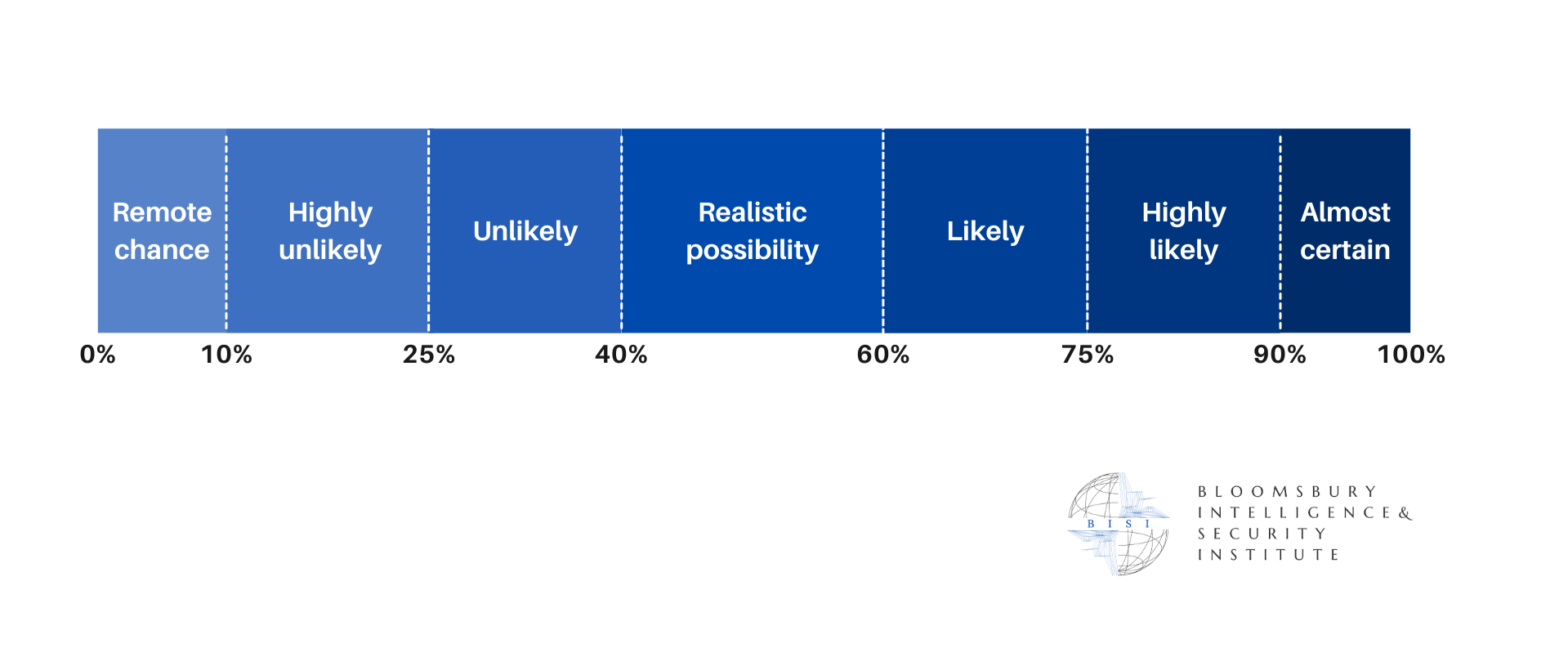
There is a realistic possibility that insurgents will overthrow the current Malian government within the next year.
Context
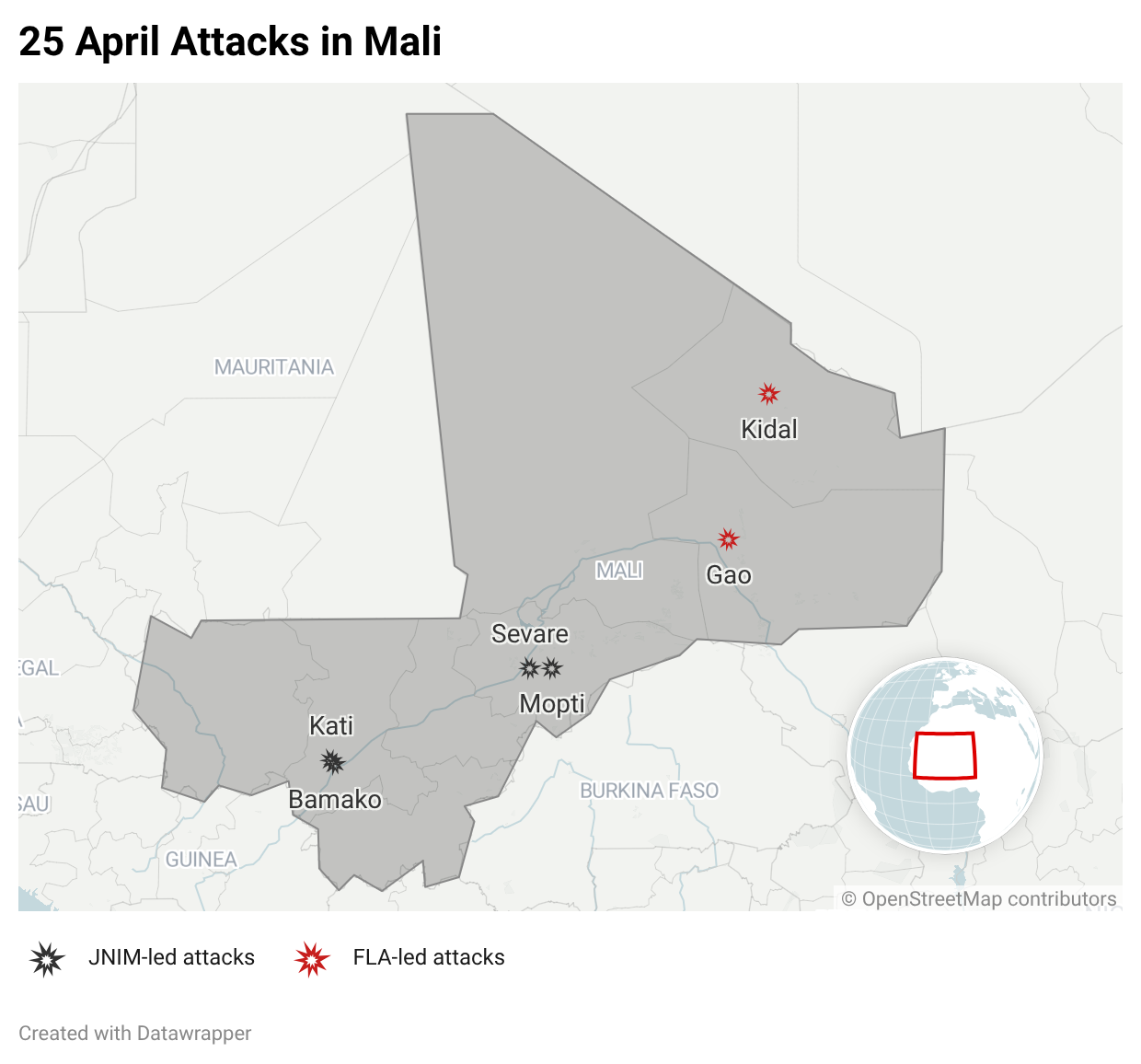
On 25 April 2026, insurgents and jihadist terrorists launched a coordinated attack across Mali, with fighting reported in the capital city of Bamako, Kati, Gao, Sevare, Mopti, and Kidal. Mali has faced years of violence from groups affiliated with Al Qaeda and the Islamic State, with a significant number of recent attacks carried out by Al Qaeda affiliate JNIM. The Tuareg separatist group FLA coordinated attacks on 25 April with JNIM, according to statements by both groups. The attacks included a suicide bomber targeting the residence of Mali’s defence minister Sadio Camaro, who was later confirmed dead. Since the attacks, Bamako has been under a partial blockade imposed by JNIM.
Implications
Following the coordinated attacks, FLA claimed that it had gained control of the northern city of Kidal. In videos posted on social media, fighters were seen gaining control of the Kidal governor’s office. The capture of the city poses a significant gain for FLA, which seeks to establish a breakaway state for the ethnic Tuaregs across northern Mali. Kidal previously served as the unofficial headquarters for the separatist movement until it was captured by the Malian military in 2023. In addition to controlling Kidal, FLA made significant advancements in the northern city of Gao, taking control of the city gates and expanding its presence towards military strongholds. According to an FLA spokesman, the group’s main goal moving forward is to fully capture Gao, and subsequently, the city of Timbuktu will be easy to fall. The loss of government control will provide significant traction for the separatist movement.
The attacks across Mali pose a significant risk to the stability of the military junta regime, which has been in power since a 2021 coup. The government initially partnered with the Wagner Group for security, and in June 2025, the operations were taken over by Africa Corps, a Russian Ministry of Defence-controlled paramilitary group. On 27 April, Africa Corps confirmed that it had fully withdrawn from Kidal but remained operational in other cities across Mali. The group statement also included unsubstantiated claims that Ukrainian mercenaries and Western intelligence agencies were involved in the attacks. Russian state media responded to the attacks, and Africa Corps helped prevent a coup in Mali and called for peace and stability in the country. The volatility of the government’s control presents opportunities for further Russian involvement in security operations. However, FLA is demanding a permanent withdrawal of Africa Corps from the country. On 30 April, Russia rejected the demands for a withdrawal and reaffirmed its commitment to the security partnership with Mali.
The collaboration between FLA and JNIM has significant security implications for the country and the greater Sahel region. Previously, the two groups clashed, with FLA’s separatist movement at odds with JNIM’s aim to expand its presence across West Africa. By collaborating their efforts, the two groups were able to carry out attacks across the country in the largest jihadist attack in years. The newfound alliance between JNIM and its former rival poses a threat to the region due to increased violence against government, military, and civilian targets if insurgent infighting decreases.
Following the attack, the Economic Community of West African States (ECOWAS) issued a strong condemnation of terrorism in the region and called for greater cooperation across governments to address the elevated regional security concerns. Mali was formerly a member of ECOWAS and received significant counterterrorism support from the alliance, but the government officially withdrew from the alliance in January 2025. Burkina Faso and Niger, also under military rule, withdrew at the same time and formed the Alliance of Sahel States (AES) with Mali, a new bloc coordinating security efforts that turned to Russia for increased support while kicking out France and the United States. Despite Mali’s rejection of Western support and greater regional cooperation, the extreme security risks across the Sahel will likely lead to increased security operations from neighbouring countries and the potential for ECOWAS members to request additional support from international allies.

Wikimedia
Forecast
Short-term (Now - 3 months)
It is highly likely that within the next few weeks, FLA will successfully capture the city of Gao and make advancements towards Timbuktu.
It is likely that ECOWAS members will increase counterterrorism operations in the coming weeks to protect against the spread of jihadist attacks across the region.
Medium-term (3 - 12 months)
It is likely that JNIM will scale up its operations across the Sahel region beyond Mali.
It is unlikely that Russian forces will withdraw support of the Malian government in the coming months.
Long-term (>1 year)
There is a realistic possibility that within a year, the current military junta in Mali will fall to insurgent fighters.