By Ipek Kara | 19 May 2026
Summary
On 7 May 2026, the European Parliament and Council reached an agreement on the “AI Omnibus”, a legislative package to prevent the AI Act from slowing down industrial growth.
The changes introduce a “strategic implementation delay,” pushing the compliance for high-risk industrial AI to August 2028 while fast tracking bans on “nudifier apps" to address immediate public outrage.
The European Union (EU) is attempting to preserve its manufacturing dominance through decoupling industrial AI from the AI Act, risking a fragmented regulatory landscape that favours established companies over startups to keep the industrial growth stable.
Context
On 7 May 2026, the EU finalised the negotiations of the “AI Omnibus,” a legislative correction of the EU AI Act’s implementation framework since its initial adoption in 2024. The package is in response to pressure from member states, led by Germany and France, who have argued that the original timelines of the Act and overlapping rules could slow down European tech innovation and disadvantage domestic manufacturers in the global race with US and Chinese AI firms.
This political pivot is directly rooted in structural macroeconomic challenges. According to the European Investment Bank (EIB) Investment Report 2025/2026, the EU is facing a persistent stagnation in real corporate investment since the post-pandemic period, threatening its long-term industrial viability. The report also highlights that 62% of the EU firms cite regulatory fragmentation and compliance friction as primary structural barriers to their investment and export expansion.
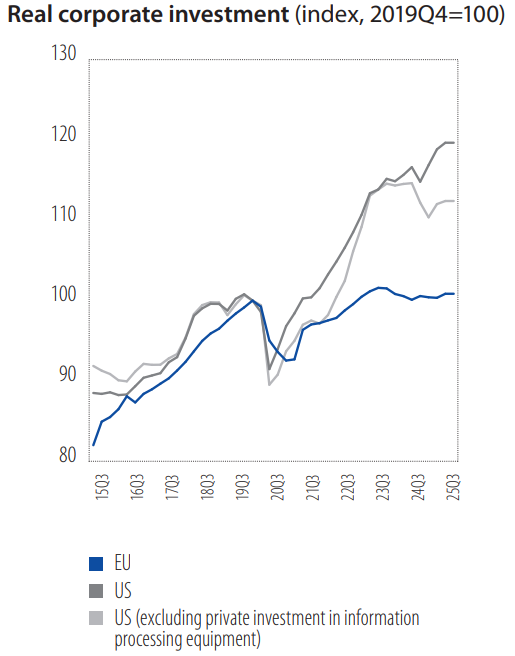
European Investment Bank (EIB) Investment Report 2025/2026
A core component of the deal is the streamlining of Annex I high-risk AI systems (embedded AI in regulated products). The Omnibus resolves the previous double regulation problem under both the AI Act and existing sectoral safety laws by integrating the AI-specific health and safety requirements into the existing Machinery Regulation through delegated acts.
Parallel to industrial concessions, the Omnibus is used as a fast-track protection against emerging AI-driven social threats following the increase in “deepfake” incidents. It explicitly bans AI systems designed to generate non-consensual sexualised imagers so called the “nudifier apps”, and mandates general purpose AI providers to implement watermarking by 2 December 2026, moving the deadline of the original act closer by 3 months.
Implications
The AI Omnibus is significant because it marks a retreat from the “regulation-first” approach that has defined EU digital policy for years. By delaying the enforcement of high-risk AI obligations, the EU is granting a two year breathing room to the tech sector. This suggests a recognition that the compliance infrastructure (such as national notified bodies and harmonised standards) is not yet mature enough to support the original timeline.
The economic shift also favours Big Tech and heavy industry. Large manufacturers in Germany and France are the primary beneficiaries of the “machinery exemption”. This prevents a massive spike in certification costs for exported goods due to the cost of a fragmented regulatory landscape. Significantly, although industrial AI is being deregulated, AI in medical devices remains under strict, dual-layered oversight, due to pushback from the European Medical Community against deregulation. This creates an unbalanced regulatory system that could lead to uneven investment across different tech sectors.
For small and medium-sized enterprises (SMEs) and small mid-caps, the Omnibus is introducing a “Correction Period,” granting them a 30-day warning window to rectify non-compliance before any implementation of fines. This shifts the EU towards a soft enforcement model, protecting the smaller firms from immediate insolvency due to administrative errors. However, the EU risks allowing frontier-level threats to become embedded in digital ecosystems by loosening the immediate enforcement mechanisms.
The deal also consolidates significant enforcement authority to the European AI Office, positioning it as a “super-regulator”. Under the new 2 December 2026 deadline, the Office is tasked with defining technical specifications for mandatory watermarking and enforcing the ban on "nudifier" applications. If the office fails to provide clear technical standards for watermarking, the EU risks a wave of "accidental non-compliance" that could partially paralyse the media and creative sectors.
Forecast
Short-term (Now - 3 months)
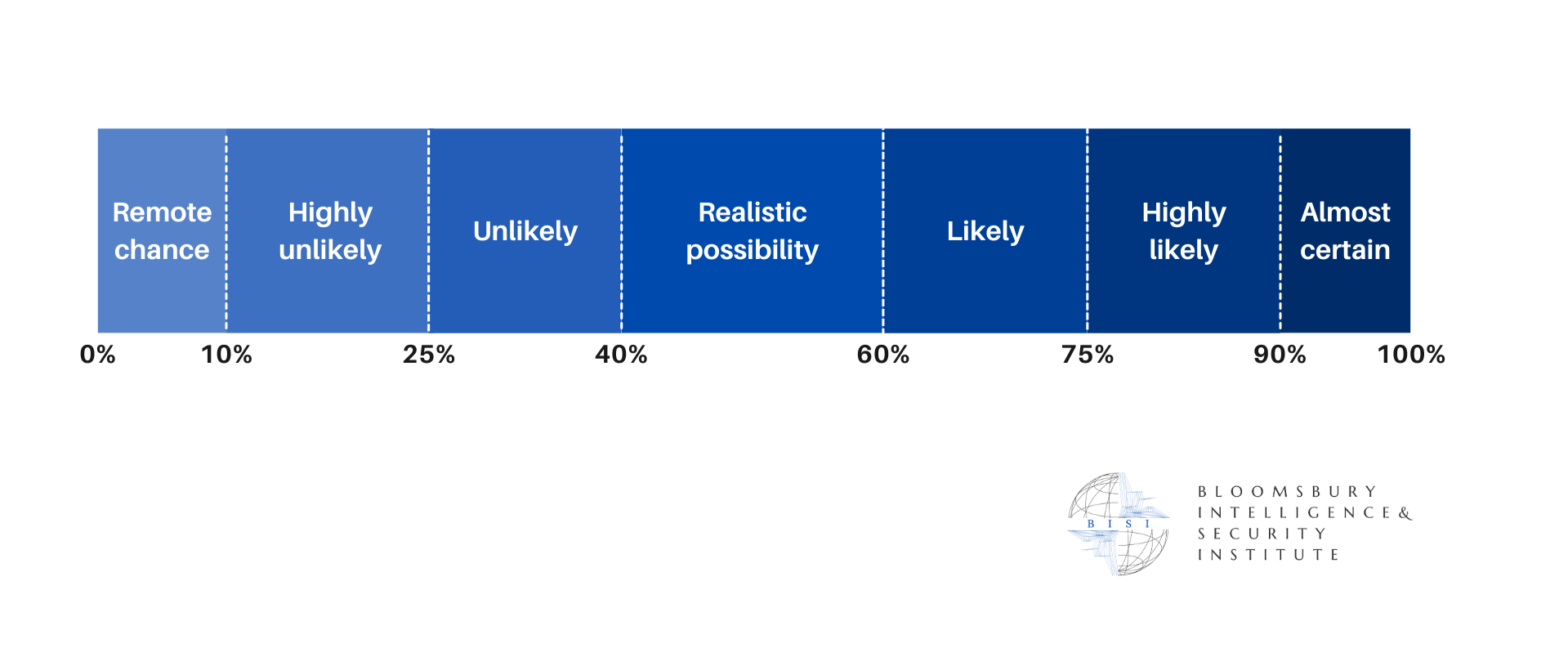
The provisional deal is highly likely to be formally ratified by the European Parliament and Council, providing legal certainty for businesses planning their 2027 budgets.
An upward trend in AI integration projects within the European machinery and manufacturing sectors is likely, as "double-regulation" fears subside.
Medium-term (3 - 12 months)
The ban on nudifier apps is highly likely to take effect, including high-profile takedown orders and the first major fines under the revised penalty structure for providers of prohibited AI systems.
A surge in demand for digital provenance and watermarking technologies is likely, as providers will scramble to meet the December 2026 deadline for AI-generated content.
Long-term (>1 year)
The EU is likely to face internal friction as different sectors (medical vs. industrial) experience varying levels of regulatory problems, potentially leading to further "Omnibus" packages to fix remaining overlaps.