By Elisa Guillen | 9 November 2026
Summary
The results of the Israeli election left the country in a political deadlock, with no clear prospect of forming a coalition, and a return to the polls is likely.
Regardless of the government, variations between parties tend to be more tactical than in terms of their vision for the country. The main implication of the election is political instability.
The political deadlock is likely to constrain the government and lead it to prioritise its own political survival.
Context
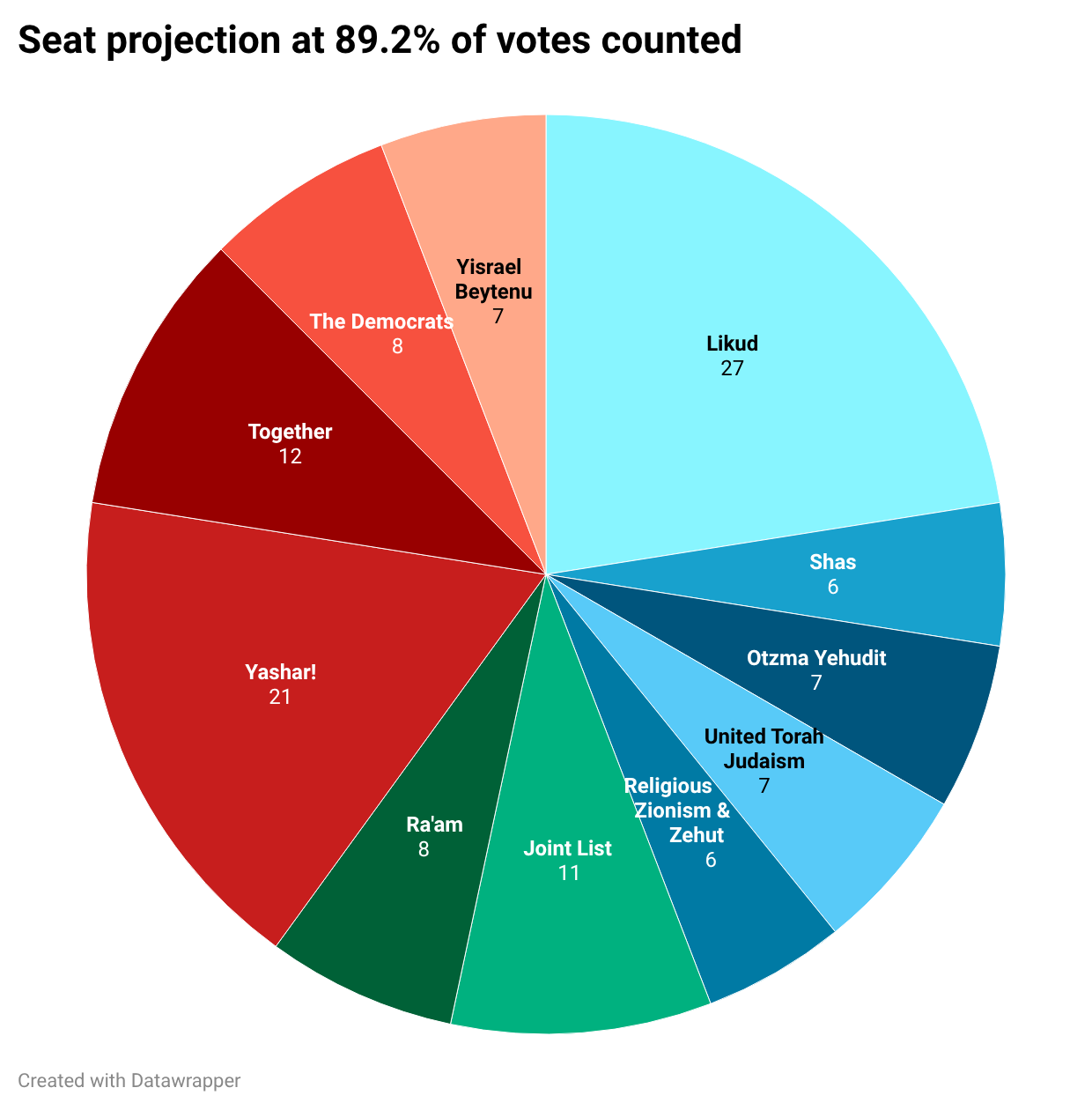
On 27 October 2026, the Israeli elections took place, resulting in no party achieving a clear majority. The political landscape consists of 3 main blocs: Netanyahu’s bloc, comprising Likud, United Torah Judaism, Shas, and Otzma Yehudit; the opposition coalition led by Eisenko, comprising Yashar, Together, Yisrael Beytenu, and the Democrats; and the Arab parties, including the Joint List and Ra’am. The election saw a historic turnout of 77%, with Arab voters contributing notably. Netanyahu’s bloc won 53 seats, the opposition won 48 seats, and the Arab parties won 19 seats, a historically high result. The turnout was also due to the votes of Israelis living abroad. As Israel does not allow remote voting, 70 000 Israelis were expected to travel to Israel to vote due to the stakes of this election. In the event of new elections at short notice, such a turnout may not be repeated.
The Israeli electoral system is not designed to accommodate a minority government. To be instituted, a coalition needs 61 seats. Therefore, neither Netanyahu’s bloc nor the opposition bloc can form a government without either collaborating with each other or with the Arab parties. If no coalition is formed, Netanyahu will remain in power until new elections are scheduled. If no bloc has formed a government after approximately 100 days, Israelis will be asked to vote again. Netanyahu’s bloc and the opposition bloc ruled out forming a coalition with the Arab parties before the elections. Opposition bloc’s leaders also stated that they were ruling out the possibility of joining a coalition led by Netanyahu.
Implications
Political scenarios:
The results of the Israeli elections do not clearly indicate what the future holds for Israel. As no bloc has a clear majority, several outcomes are plausible. It is likely that no bloc will be able to form a government, leading to new elections and Netanyahu's government continuing for the next few months, giving him an advantage. He is more likely to adopt extreme attitudes to remain in power. Escalation of the war with Iran or the use of threats as a bargaining tool would pressure Eisenkot into a unity government in the name of national security. Another possibility is that the opposition bloc will form a more or less formal alliance with the Arab parties. Following Netanyahu’s bloc's failure to obtain a majority, opposition party leaders claimed victory, which implies an alliance with the Arab parties. However, other leaders have openly rejected the idea, which renders the scenario unlikely. Even if the coalition were to form a government, it would be unlikely to last. A coalition with the Arab parties would likely destabilise the opposition bloc from within, exacerbating the parties' already significant differences. The last remaining possibility is that some of the parties would leave their blocs to form a new coalition. As the opposition bloc was formed as a rejection of Netanyahu’s government and his military exemption policy for ultra-Orthodox Jews, this is also unlikely to happen. All of these possibilities would have serious consequences for the political parties, as forming a government would require them to break their campaign promises. Anything remains possible, but a new election appears to be the most likely outcome.
Implications in the Middle East:
No matter how the situation unfolds, little change is to be expected for Israel’s nearest neighbours. The military occupation of South Lebanon and the Golan Heights in Syria is highly unlikely to end. The importance of a ‘buffer zone’ is widely accepted in the Knesset. Consequently, normalisation with Syria is highly unlikely, as al-Sharaa refuses to consider it unless there is a withdrawal from the occupied territories. There is also no prospect of a Palestinian state forthcoming. However, there are notable differences between Netanyahu’s and Eisenkot’s positions regarding the war in Iran and the occupation of the West Bank, particularly in tactics. Eisenkot plans to maintain the occupation of the West Bank while limiting major projects, such as the E1 settlement plan, which involves enlarging illegal Israeli settlements to divide the West Bank in two. He also intends to limit settler violence. On Iran, Eisenkot takes a cautious approach. He wants to target Iran if there are signs of significant progress in the Iranian nuclear programme, unlike Netanyahu, who seeks regime change. Both leaders are striving for the same objective, but differ in their methods.
The political deadlock in Israel is highly likely to cause long-lasting instability in a country facing external threats and internal unrest. The greatest consequence of this situation may be instability, rather than the governing parties. Whether it is Netanyahu’s bloc in a caretaker government, or Eisenkot in a weak coalition, leaders will be constrained and likely to act with careful consideration of their political survival rather than make long-term plans.
Tiia Monto/wikimedia, CC BY-SA 3.0
Forecast
Short-term (Now - 3 months)
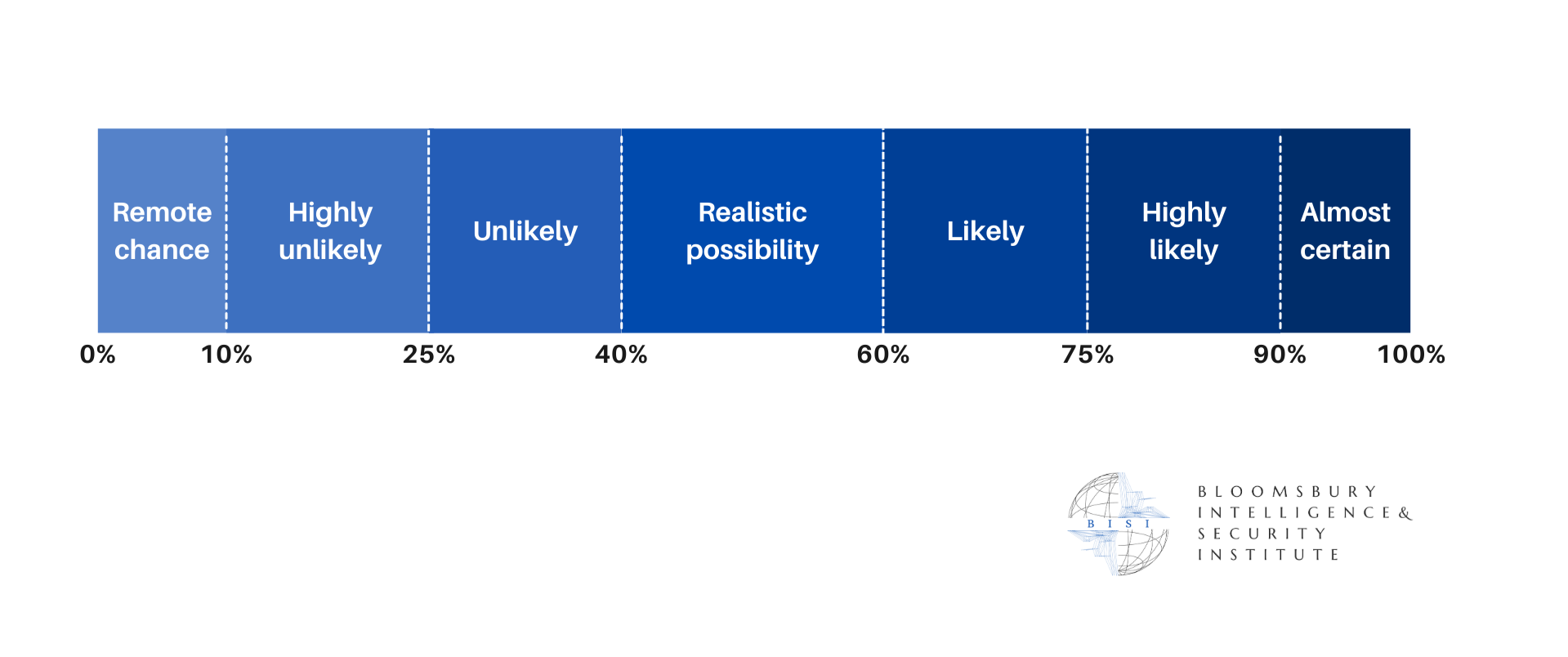
It is almost certain that Netanyahu will remain in power for around a month while coalitions successively try to form a government. He is also likely to remain in power for the next 6 months during the transition period. In order to secure his continued leadership, he is likely to adopt a more aggressive posture by invoking security reasons. This would lead to further instability in the region.
Medium-term (3 - 12 months)
New elections are likely to occur.
In this case, the caretaker government will likely face growing resentment if escalations with Iran or Lebanon bring visible costs, such as casualties or economic disruptions.
However, there is a realistic probability that prolonged instability would push the main parties towards forming a unity government in the face of security threats, particularly if the situation with Iran deteriorates.