Gang Governance and State Erosion in Haiti
By Gabriel Perkins | 11 May 2026
Summary
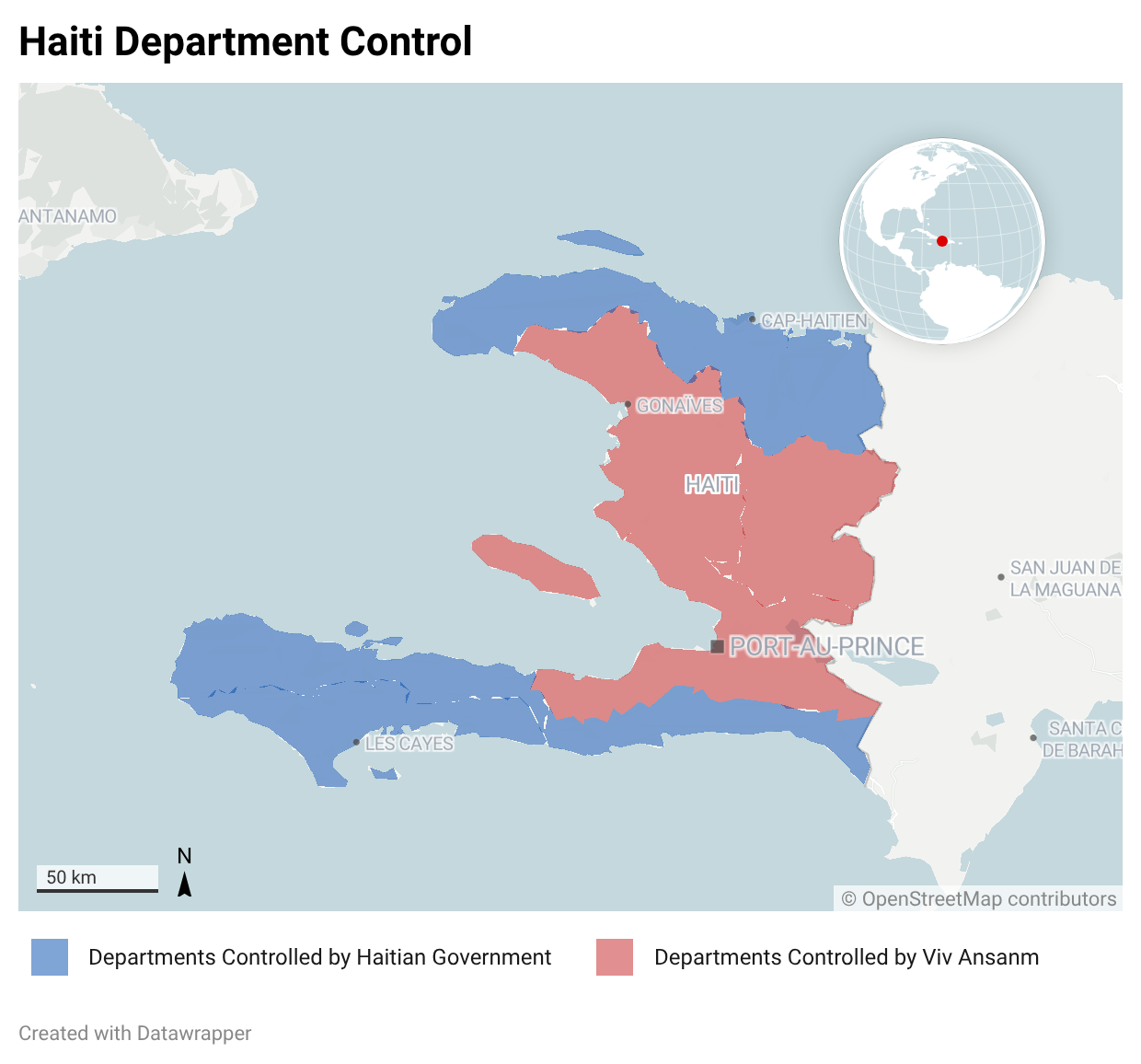
Viv Ansanm, a coalition of Haiti's two dominant gang factions, formed in September 2023, controls over 90% of Port-au-Prince and has expanded into 3 of the country's 10 departments, displacing 1.4m people and producing at least 4,384 deaths between January and September 2025.
Territorial consolidation has enabled the construction of a parallel governance structure built on systematic extortion, forced displacement, and deliberate infrastructure destruction, directly undermining both the acting government and the UN-authorised Gang Suppression Force's capacity to restore state control.
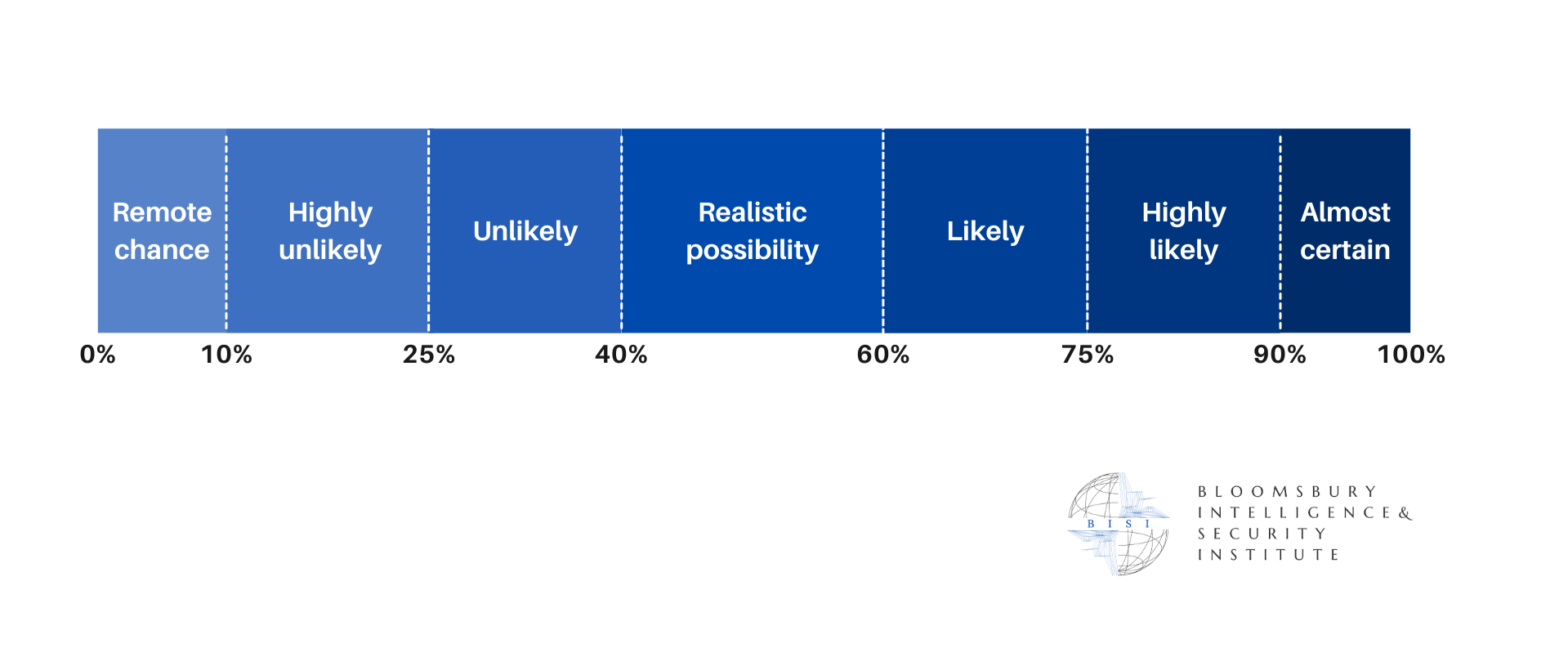
Viv Ansanm is highly likely to exploit the political transition ahead of elections scheduled for 30 August 2026, seeking to embed criminal actors within formal institutions if no credible demobilisation framework is established.
Context
Viv Ansanm (VA), formed in September 2023, is a merger of Haiti’s G-9 and G-Pèp gangs under the leadership of Jimmy Chérizier. Chérizier is a former elite police officer in the Haitian National Police (HNP). Since February 2024, VA has been coordinating large-scale offensives against state institutions. They have since consolidated control over more than 90% of Port-au-Prince and expanded into the Artibonite, Centre, and West departments, 3 of Haiti's 10 departments.
During the period January 2025 to September 2025, Haiti recorded at least 4,384 deaths, 1,899 injuries, and 491 kidnappings linked to criminal groups. In January 2025, VA launched an attack on the strategically positioned commune south of Port-au-Prince, Kenscoff. The United Nations Security Council (UNSC) estimates that between 90 and 150 people were killed, and another 3,139 people were displaced. In May 2025, the United States Department of State designated VA as a Foreign Terrorist Organisation (FTO). In July 2025, the UNSC imposed sanctions on VA.
Implications
VA’s transition from being a criminal enterprise to becoming a governance actor demonstrates a structural change in Haiti’s security landscape. In the territories under VA control, the organisation has imposed systematic extortion regimes on residents, businesses, and road networks. Through these regimes, they have been able to replace state revenue functions and now have a criminal taxation network instead. The model is self-reinforcing; each territory that is gained generates more revenue in extortion and funds future expansion. VA's sustained pressure on Pétion-Ville, Port-au-Prince's financial and administrative hub, threatens the last functional concentration of formal economic activity in the country.
The Gang Suppression Force (GSF), which replaced the former Multinational Security Support mission via UN Security Council Resolution 2793 in October 2025, has an authorised personnel ceiling of 5,500 uniformed officers but currently only operates with approximately 1,000, as the states that contribute to the GSF withdraw their troops due to deployments coming to an end. Coordination failures between the GSF and the HNP exacerbate the already large operational deficit. With 5.7m people facing acute food insecurity and humanitarian supplies distributed by VA-controlled networks, supply shortages are compounding across the West, Centre, and Artibonite departments.
VA's political repositioning has introduced a distinct governance risk. They have declared their intention to form a political party and have submitted a letter to the UN secretary-general's special representative requesting negotiations. They are framing themselves as a legitimate political stakeholder. With general elections in Haiti scheduled for 30 August 2026, VA is working to place allies within the successor administration and secure broad amnesty. Haiti's acting government under Prime Minister Alix Didier Fils-Aimé remains divided on whether they should engage with VA or not. This is creating a political opening that VA is well-positioned to exploit.
The regional dimension to Haiti’s gang governance is also significant. The displacement of 1.4m people has increased migration pressure on the Dominican Republic (DR) as well as the wider Caribbean region through maritime routes. This increase in migration from Haiti to the DR has also increased tensions between the two states. VA becoming an FTO establishes a legal base for extraterritorial prosecutions, but a coordinated regional interdiction framework has not been created.
Forecast
Short-term (Now - 3 months)
It is highly likely that VA will intensify pressure on Pétion-Ville and escalate extortion operations ahead of the 30 August 2026 elections, given the GSF's severe personnel shortfall and the HNP's demonstrated inability to sustain counter-operations without international support.
Medium-term (3 - 12 months)
There is a realistic possibility that the VA will succeed in placing political allies within Haiti's electoral infrastructure ahead of 30 August 2026, formalising criminal influence within state institutions if no demobilisation framework is implemented before candidate registration closes.
Long-term (>1 year)
It is likely that, in the absence of a fully deployed GSF and a credible institutional disarmament process, VA's governance model will consolidate across at least 4 of Haiti's 10 departments, presenting Caribbean Community (CARICOM) member states with a nominally sovereign state substantively controlled by an FTO-designated actor.