Colombian Election Preview
By Rapahel McMahon, Gabriel Perkins, Jonathan Tenhove, Max Brockdorff | 8 May 2026
Summary
Presidential elections are scheduled for 31 May 2026. Outgoing President Gustavo Petro, elected in 2022 as Colombia's first left-wing president since independence in 1810, is constitutionally barred from seeking a consecutive second term. If no candidate secures over 50% of first-round votes, a runoff takes place on 21 June 2026.
On 8 March 2026, coalition primaries ran alongside legislative elections. Paloma Valencia won the centre-right Gran Consulta with 3.23m votes, representing nearly 46% of all ballots cast across the 3 primaries. The centre-right coalition won 4 out of 5 votes cast, making it the dominant force entering the first round.
The campaign has been plagued by political violence. A wave of attacks, including the kidnapping of a senator and the assassination of presidential candidate Miguel Uribe Turbay, the first killing of a Colombian presidential candidate in over 30 years, has led all remaining candidates to scale back public campaigning out of security concerns. Over 60 political and community leaders were killed during the campaign period, with more than 126,000 law enforcement officers deployed to secure the 8 March elections.
Country Profile Data
GDP: 418.82bn
GDP per capita: 7919.2
HDI: 0.788
Official Currency: Colombian Peso
Population: 52,886,363
Ethnic Composition: Mestizo (50.3%), White (26.4%), Indigenous (9.5%), African Colombians (9%), Mulattos (4.4%)
Religious Composition: Roman Catholic (64%), Protestant (17%), no religion (14%), atheist/agnostic (2%), other (2%)
Major Candidates
Iván Cepeda (Historic Pact, Left)
Cepeda is a senator and human rights activist, born in Bogotá in 1962. Cepeda won the Historic Pact's internal primary in October 2025 with 65% of the vote, defeating former health minister Carolina Corcho, with his campaign built around continuing Petro’s "Total Peace" policy, agrarian reform, and protecting judicial independence.
The Historic Pact secured over 4.4m votes for the Senate in the 8 March legislative elections, making it the dominant parliamentary force and providing Cepeda with significant legislative backing. He announced indigenous leader Aida Quilcue as his running mate, reinforcing his coalition's ties to social and ethnic movements in the Cauca region. He presents himself as the guarantor of Petro's reform programme, polling best among younger voters and in Caribbean and Pacific coastal departments.
Despite leading polls, Cepeda’s negative ratings are among the highest of any public figure. His association with Petro’s security record has contributed to this, risking pushing centrist voters toward the moderate right ahead of the 31 May first round.
Paloma Valencia (Democratic Centre, Centre-Right)
A senator since 2014 and granddaughter of former President Guillermo León Valencia (1962 to 1966). Leading voice of the No campaign against the 2016 FARC peace deal. She represents the more technical wing of Uribismo (the political movement associated with former President Álvaro Uribe, centred on hardline security policy and economic conservatism), emphasising decentralisation, institutional reform, and innovation policy.
Her economic agenda prioritises lower taxes, private investment, and expanded energy generation, including through geothermal and nuclear energy production, alongside a pledge to improve 10,000km of rural roads. On security, she proposes an international alliance between Colombia, the United States (US) and Europe to confront drug trafficking and calls for a coordinated response from major cocaine consumer-market economies.
Her standing strengthened considerably after her primary victory, with post-primary polling placing her at around 20%, up from single figures before 8 March. Her closest primary runner-up, centrist Juan Daniel Oviedo, joined her ticket as running mate, boosting her appeal among moderate voters.
Abelardo de la Espriella (Defensores de la Patria, Far-Right)
A Colombian-Italian criminal defence lawyer and supporter of US President Donald Trump, Argentinian President Javier Milei and Salvadoran President Nayib Bukele. His policy proposals favour shrinking the state, lowering taxes, cutting business regulations, and aggressive military action against armed groups, including bombing "narco-terrorist camps" and fumigating coca plantations with the assistance of US aircraft.
De la Espriella has built an international far-right network, meeting Santiago Abascal, the leader of Spain’s Vox party, and participating in the Foro de Madrid, an alliance of conservative movements aligned with Argentina’s President Javier Milei, Chile’s José Antonio Kast, and Italy’s Giorgia Meloni.
His combative social media presence, built on short, forceful phrases that spread as viral videos, has allowed him to connect with younger voters who consume politics through digital platforms. He adopted the slogan "with a firm hand, but a smaller heart," a deliberate reinvention of Uribe's Democratic Centre motto, positioning himself explicitly to the right of established Uribismo.
Comparative Analysis
There is a central divide between Cepeda on the left, representing the continuation of Petro’s project and De la Espriella and Valencia, the right-wing candidates, both competing for the anti-Petro vote, but are split between far-right populism and centre-right institutionalism. Security and territorial control are key voter concerns, with 73% of Colombians saying the government has lost control to armed groups. This puts Cepeda at a disadvantage and benefits any candidate widely trusted on the law-and-order issue. Valencia’s victory in the primaries and Oviedo’s selection as her running mate position Valencia as the most capable candidate to consolidate the moderate conservative vote as well as hardline conservative voters, threatening De la Espriella’s ability to unify the right. Fragmentation in the centre, with López at 1.7% and Fajardo at 7.8%, reflects a broader failure by centrist candidates to capitalise on voter fragmentation. This pattern is consistent with the 2018 and 2022 elections. The outcome of the right's internal consolidation between Valencia and De la Espriella is the single most consequential variable before 31 May. A divided right-wing vote is the clearest path to a Cepeda first-round lead and a polarised runoff.
Implications
Domestic
Iván Cepeda
Cepeda has explicitly stated that he will maintain the domestic policy framework of Petro for dealing with internal armed conflict. Most notably he shall continue to apply the Total Peace framework that pursues diplomacy rather than military action to deal with armed groups - such as Revolutionary Armed Forces of Colombia (FARC) and the National Liberation Army (ELN). This policy has had some moderate success under Petro in reducing conflict between the state and armed groups. However, the removal of military pressure on armed gangs has encouraged intergroup fighting between paramilitary groups, as well as allowing these organisations to bolster their illicit revenue streams - such as drug trafficking and illegal mining. Additionally, without the need to fight the government, gangs have diverted resources more effectively to target civilians - evidenced by kidnappings in 2023 reaching their highest level in eight years.
Like Petro, Cepeda will aim for lower economic dependence on oil, and focus on industrialisation, technological innovation, and strengthening of agriculture. Under Petro, Colombia’s economy grew moderately, reaching 2.6% in 2025, up 0.3% from 2024. This is attributed largely to increased household and retail trade, which grew by 4.6%, a rise of 4.5% in public spending and a 3.1% hike in agriculture - primarily by exports of fruits and fish. However, the oil industry has contracted by 4.3%, likely due to the government reducing exploration contracts for oil and gas as part of climate change initiatives. This contraction will likely continue under Cepeda, who has stated that he wants to shift the Colombian economy away from extraction entirely.
Under Cepeda, Colombia is likely to experience moderate economic growth, the decline of FDI under Petro is likely to continue. The lack of historical success of the Total Peace framework suggests that Cepeda will have limited success in dealing with armed groups, leading to widespread demand for military action, likely precipitating incumbency fatigue for his party. Subsequently, activities of guerrilla, drug trafficking and paramilitary groups are likely to remain high, prolonging domestic instability.
Paloma Valencia
Paloma Valencia seeks to move significantly away from Petro's domestic policies, both in terms of economics and security, adopting a hardline approach to illicit networks and austerity measures to reduce the size of the government, while focusing on creating a more business-friendly Colombia.
Valencia's plan to combat criminal organisations in urban areas as part of Plan Colombia 2.0, by integrating artificial intelligence and targeted policing to disrupt illicit activity, similar to that of former President Alvaro Uribe. However, much like Espriella, she will likely suffer from a lack of corresponding social policy to reintegration and tackle criminal organisations long term. Economically, Valencia has expressed a desire to boost Colombia's energy production through heavy investment in renewables, notably geothermal and nuclear energy. However, she has also expressed a desire to boost fracking and fossil fuel production, a significant contradiction of Petro's existing policy to end fossil fuel dependency by 2034.
Valencia's opposition to the 2016 FARC Peace Accords - partly due to what was perceived as overly lenient treatment of guerrilla fighters - will likely destabilise regions where former FARC members are attempting to reintegrate, prompting an increase in violence within rural communities. The lack of social integration for former participants in illicit activities could lay the foundation for future gang recruitment and raises concerns about the depth of commitment to rural development, as farmers would receive redistributed land as part of the peace accords. She has addressed this by committing to significant infrastructure upgrades to rural communities, notably 10,000 km of new roads as a means to connect the government to rural communities where paramilitary groups are most influential. However, moving away from the 2016 peace accords may contradict progress in rural areas by limiting societal integration of former guerrilla fighters, possibly leading to increased gang violence or illicit activity. Acquiring funding for this will also prove difficult, given tax deductions and a reduction in government size.
Ultimately, Valencia has a clear goal of making Colombia more business-friendly, however, her dedication to austerity is not consistent with her broader policy agenda on illicit activity and rural development. Similarly to Espriella, her approach to gangs will be perceived as hardline, but with such an emphasis on security and little thought given to social mobility, it is unlikely that her government would be successful long-term in dealing with armed groups.
Abelardo De La Espriella
Abelardo De La Espriella stands as the most controversial candidate, marketing himself as a Trump-style economic reformer and a proponent of mass military operations to dismantle illicit activity. He aims to cut the government by roughly 40% and encourage economic growth through reduced corporate taxation. This has drawn extensive criticism, as reducing corporate taxes and government regulation would exacerbate Colombia's income inequality.
Espriella aims to launch mass military operations to dismantle illicit armed groups, including aerial bombardments and fumigation of coca fields, likely increasing violence in the short term as paramilitary groups engage government forces, and sustained military pressure may gradually erode government military resources, compelling them to negotiate. Furthermore, paramilitary groups have grown significantly wealthier under Petro, bolstering their capacity for armed conflict, making nationwide violence a likely consequence. His strategy offers no formal social reintegration for former criminals, instead opting for Bukele-style mass prison infrastructure, which, without structures of rehabilitation, risks prolonging the recruitment pipeline for illicit organisations. Minor concessions such as crop substitution programmes will also prove difficult to implement alongside extreme austerity.
Espriella's approval rating would likely be high at the outset of his presidency due to populism, perceived as a break from years of decline under Petro. However, his hardline approach and neglect of social issues will quickly diminish his popularity. Heavy opposition from Historic Pact would further limit his ability to implement policies at the scale he is campaigning for, making a significant increase in short-term instability the most likely outcome of his government.
Geopolitics
Iván Cepeda
In the event of a Cepeda presidency, Colombian foreign policy would follow on from his predecessor Petro’s approach. Cepeda’s similar ideological outlook would see a continuation of tense diplomacy with the US, with a realignment to reduce Colombia's reliance on security and economic aid. Cepeda and Petro’s approach to anti-drug campaigns, focused on tackling coca farming, directly contradicts Trump’s militarised anti-drug campaign. This approach focuses on peaceful relations with armed groups, and so while a Cepeda presidency would likely see continued stability in relatively low homicide rates, kidnapping and extortion will likely remain at their currently high levels. Furthermore, their alignment with former Venezuelan President Nicolas Maduro places Colombia under even greater pressure, as it has already been regionally isolated.
However, a level of cooperation with the U.S. will remain, even in the event of a Cepeda presidency, due to Colombia's deep reliance on U.S. financial aid. Realignment involves a pivot towards China, instigated by Petro, having joined the Belt and Road Initiative in 2025. Cepeda as President would see a continuation of this pivot, deepening economic relations with China while simultaneously reducing reliance on US and European aid.
Paloma Valencia
Valencia’s Presidency would see a return to Uribe-era foreign policy, characterised by strong cooperation with the US, especially in anti-drug and anti-militia activity. Her platform focuses on renewed US cooperation, seeking a new Plan Colombia to strengthen the Colombian state and armed forces with US aid. Under Petro, paramilitary groups have gained significant power even as violence has declined, something Valencia seeks to change. Her platform would deepen security ties with the US and Europe significantly, like the policies of her ideological predecessor, former President Alvaro Uribe. Her more hawkish approach to criminal networks and paramilitaries will likely not reach the same level as the often-controversial Uribe due to her more moderate stance. But it is likely to spark an increase in violence amidst the crumbling peace process. The extent to which she can achieve this stance is uncertain, especially with the Historic Pact dominating Congress. A softer stance than Petro towards the US is highly likely in the case of Valencia’s Presidency, paired with a pragmatic China policy similar to Uribe, centred around trade and economic cooperation.
Abelardo De La Espriella
Espriella’s geopolitical stance is by far the most hawkish of the main candidates, driven by his ideological alignment with right-wing populist leaders like Donald Trump in the US or President Nayib Bukele of El Salvador. He would renew relations with Israel after Petro broke them off in 2023, revitalising arms sales from Israel to Colombian security forces. This would occur alongside similar policies regarding the US. Espriella’s extremely hard stance on public security would potentially involve allowing US troop interventions on Colombian soil, likely leading to an extension of Trump’s militarised War on Drugs. Increased violence against and by Colombian guerrilla, paramilitary and drug trafficking groups would be highly likely in this scenario, renewing violence that has characterised the country for the last 50 years. Again, the extent to which he could achieve these policy proposals without Congressional support is uncertain due to Historic Pact’s recent electoral success. However, renewed relations with the US and Israel would be highly likely in the event of Espriella winning in May.

Scenarios
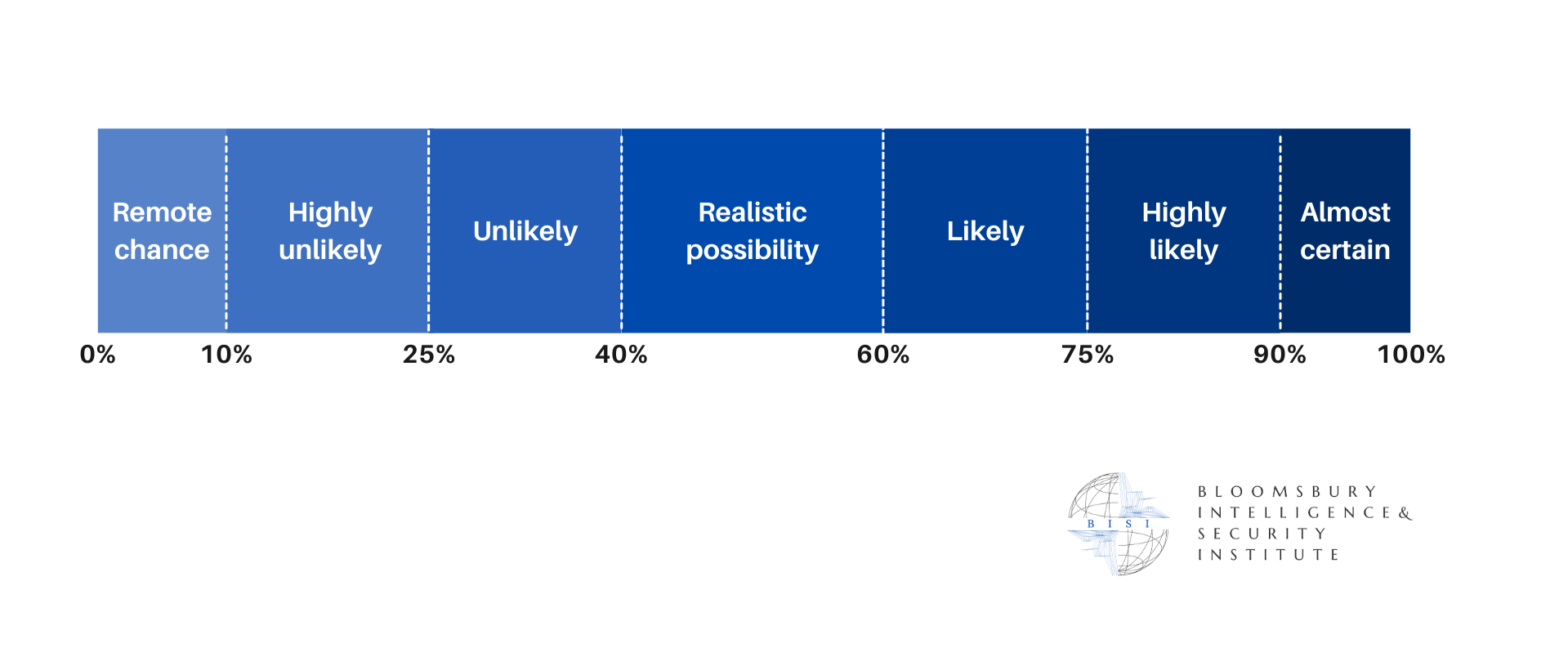
Scenario 1: Right-Wing Consolidation and Security Reorientation (Likely: 60-75%/High Impact)
It is highly likely that no candidate will secure over 50% of the vote in the first round on 31 May 2026, producing a runoff between the two leading candidates on 21 June. It is highly likely that the centre-right vote will consolidate behind Senator Paloma Valencia of the Democratic Centre party following her primary dominance, positioning the runoff as a contest between left-wing continuity under Senator Iván Cepeda of the Historic Pact and a Valencia-led centre-right government. A Valencia victory would mark the most significant reorientation of Colombian security and foreign policy since President Gustavo Petro took office in 2022.
Potential impacts: It is highly likely that the United States (US) and Colombia security cooperation will be restored, including the anti-narcotics certification and intelligence-sharing arrangements suspended under Petro. Negotiations with the National Liberation Army (ELN) and Fuerzas Armadas Revolucionarias de Colombia (FARC) dissidents are likely to collapse, increasing the risk of renewed armed conflict in rural departments. Investor confidence is likely to improve in the short term, given Valencia's commitment to lower taxes and private investment. It is likely that Historic Pact social reforms, including the 2025 labour reform and pending healthcare legislation, will be reversed or significantly weakened in the 2026 to 2028 legislative period.
Scenario 2: Cepeda Victory and Left Continuity (Realistic Possibility: 40-60%/High Impact)
There is a realistic possibility that Cepeda wins the presidency through a runoff on 21 June 2026, contingent on the right-wing vote remaining split between Valencia and Abelardo de la Espriella of the Defensores de la Patria movement through to the second round. A Cepeda victory would represent a consolidation of the progressive project initiated by Petro, with Cepeda presenting himself as a more institutionally grounded successor. The Historic Pact secured over 4.4m Senate votes on 8 March 2026, giving Cepeda significant but not majority legislative backing.
Potential impacts: It is likely that the Total Peace negotiation framework with the ELN and FARC dissidents will be maintained. However, it is unlikely to produce a signed agreement within 12 months, given the breakdown of talks under Petro. US and Colombian relations are likely to remain strained, with a realistic possibility of further sanctions or diplomatic pressure from the Trump administration. There is a realistic possibility that stalled labour, healthcare, and pension reforms will be resubmitted to Congress, where fragmentation will limit their passage. It is highly likely that political polarisation will intensify domestically, as a Cepeda victory will be contested by a right-wing opposition emboldened by its combined primary performance.
Scenario 3: De la Espriella Surge and Far-Right Presidency (Highly Unlikely: 10-25%/High Impact)
It is highly unlikely that De la Espriella maintains his pre-primary polling position through to the first round, given Valencia's strong 8 March primary result and former President Álvaro Uribe's institutional backing of her candidacy. However, there is a realistic possibility that his social media campaign and anti-establishment appeal produce a stronger first-round result than current post-primary polling suggests, placing him in the runoff on 21 June. A De la Espriella presidency would represent a significant shift toward far-right populism, consistent with the regional trend seen in Argentina and El Salvador.
Potential impacts: It is highly likely that the Total Peace policy would be immediately abandoned, with military operations against the ELN and FARC dissidents resumed, significantly increasing the risk of violence in conflict-affected departments in the short term. It is likely that De la Espriella would seek rapid alignment with the Trump administration on drug trafficking, potentially including support for aerial fumigation operations over coca-producing regions. There is a realistic possibility that institutional oversight of the executive would be weakened, given his lack of a formal party structure and reliance on a personalised political movement with no congressional majority. It is highly unlikely that his administration would secure stable legislative support, making governance delivery highly uncertain across the 2026 to 2030 period.