Emerging Technology and the Decline of Arms Control Verification
By Rakotoarimanga Tinah | 8 June 2026
Summary
The expiration of New START on 5 February 2026 has removed the final binding transparency framework governing US and Russian strategic nuclear forces
This comes at a time when all 3 major nuclear powers are deploying hypersonic systems and integrating AI into command-and-control (CAC) structures, technologies that are increasingly difficult to monitor through the inspection and telemetry mechanisms on which previous arms control frameworks relied.
As AI enabled systems become increasingly widespread in both civilian and military contexts, it’s harder to separate them out. It matters because when you combine that with the dual use nature of AI decision support systems and the uncertainty around what hypersonic glide vehicles are actually carrying, it becomes much harder to check compliance using the usual arms control methods like inspections or data sharing
Context
Nuclear arms control agreements have traditionally rested on the assumption that strategic weapons are visible and tied to physical infrastructure. Warheads sit on missiles, they’re deployed in silos or submarines, and both sides can monitor them using satellite imagery, inspections, and telemetry exchanges.
Agreements such as the Intermediate Range Nuclear Forces (INF) treaty and the New START were built around this logic. Those transparency measures allowed each side to maintain a degree of predictability about the other's force posture.
The verification problem has been around for decades, and the New START treaty was designed for a strategic environment centred on ballistic systems and fixed launch platforms. Weapons travelling on non-ballistic trajectories for more than 50% of their flight, including hypersonic glide vehicles and hypersonic cruise missiles, largely fell outside its scope.
By the time the treaty expired, all 3 major nuclear powers were already moving beyond the technological assumptions on which it had been built. Russia had deployed the Avangard hypersonic glide vehicle through modified SS-19 systems, while China accelerated deployment of the DF-17. The US is now pursuing its own hypersonic nuclear delivery capability through the Next Generation Reentry Vehicle (NGRV) programme linked to the WXX warhead initiative. Existing arms control frameworks were not designed to monitor systems whose trajectories, payload configurations and launch profiles are significantly harder to classify through traditional verification methods.
The growing integration of AI into command, control, communications and intelligence (C3I) systems further complicates the issue. In March 2025, NATO acquired Palantir’s Maven Smart System to support AI enabled data fusion within Allied Command Operations, while Russia and China continue to expand automated decision support capabilities within early warning and targeting architectures. Unlike missile silos or launch platforms, software-based systems leave few observable indicators. Capabilities can evolve through software updates without visible changes to physical infrastructure, making verification significantly more difficult through conventional inspection regimes.
The result is an increasingly unstable strategic environment in which nuclear modernisation is accelerating across all 3 major powers while the institutional frameworks intended to regulate that competition remain tied to an earlier technological era. As transparency mechanisms weaken and verification becomes more difficult, strategic stability is likely to depend increasingly on assumption and threat perception rather than negotiated predictability.
Implications
Dual use verification problem
Arms control relied on material legibility as silos counted, submarines tracked, and delivery systems were identifiable within a shared physical framework.
AI enabled systems do not replace that architecture so much as dissolve into it; for example, software updates can alter command and control functions without any visible hardware change. The same system can sit across conventional and nuclear domains depending on configuration; from that, verification loses a stable object and regulation shifts away from something fixed and starts to look more like a moving capability.
On site inspection, central to earlier regimes like INF, does not translate to this environment. NATO’s TEVV framework acknowledges the issue, but remains internally bounded. There is no shared audit mechanism across adversarial contexts.
The payload problem
Hypersonic systems extend the same logic into delivery. Kinzhal, Tsirkon, DF-17 and the US Conventional Prompt Strike programme are all dual capable and deliberately ambiguous.
That ambiguity tends to push worst case thinking as soon as something is launched. Here, the problem is that verification systems were designed on the assumption that you could actually fix what the system is, and it doesn’t hold here.
The payload may only be known at impact, which removes verification from the decision window.
The tripolar counting problem
The structure can be perceived as more unstable in a tripolar setting. China’s nuclear modernisation operates outside any binding ceiling or inspection regime, and this introduces asymmetry into a system still designed around bilateral constraint.
Any US–Russia limitation now exists alongside an unconstrained third actor, and the effect is not only numerical but interpretive; for example, signals within one dyad are increasingly filtered through the posture of a non signatory third party, reducing clarity across the system.
A trilateral verification framework remains structurally out of reach under current conditions.
Modernisation as an institutional accelerant
Modernisation is moving faster than institutions can really keep up with. The US is deploying long range hypersonic systems in Europe and starting to bring AI into parts of nuclear command and control. NATO allies are also trying to speed up procurement so they can field new technologies faster, and each of these moves changes the picture as it happens. Any future agreement would already be trying to catch up, but the response from other sides is just as quick.
Missile deployments trigger upgrades in air defence and detection, which in turn accelerate counter–C2 and electronic warfare development.
Institutional timelines remain measured in years, and modernisation operates in months, so the gap between the two continues to widen.
Forecast
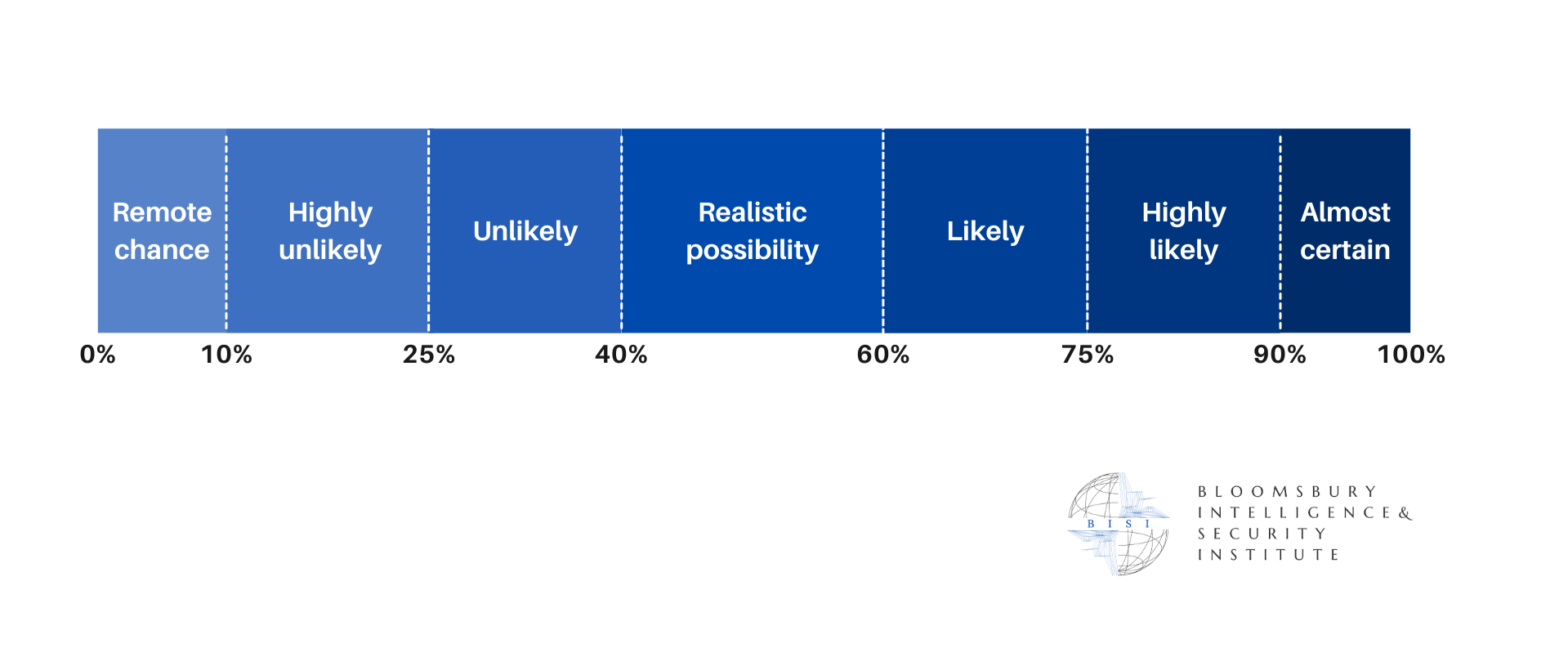
Short-term (Now - 3 months)
The rollout of new hypersonic systems across the US, Russia and China is likely to accelerate capability based planning as states rely less on declared posture and more on inferred intent. Deployments such as Dark Eagle in Europe are likely to trigger symmetrical responses framed as modernisation rather than escalation.
Strategic stability dialogue is highly unlikely to produce substantive outcomes. The absence of even a preliminary trilateral framework limits engagement to technical level contacts with no realistic path toward binding measures in this window.
Medium-term (3 - 12 months)
Stability is likely to become increasingly dependent on AI enabled early warning and C3I systems that remain opaque and only partially understood by external observers. Any disruption in these systems would be processed under compressed timelines, with limited contextual verification available.
Bilateral arms control is highly likely to weaken further as China’s unconstrained modernisation increasingly shapes US–Russia calculations. Any agreement excluding Beijing is likely to be viewed as structurally incomplete, limiting the viability of new confidence-building measures.
Long-term (>1 year)
A persistent gap is likely to emerge between the pace of AI and hypersonic deployment and the ability of institutions to build verification frameworks around them. Dual-use ambiguity and software defined capability make comprehensive inspection architectures technically unresolved in the current paradigm.
Strategic stability is likely to shift away from treaty based force counting towards system resilience and opacity. The key risk becomes not a discrete violation but the gradual loss of shared interpretive frameworks that previously underpinned deterrence stability.