Drone Warfare and Violence Against Civilians Escalate Ongoing Crisis in DRC
By Sarah Ambrose | 13 April 2026
Summary
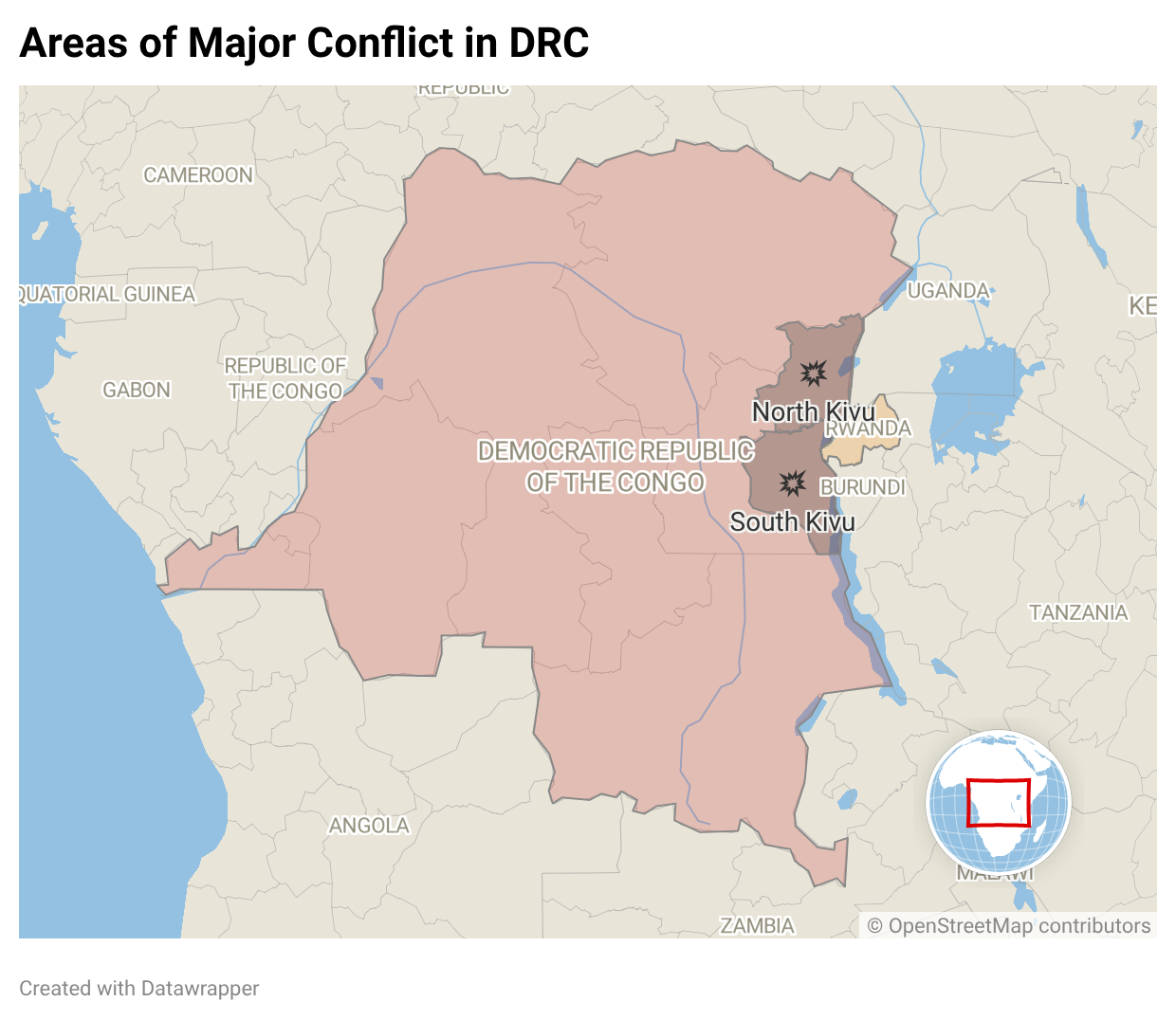
Violence against civilians and humanitarians is escalating in the Democratic Republic of the Congo (DRC), including an increase in the use of drones.
The DRC accuses the Rwandan government of supporting rebel militant groups in eastern DRC and fueling the conflict that has claimed 6 million lives since 1996.
It is highly likely that the ceasefire stemming from the 2025 Washington Accords will not be followed through by any side in the conflict.
Context
Drone warfare is increasing in the ongoing conflict in the DRC between the government and militant groups, in violation of a ceasefire agreed upon in the 2025 Washington Accords. In February 2026, 31 drone strikes were reported within the DRC, the highest monthly rate. These strikes disproportionately target civilians, including a French United Nations (UN) employee who was killed on 11 March 2026. On 26 March 2026, Vivian van de Perre, the Deputy Special Representative for Protection and Operations in the United Nations Stabilisation Mission in the Democratic Republic of the Congo (MONUSCO), issued a statement regarding the increase in drone usage and its impact on the escalating violence across eastern DRC.
Implications
The current conflict began with the resurgence of the March 23 Movement (M23) rebel group in 2022, following years of inactivity in the DRC. As the DRC and Rwanda are embroiled in a decades-long conflict, the DRC accuses the Rwandan government of financing and supporting M23’s operations, which Rwanda denies. Corroborating the DRC’s claims, the UN Human Rights Council (UNHRC) found evidence of the Rwandan Defence Force (RDF) providing support to M23, including RDF soldiers fighting alongside the militant group within the DRC. The continued surge in violence across the region in 2026 demonstrates a violation of the 2025 Washington Accords, a peace agreement between Rwanda and the DRC in which both governments committed to ending the conflict. As previous ceasefire efforts failed to bring about lasting peace, this trend in violence suggests the region risks a prolonged continuation of the conflict.
Civilians face significant danger as the regional violence escalates. Since the conflict’s beginning, over 6 million people have been killed, and seven million people have been internally displaced, fleeing violence in eastern DRC. Dating back to 1996, the conflict is bolstered by ethnic disputes, particularly between the Hutus and Tutsis, which often results in violence targeting non-combatants and children. An International Criminal Court (ICC) fact-finding mission concluded that all parties have committed violations that may constitute war crimes or crimes against humanity, such as torture, sexual violence, and the deliberate killing of civilians. Current drone usage frequently targets civilian areas such as apartment buildings in residential neighbourhoods, placing all residents of the region at risk.
The recent drone strike killing a UN worker marks an increase in violence against humanitarian workers in the DRC. In 2025, 13 humanitarian aid workers were killed in eastern DRC, compared to 9 in 2024. MONUSCO faced a series of violent local protests in 2022 and 2023 from anti-interventionists, and its mandate was terminated prior to a swift reversal from the UN Security Council to avoid a security vacuum. Due to recent funding cuts for global humanitarian efforts, van de Perre indicated that MONUSCO does not have the resources to carry out its additional new mandate of monitoring the recent ceasefire. Also, given the limited resources and ongoing violence against humanitarian workers, it is unlikely that interventionist efforts will be able to uphold the ceasefire and resolve the conflict.
Forecast
Short-term (Now - 3 months)
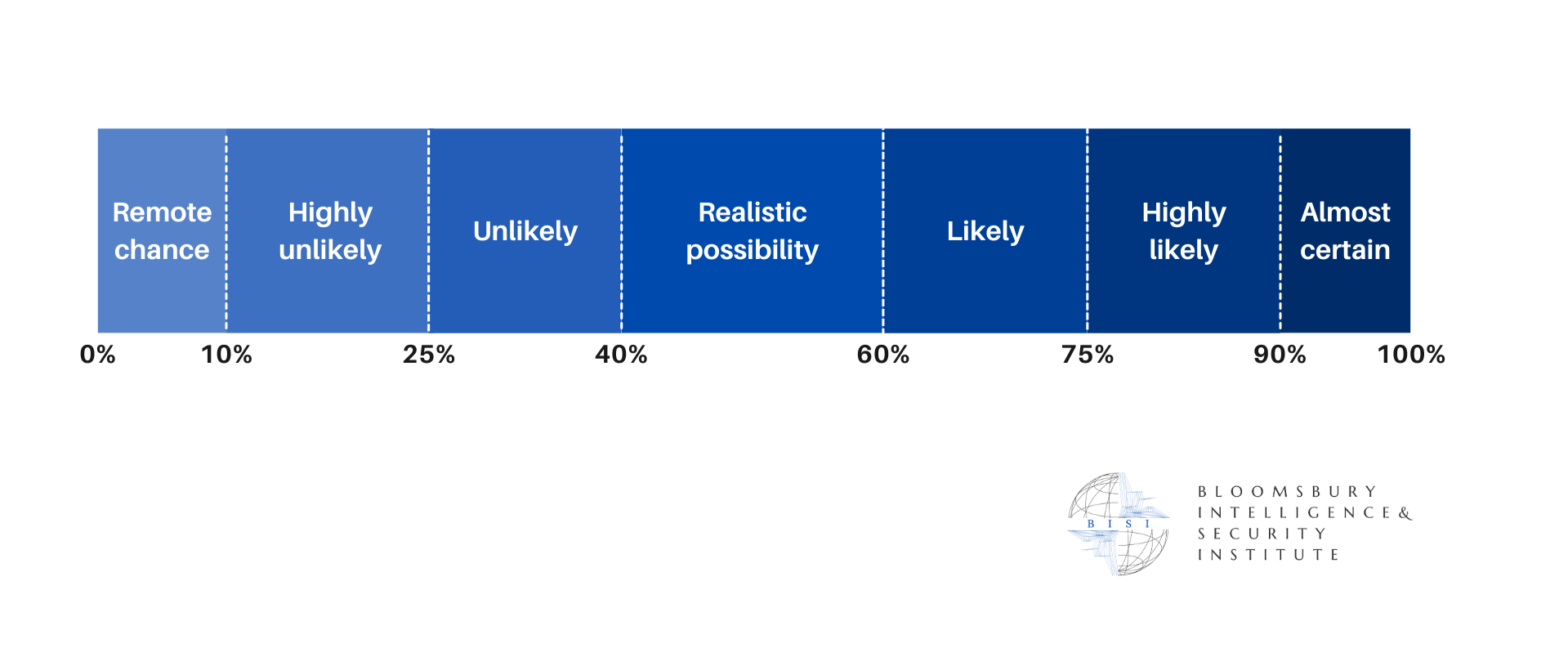
It is highly likely that the previously agreed upon ceasefire between the DRC and Rwanda will soon dissolve due to the continued violence.
It is highly likely that drone usage in the conflict will continue in the next few months.
Medium-term (3 - 12 months)
It is unlikely that Rwanda will increase its direct military engagement within the next few months, as its government denies a connection to M23 and maintains its disengagement from the conflict.
Long-term (>1 year)
It is highly unlikely that the conflict will be resolved within the next year or that any peace talks will result in lasting agreements.