A Neglected Nuclear Umbrella: Asia Proliferation Fears Amidst US-Iran Redeployments
By Larissa Alves Lozano | 13 April 2026
Summary
Due to the escalation of the Iran War, the United States (US) relocated some of its anti-missile defence systems from South Korea to the Middle East, jeopardising decades of defence assurances.
The mobility of the US’ nuclear umbrella in Asia has reignited fears over a nuclear domino effect to ensure permanent security, leaving its Asian allies vulnerable to North Korean and Chinese aggression and fearful of future asymmetrical wars blending conventional and nuclear missiles.
If the US remains unable to uphold its extended deterrence agreements and continues to over-extend itself across military conflicts, its extended deterrence nuclear umbrella will face irreparable physical and diplomatic damage.
Context
Since 2017, the US has provided South Korea with Terminal High-Altitude Area Defence (THAAD) anti-missile systems to deter and protect against missile attack threats by North Korea and China. This system has protected South Koreans and over 20,000 US military troops stationed in the country. THAAD is specially designed to shoot down short and medium-range high-altitude missiles (under 1,000 km to 5,000 km), such as nuclear ballistic missiles, which is key for protecting US interests from nuclear-armed adversaries.
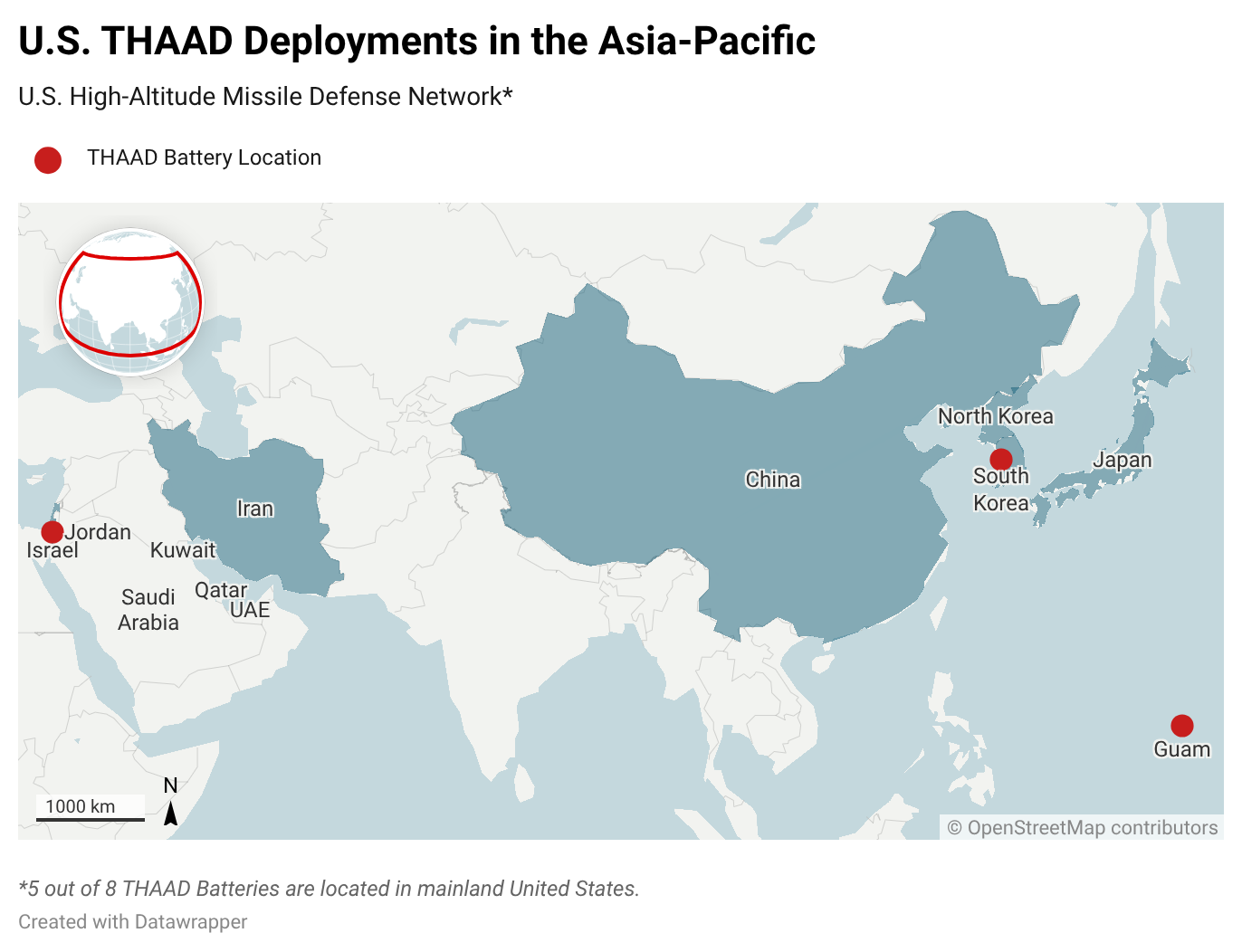
Based on a report by the US Congress, America operates about 8 THAAD systems deployed across Fort Bliss, Texas (3 batteries), For Cavazos, Texas (2 batteries), Israel (1 battery), Guam (1 battery), and South Korea (1 battery). Each battery has 6 launchers, totalling 48 interceptors (8 per launcher) to “hit-to-kill” incoming missiles identified through radar. These radars are located in various countries, such as Jordan, the UAE, and Saudi Arabia. It has been reported that some of these radars have been struck by Iranian forces, and the US is already running low on missile interceptors for its allies.
The relocation was met with local protests and fears of regional destabilisation, primarily in the face of growing North Korea and China missile tests. Leading up to the escalation in Iran and the THAAD relocation news, North Korea fired about 10 ballistic missiles towards the Sea of Japan, and China has continued its nuclear and military buildup. What was thought to be a permanent security assurance from the US has now been proven to be mobile, thus challenging the reliability of American nuclear security assurances and fueling independent missile defence and nuclear weapons ambitions in Asia.
THAAD Shifts: Precaution or Overbalancing?
THAAD deployments emphasise the crucial role of deterrence for security and raise alarm about regional stability, the longevity of the US’ nuclear umbrella, implications for nuclear proliferation in Asia, and a warning for the future of warfare.
China has been the biggest critic of THAAD since it was deployed to South Korea in 2017, claiming it destabilised the region and undermined its own arsenal and security while not easing tensions with North Korea. China’s Communist Party has been adamant that South Korea will “pay the price” for threatening China’s core interests. Just like the deployment of THAAD under the US nuclear umbrella created a power imbalance that undermined China and North Korea’s threat credibility, its relocation has created an opposite imbalance by emboldening adversaries to exploit the defensive gap. This poses concern not only for South Korea but also Japan, another key US ally. China has sought to undermine the US nuclear umbrella in Asia by boycotting THAAD, and the Iran war re-prioritisation has contributed to that goal.
Heightened security fears have materialised into unilateral military modernisation instead of fully trusting and relying on US capabilities. South Korea is fast-tracking the development of the Korea Air and Missile Defence (KAMD) system, a local multi-layered iron-dome inspired missile defence network. Japan has been deploying upgraded Type-12 standoff missiles to ensure preemptive strike capabilities, instead of its usual defence-only missile posture.
The decline in trust in security assurances has been an ongoing downward slope in the Indo-Pacific, primarily due to President Donald Trump’s foreign policy approach. The trade-off between losing long-standing nuclear allies in Asia to win a temporary conflict in the Middle East will be detrimental to the US’s goal of having strategic outposts to counter Chinese threats.
The global deployments of THAAD systems show that the US nuclear umbrella has grown beyond formal nuclear alliances such as NATO and the US-Republic of Korea (ROK) Mutual Defence Treaty to encompass informal security assurances in the Middle East, which mostly consist of conventional threats. South Korea is a key member of the US nuclear umbrella, and the visible physical defence commitments have been instrumental in keeping its nuclear weapon ambitions at bay for decades. Still, this may change as polls by the Asan Institute for Policy Studies in April 2025 have shown that over 76% of the 1,000 surveyed public responders support acquiring nuclear weapons. Moreover, the war in Iran has once again evidenced that the security provided by the possession of nuclear weapons and latent capabilities, such as uranium enrichment, is not a strong enough deterrent to nuclear-armed adversaries.
Ultimately, THAAD’s high-cost nuclear targeting capabilities being used for conventional defence exacerbates a blind spot in lower-cost technologies within the US defence umbrella. Asymmetrical warfare is the future, and defence systems must be adaptable and quickly produced, especially in the age of expendable unmanned vehicles (UAVs). This is a reality South Korea and other Asian allies must be prepared to address, with or without the US.
Forecast
Short-term (Now - 12 months)
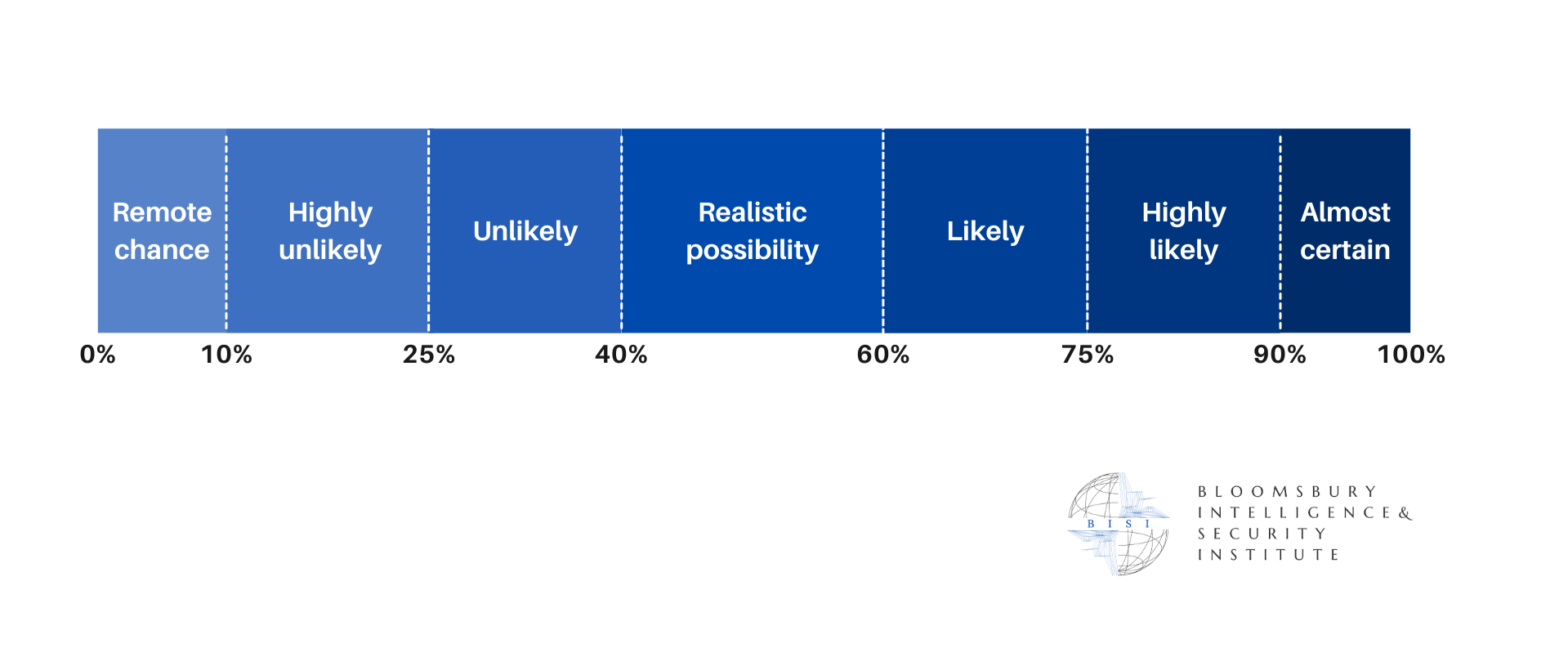
It is highly likely that China and North Korea will continue developing and testing missiles in the Asia-Pacific while the US focuses its resources on the Middle East.
It is highly likely that South Korea and Japan will continue pursuing anti-missile systems buildup to counter China and North Korea's growing missile and drone threats.
However, their nuclear ambitions remain unlikely to come to fruition easily, given the terms of US defence alliances and the offensive signal it would send to adversaries.
Long-term (>1 year)
There is a realistic possibility that the THAAD redeployment to the Middle East will not be permanent; however, the adverse effects of reduced trust and regional security vacuums have already been created and will be hard to undo.
Given the war in Iran spreading to various US allies in the Middle East, there is a realistic possibility that Saudi Arabia might continue pursuing its nuclear weapons ambitions or attempt to seek a formal security assurance with the US, as South Korea has.