
Wattage Warfare: Russia-Ukraine Drone Strikes and Energy Blackmail
By Larissa Alves Lozano | 16 December 2025
Summary
Russia and Ukraine have targeted each other’s energy infrastructure with drone strikes, even amidst various peace talks attempts.
Energy infrastructure attacks have become a tool for escalation and bargaining during the war through counterforce and countervalue targeting and the resulting financial and humanitarian pressure. However, the efficacy of such tactics is mixed.
Energy resilience, not military superiority alone, might determine the future of the Russia-Ukraine war.
Context
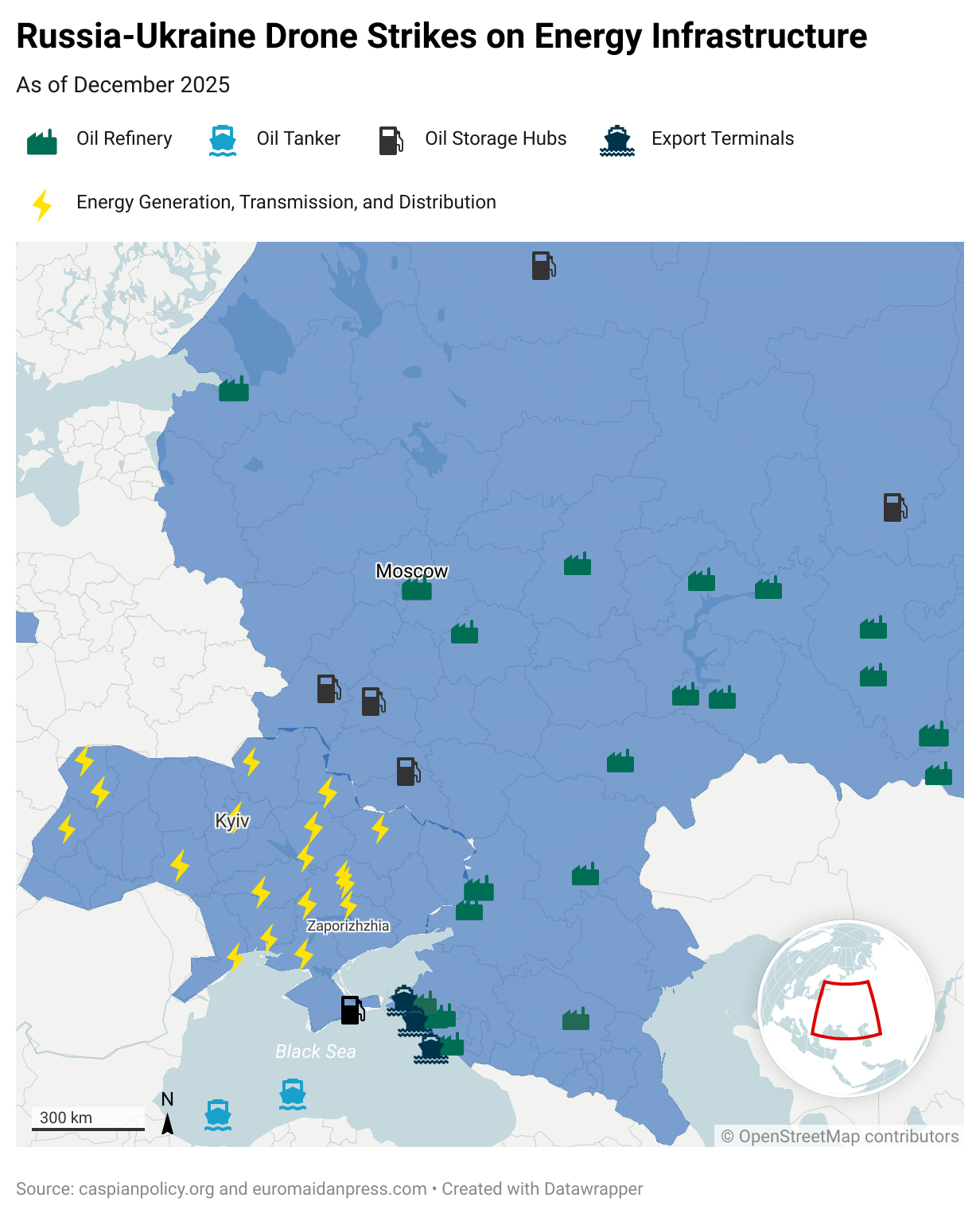
Drone warfare has completely changed the Russia-Ukraine war. Various 2025 reports indicate that drones are now the leading cause of both military and civilian casualties, in addition to extensive damage to energy infrastructure – from power plants to oil refineries to export terminals.
Since 2022, Russia has fired over 2000 drones that have damaged about half of the generation and transmission capacity of Ukraine’s grid. Most recently, from December 5 to 6, Russia launched 653 attack drones on Ukrainian energy infrastructure amidst peace talks with the United States. So far, gas and electricity generation, distribution, and transmission facilities have been damaged across various provinces, including Zaporizhzhia – home of the largest nuclear power plant in Europe. As of December 2024, the World Bank estimates that Ukraine’s energy-related damages have reached over USD $20b (approximately GBP $15.03b).
The drone strikes are not one-sided. In late November 2025, Ukrainian drones hit two Russian oil tanker ships in the Black Sea off the coast of Turkey. This attack was part of a broader campaign targeting Russia’s profitable oil industry. To date, Ukrainian drones have hit over 24 Russian oil refineries, disrupting about 20% of its refining capabilities, in addition to various fuel storage hubs and export terminals to Central Asia. Most notably, the Novorossiysk terminal has been damaged, which handles about 20% of Russian sea exports and 2% of global supply. A 2024 study by the University of Oxford estimates that Russia’s oil and gas revenue accounted for 30 to 50% of its total federal budget, which is crucial for defence spending and drone manufacturing.
Energy Blackmail in War and Bargaining
Drone attacks on energy infrastructure showcase a larger trend of weaponising valuable resources as a tool for escalation and/or coercion. Energy is the backbone of every country as it powers homes, businesses, and public services (countervalue), military facilities, and even (counterforce). If energy is cut out, most things in a country will stop working, and people’s livelihoods and the economy will be jeopardised. Russia has mostly conducted countervalue strikes to undermine Ukraine’s resistance and retaliation abilities through humanitarian pressure. Ukraine has targeted Russian oil mostly for its military and economic importance (counterforce). Russia has engaged in “energy blackmail” for decades towards former Soviet states, but Ukraine has been fighting back on a scale Russia did not anticipate.
Besides an intimidation tactic, energy blackmail is being used as a tool to demand concessions from the other side and signal to both allies and adversaries, which has been evident in various peace talks with the United States and reactions from European and Central Asian countries and even the United Nations. Both countries are facing the infrastructure and financial consequences of energy-related drone strikes, but the motivation to fight remains strong. For Ukraine, the energy damages have only bolstered allied support through aid packages and munitions supply. For Russia, although the damage to its oil infrastructure is not decapitating, it poses a grim future for the longevity of its war financing, overall economic stability, and has damaged relations with its Central Asian allies, primarily Kazakhstan, which relies on the now-damaged Caspian Pipeline Consortium (CPC).
Ever-advancing drone capabilities are changing the nature of the war, as attacks are increasing in speed and scale in relation to troops on the ground. The conflict stakes have been raised as critical infrastructures are on the line. Ultimately, Ukraine has seen more success than Russia by utilising drone strikes for energy blackmail. With both militaries remaining determined to achieve their war objectives, whichever country’s energy infrastructure collapses first might be the deciding factor in reaching any compromise.
Forecast
Short-term (Now - 3 months)
Energy resilience measures, from resource diversification to maintenance, are highly likely to remain fundamental for both Russia and Ukraine to survive the war.
The race to develop and produce advanced drones in Russia and Ukraine is highly likely to continue accelerating, especially with foreign allied-supplied components and private industry participation.
Ukraine’s recently proposed 20-point peace plan that includes an “energy truce” is unlikely to succeed if both sides continue engaging in blame shifting and escalation. Or, on a sombre note, it might only be effective once one side has suffered irreparable damage.
Long-term (>3 months)
If no peace negotiation attempts succeed, Russia and Ukraine are highly likely to utilise more and more financial tactics to bring the war to a halt.
It is likely that western sanctions on Russian oil are almost certain to remain ineffective in crippling its war financing, primarily due to its high trade with China.
As Russia's relations with its Central Asian neighbours deteriorate through disrupted gas and oil supply, Europe and countries around the Caspian Sea have a realistic possibility of filling these growing diplomatic and energy trade gaps.
