
UK’s National Security Threat and Economic Strategic Partner: China
By Anna Toso | 22 December 2025
Summary
The United Kingdom (UK)’s Security Service (MI5) issued a foreign interference alert, warning of Chinese espionage targeting individuals affiliated with the British Parliament through headhunting profiles on LinkedIn.
The UK’s dependency on Chinese technologies and supply chains intertwines with threats of foreign interference and espionage, posing challenging political dilemmas to the UK’s administration about its domestic economy, national security, and diplomatic standing.
In the short term, if the UK detects further interference by China targeting its democratic institutions, the Labour administration is likely to limit its accommodating bilateral economic policy towards China.
Context
On 18 November 2025, the MI5, the UK’s Security Service, issued an alert over Chinese spying in Westminster. Allegations reveal that Chinese intelligence officers are attempting to recruit staff linked to the British Parliament through headhunting profiles on LinkedIn to access sensitive data about the UK. China’s Foreign Ministry spokesperson officially denied espionage accusations, labelling them “phantom allegations” and “false projection.” However, using professional networking websites to gather intelligence from individuals holding sensitive information and state secrets is a long-standing strategy in China’s pursuit of economic power and influence over the international political debate. Precedents of large-scale malicious cyber operations occurred in the UK and elsewhere, including Germany and the United States (US). For example, the “Salt Typhoon” case involved extensive infiltration in US telecommunications companies and internet service providers, including AT&T, Verizon, and Lumen, by Chinese state-sponsored hackers.
Past warnings of Chinese interference in the UK occurred in January 2022, when parliamentary activity was detected, and in 2023, when over 20,000 individuals working in high-tech industries were approached via LinkedIn to disclose industrial secrets. Most recently, in September 2025, charges of espionage for China were dropped for 2 British citizens due to a lack of evidence demonstrating existing threats to national security. The attorney general blamed the politically controversial withdrawal on this outdated national security legislation, dating back to 1911.
Implications
Security and Operational Implications
Following the MI5 warning, the British Security Minister Dan Jarvis vowed to introduce additional security measures against foreign espionage. This new Counter Political Interference and Espionage Action Plan sets up the implementation of additional legislative tools, task forces, educational campaigns for civil servants, and consultations with universities and manufacturers in strategic industries. The provisions also involve tighter control over electoral campaign donations, cooperation with professional networking media to prevent their misuse by spies, and investments worth GBP 170m (USD 227.30m) to renew the civil service’s information encryption system. Beyond cybersecurity, the UK’s total defence spending has registered new peaks since the Cold War. Prime Minister Keir Starmer set the goals of increasing the defence spending share of national GDP to 2.6% by 2027 and 3.5% by 2035.
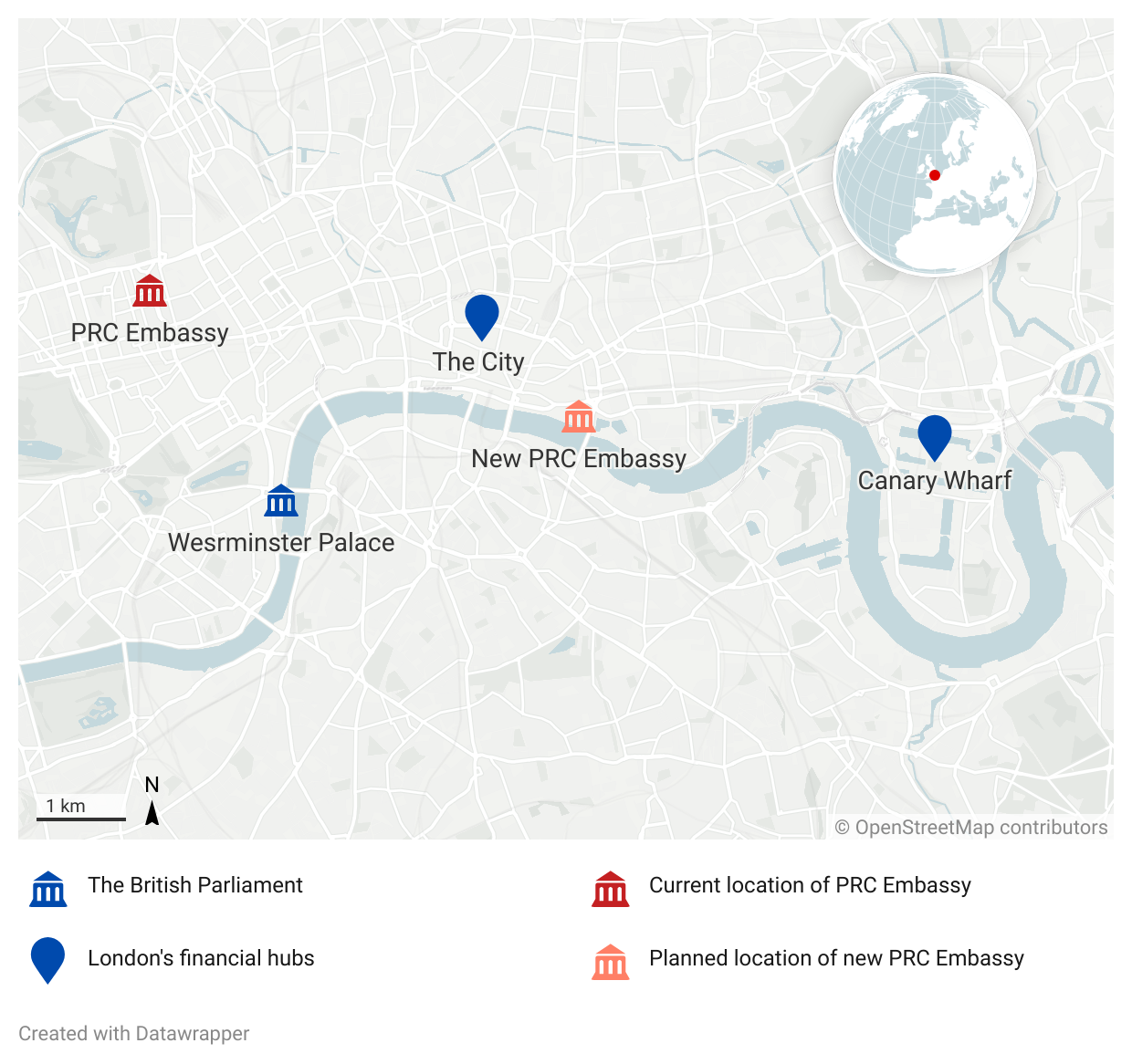
The most recent British Strategic Defence Review, published in July 2025, labelled Chinese technology as a leading, sophisticated and persistent challenge for the UK. Therefore, all sensitive British governmental sites globally have discontinued the use of Chinese-manufactured surveillance technology. The removal only targeted equipment produced by Chinese firms subject to the Chinese National Intelligence Law. This demonstrates the UK’s interest in maintaining positive economic relations with China when national security is not threatened. Additionally, the plan to open a new Chinese embassy in central London raised further concerns about China compromising British security operationally. Such a 5.5-acre complex with basements and tunnels could heighten the risk of breaching underground fibre-optic cables connecting London’s financial hub.
Beyond physical infrastructural risks, China’s espionage often relies on cyberattacks targeting bulk data about individuals’ financial, health, and personal information to train Chinese-developed AI software and manipulate local public opinion, shifting views toward Beijing’s favour. Although every government gathers intelligence in foreign states, the Chinese Intelligence Services exceed regular scale and practices. China’s Ministry of State Security (MSS) encompasses a workforce of 500,000-800,000 individuals. It operates domestically and abroad through security, surveillance, intelligence, and counterintelligence to ensure a favourable environment for a resilient Chinese Communist Party and domestic economic development.
Economic and Political Implications
Positive commercial relations with China benefit the UK’s economic interests. The Labour government has been conducting a more conciliatory diplomacy with China compared to the preceding Conservative administrations. For example, an unprecedentedly large British delegation travelled to Chongqing in March 2025. Several trade deals were signed with the Chinese counterparts. Namely, the UK was the third largest recipient of Chinese investment between 2005 and 2024. The UK-China commercial liberalisation could boost the British economy by GBP 1b (USD 1.34b). Furthermore, China holds a quasi-exclusive monopoly over rare earth mineral extraction and refinery, underpinning global supply chains for high-tech and green energy transition manufacture. Like most countries worldwide, the UK is overreliant on China for the import of these critical supplies.
The British government currently lacks a long-term strategy to structure its engagement with China. The recent national security threats lengthen the list of fault lines between the two countries. Other matters causing political strain include China’s erosion of Hong Kong’s “One Country, Two Systems” policy, human rights abuses in Xinjiang, the stance on Taiwan’s independence, and the role in Russia’s war against Ukraine. UK-China economic relations cannot overlook these geopolitical divergencies.

Wikimedia
Forecast
Short-term (Now - 3 months)
If further interference with British national security is detected, the economic deals established with China in the past months will likely face limitations.
Nevertheless, the most vital deals for the UK, such as those linked to rare earth mineral supplies, are highly unlikely to halt as the British economy relies on them and there are no alternative suppliers in the market.
Medium-term (3-12 months)
If continued, the cooperative approach with China on economic matters pursued by the British Labour government will likely spur diplomatic resentment in one of the UK’s closest and most influential allies, the United States.
Long-term (>1 year)
In the long term, for the UK to negotiate with China on a diplomatic level, the Labour administration will likely be required to set clear boundaries regarding its willingness to compromise national security, human rights, and democratic values in exchange for economically beneficial cooperation with China.
