Russian Military Performance in the Ukraine War
By Dorota Vandakova | 10 March 2026
Summary
Russia’s invasion of Ukraine in February 2022 revealed persistent structural weaknesses in logistics, coordination, and command despite reforms implemented after the war with Georgia.
Russia’s current military performance demonstrates an ability to sustain operations but with slow advances, high casualty rates, and continued reliance on attritional warfare.
The conflict is likely to remain prolonged, with Russia maintaining pressure but facing constraints that limit decisive breakthroughs over the short to long term.
Context
On 24 February 2022, Russia initiated a full-scale assault on Ukraine across every front, including land, air, and sea. This marks the most significant military conflict between European nations since 1945, realising the Western world's darkest predictions. Prior to Ukraine, Russia's last major invasion was the 2008 war with Georgia. Moscow initiated a series of military reforms aimed at modernising equipment, improving readiness, and restructuring command-and-control frameworks. Despite these efforts, the Ukraine invasion has shown major structural issues. Russian forces encountered logistical bottlenecks, inconsistent unit coordination, and rigid command hierarchies, all of which reduced operational flexibility and slowed advances.
In early 2026, Russian forces adapted their approach but remained constrained. The conflict has evolved into a prolonged war of attrition, with Russia relying heavily on artillery, missile strikes, and drone warfare rather than manoeuvre-based operations. Russian forces continue to make incremental territorial gains, but advances are slow, measured in metres rather than kilometres, reflecting the difficulty of achieving decisive breakthroughs. Between February 2024 and January 2026, Russian military forces advanced slightly less than 50km2 during the offensive from Avdiivka to Pokrovsk. This progress represents an average daily gain of approximately 70m.
Implications
Russia’s current military performance reflects a mixed picture of adaptation and constraint. Politically, the inability to secure a decisive victory after several years of conflict has affected perceptions of Russian military power and strategic effectiveness. While Russia retains significant capabilities, the prolonged nature of the war has undermined expectations of rapid dominance and may influence the strategic calculations of neighbouring states and adversaries.
Operationally, Russian forces have demonstrated an ability to sustain long-term combat operations, but at a high cost. Casualty rates remain significant, with estimates suggesting thousands of losses per week and heavy reliance on mass mobilisation and drone warfare. Since the beginning of the war, Russian forces have suffered 1.2 m casualties. By forcing Ukrainian defenders to reveal their positions and deplete ammunition on low-value infantry, Russia seeks to degrade Ukrainian defensive integrity over time. Concurrently, an increasing reliance on drone strikes against critical infrastructure aims to paralyse the Ukrainian rear, disrupting logistics and domestic morale while the front line remains stagnant. Additionally, Russian forces are advancing remarkably slowly and have been among the slowest in modern warfare. Even the fastest Russian campaign in Pokrovsk was slower than the British and French campaign in the Somme during World War I. This suggests that the reforms, initially implemented after the Georgian war, were only effective on paper but not on the battlefield.
From a security perspective, the conflict is radically reshaping the European environment by testing the alliance's physical and political boundaries. While NATO cohesion has strengthened, the battlefield is no longer confined to Ukrainian soil; it has evolved into a theatre of "gray zone" provocations. This is most evident in the frequent drone incursions into NATO territories, specifically in Poland, Romania, and Latvia. At the same time, the continued use of large-scale missile and drone attacks highlights the risk to civilian infrastructure and the persistence of high-intensity warfare. Additionally, beyond the eastern flank, the war has significantly destabilised the Western Balkans, where Russia leverages historical ethnic tensions to create a secondary "proxy" front of instability. By supporting separatist rhetoric in Bosnia and Herzegovina and stalling normalisation between Kosovo and Serbia, Moscow aims to distract Western resources and political focus away from Ukraine.

Avdiivka, Ukraine in January 2024
Credit: National Police of Ukraine/Wikimedia Commons, CC BY 4.0
Forecast
Short-term (Now - 3 months)
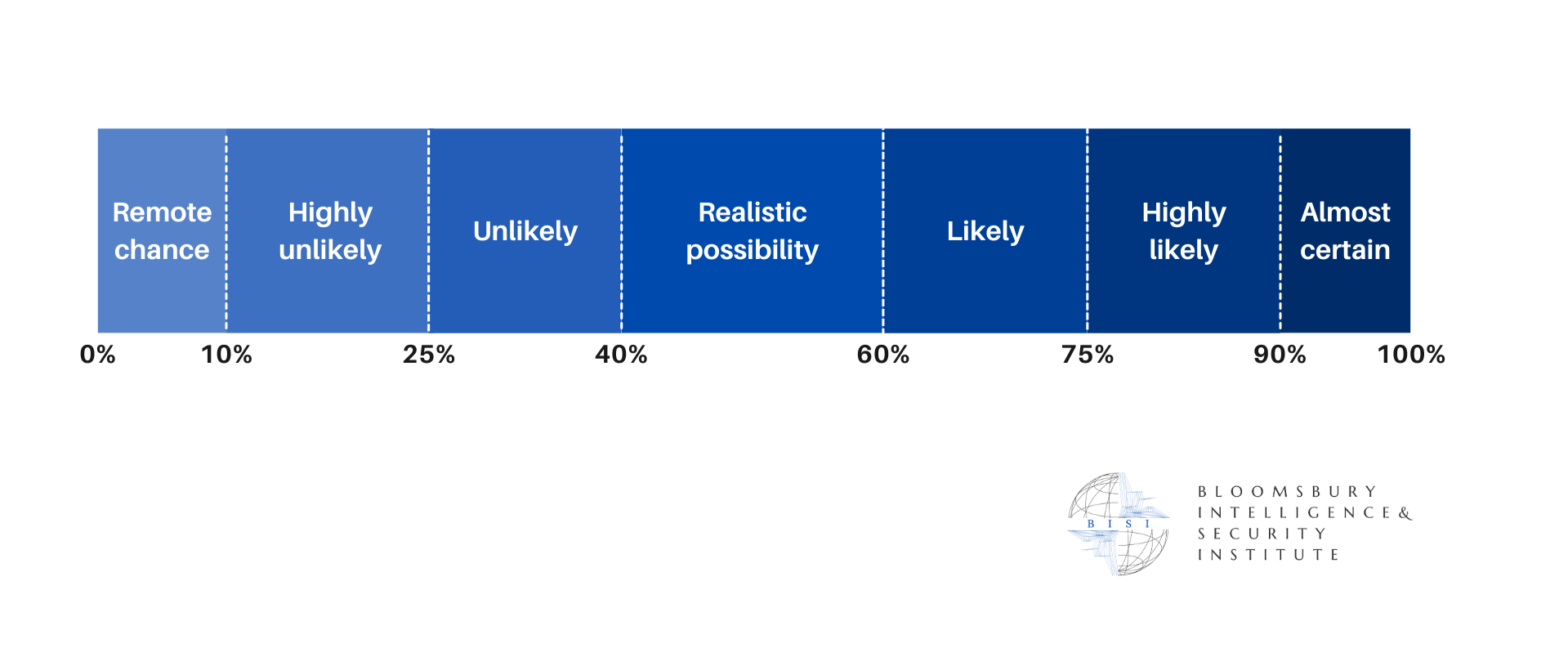
Russia is likely to continue high-intensity strikes and incremental ground offensives, maintaining pressure without major territorial breakthroughs.
Medium-term (3 - 12 months)
The conflict is highly likely to remain a war of attrition, with Russia sustaining operations but facing continued high casualty rates and limited operational gains.
Long-term (>1 year)
Russia could realistically possibly further adapt its military structure and tactics; however, systemic inefficiencies and economic constraints will likely limit its ability to achieve decisive outcomes.