
Kazakhstan Joins the Abraham Accords
By Erlan Benedis-Grab | 8 December 2025
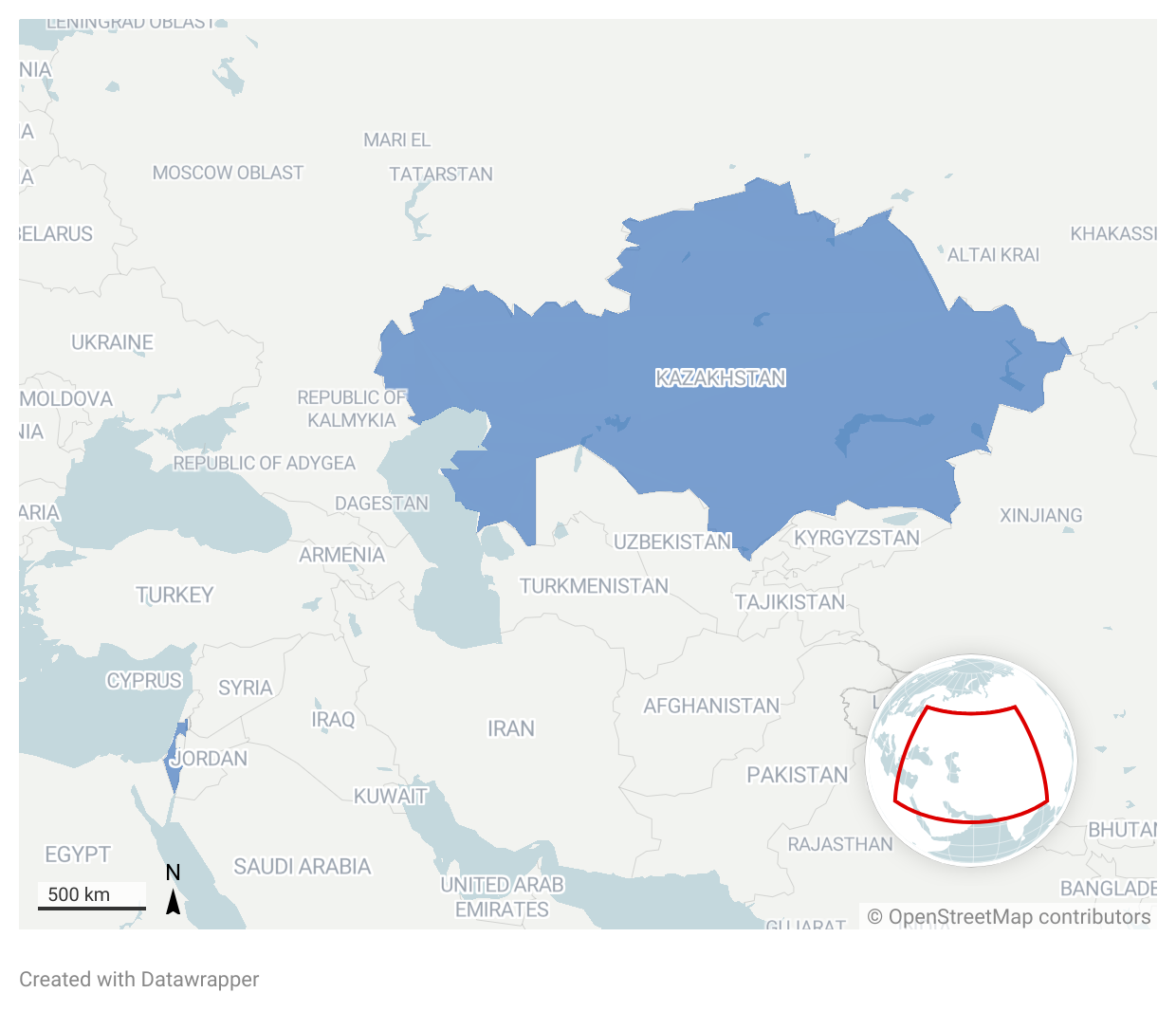
Summary
Kazakhstan has maintained diplomatic relations with Israel since 1992, underscoring that its engagement with the Abraham Accords builds on long-standing, normalised ties rather than a sudden breakthrough.
Kazakhstan aims to deepen its strategic partnership with the United States under the accords umbrella, especially in terms of securing new commercial and technological opportunities.
However, there is significant value in presenting a vision of a greater post-regional bloc of Israel and Muslim states. Kazakhstan’s entry could provide a vision for the entry of Azerbaijan or Indonesia.
Kazakhstan’s accession thus reaffirms its identity as a multi-vector state, positioning itself as a bridge not only between East and West, but also between Israel and the wider Islamic world.
Context
On 6 November 2025, the Republic of Kazakhstan and the United States announced that Kazakhstan would be joining the Abraham Accords. The Abraham Accords are a set of US-brokered normalisation agreements between Israel and several Arab states. The initial wave in 2020 included the United Arab Emirates and Bahrain, followed shortly thereafter by Morocco. The initiative was widely viewed as the signature foreign-policy achievement of President Donald Trump’s first term, and the current Trump administration appears eager to expand and capitalise on its earlier momentum. Kazakhstan is officially a secular state, even though the majority of its population is Sunni Muslim. Consequently, Kazakhstan has maintained bilateral trade relations with Israel since the early 1990s, with total trade valued at approximately USD 482m in 2023.
From Kazakhstan’s perspective, participation in the Abraham Accords serves several purposes. Firstly, Kazakhstan is cognisant of the Trump administration’s strong emphasis on expanding the Abraham Accords. Therefore, Kazakhstan aims to strengthen its position ahead of any prospective negotiations over U.S. tariff policy affecting Kazakh exports. Right now, as a result of renewed tensions between Israel and several Middle Eastern Sunni-majority states (Türkiye, Saudi Arabia, Qatar, Egypt), ascension of any of these states to the Abraham Accords is highly unlikely. Kazakhstan's entry, therefore, offers the Trump administration an easy and visible foreign-policy win, one that can signal the potential for progress in regional normalisation.
Secondly, the move is largely symbolic and therefore Astana is unlikely to face significant diplomatic risk on this issue.
Thirdly, there are tangible economic benefits as deepening trade with Israel provides access to leading Israeli technology and key resources. This includes agricultural technology, cybersecurity tools, and water-management systems. It also encompasses the technical expertise and human capital needed to modernise Kazakhstan’s strategic sectors.
Lastly, Kazakhstan is continuing the trend of gradual rebalancing between Moscow and the United States. While it still relies on Russia as its primary security guarantor, the United States has become one of Kazakhstan’s most important economic priorities as of late.
Implications
Kazakhstan’s ascension is likely to pave the way for additional Muslim-majority states to join the Abraham Accords. A realistic medium-term candidate is Azerbaijan, particularly given that both countries face an explicit strategic challenge from Iran.
Furthermore, Azerbaijan’s prospective decision also carries a distinct Turkic angle. Both Baku and Astana frame their cooperation through a shared Turkic cultural identity, so parallel moves on the Abraham Accords would reinforce these ties. This move broadens the Abraham Accords from a Middle Eastern normalisation mechanism into a wider post-regional diplomatic framework with relevance beyond the region. Furthermore, strengthening the Accord’s credibility as a versatile tool of engagement with numerous states.
Russia’s reaction to Kazakhstan’s accession to the Abraham Accords is likely to remain muted. Moscow is certainly not pleased, especially given the Accords’ alignment against Iran, but Kazakhstan moved quickly to reassure the Kremlin. Just days after the Washington summit, Kazakh President Kassym-Jomart Tokayev travelled to Moscow on 12–13 November 2025, where he and President Vladimir Putin signed a new “Comprehensive Strategic Partnership and Alliance," formally upgrading bilateral ties and further signalling that Astana is not drifting out of Russia’s orbit.
The real objective of Kazakhstan’s accession to the Abraham Accords is to project it as a stable, moderate Muslim-majority state ready for investment. In this respect, the move has already been effective, coinciding with sizeable US investment commitments announced at the recent US–Central Asia (C5+1) summit. Washington recently pledged upwards of USD 17b of investment, involving U.S. companies including NVIDIA, Boeing, Groq, and OpenAI. Given the scale and relevance of these deals, deepening alignment with U.S. strategic priorities, including the Abraham Accords, is natural for Kazakhstan.

Veronika Shabrikhina / Unsplash
Forecast
Short-term (Now - 3 months)
Kazakhstan and Israel will almost certainly hold a formal signing ceremony, finalising the Abraham Accords accession and solidifying the agreement officially.
Iran will likely issue sharp rhetoric and possibly lodge a diplomatic protest, though economic retaliation will remain unlikely.
Medium-term (3-12 months)
Azerbaijan is likely to join the Abraham Accords in the medium term, deepening its already close relationship with Israel.
Kazakhstan’s exports to Israel, especially in oil and petroleum products, are likely to modestly increase as both sides test new commercial channels and long-term supply arrangements under the Accords framework.
Long-term (>1 year)
Additional Middle Eastern states will remain unlikely to join the Abraham Accords until there is a clearer resolution to the status of Gaza.
There will be a realistic possibility that Israel becomes a partner in one or more Middle Corridor projects under the Abraham Accords umbrella. This would primarily involve integrating Israeli ports, especially Haifa, into westbound transport routes from the South Caucasus/Türkiye
