
After September 2025: Nepal’s Political Landscape
By Kira Persson | 3 February 2026
Summary
In September 2025, massive Gen Z–led demonstrations erupted in Nepal following a nationwide social media ban. The protests left over 70 dead and reflected deep grievances over corruption, nepotism, economic stagnation, and an unresponsive political class.
The protests propelled former Chief Justice Sushila Karki into office as Nepal’s first female prime minister, tasked with stabilising the country and overseeing early elections in March 2026.
Though powerful, the youth movement remains divided, and traditional parties struggle to reinvent themselves. While the protests and their outcome have expanded political participation, especially among young voters, it is likely that the March elections will produce a fragmented mandate, with coalition-building and contested governance shaping Nepal’s immediate political trajectory.
Context
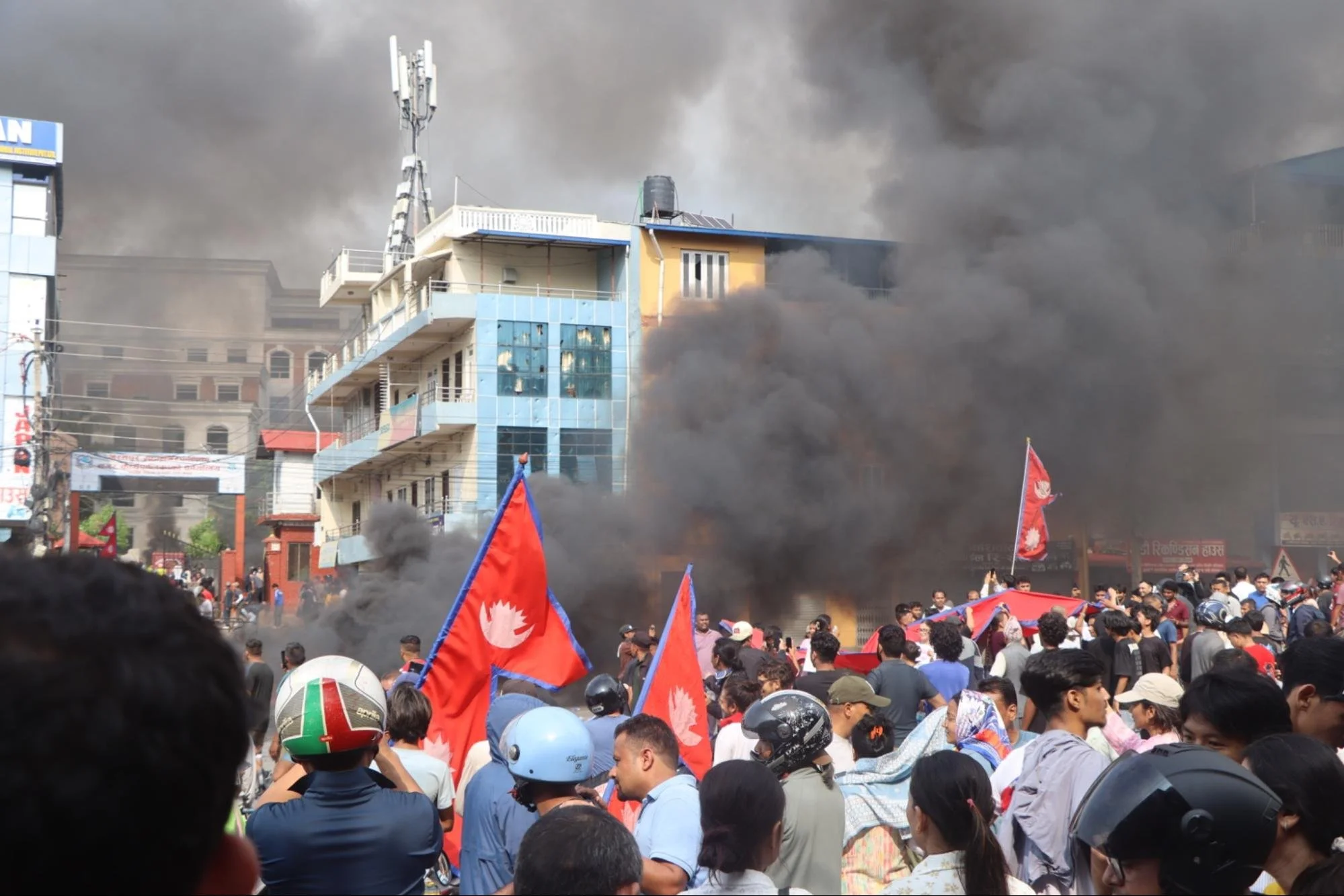
On 8 September 2025, massive Gen Z–led protests erupted across Nepal following a nationwide ban on Facebook and other social media platforms. While the government framed the ban as an effort to curb hate speech and disinformation, it unleashed underlying grievances over endemic corruption, nepotism, and a political class seen as unresponsive. In 2024, Nepal ranked 107th out of 180 countries on the Corruption Perceptions Index (CPI). In the same year, youth unemployment was 20.8%. What began as peaceful demonstrations turned violent on 9 September, with core state institutions and the residences of senior political figures attacked, resulting in over 70 deaths.
Prime Minister KP Sharma Oli resigned following the protests; the social media ban was lifted; and youth-led online coordination via Discord helped propel former Chief Justice Sushila Karki into office as caretaker prime minister. Sworn in on 12 September, Karki became Nepal’s first female prime minister, tasked with stabilising the country and overseeing a transition. On her recommendation, Paudel dissolved the House of Representatives and scheduled early elections for 5 March 2026.
Karki’s interim government has moved quickly. It launched a judicial commission to investigate the September violence, froze the passports of Oli and 4 former officials, approved compensation for victims’ families, and amended voter registration rules to allow late enrolment—thus significantly expanding the Gen Z electorate. However, grievances persist, including over ethical lapses in key appointments and the absence of high-profile arrests of ministers from Oli’s government. Major parties say Karki has prioritised retaliation over creating a conducive pre-election environment.
Outlook and Implications
A record 120 parties, a third of which have registered since September, are contesting the March polls. Established parties are struggling to adapt to youth demands. The historically dominant Nepali Congress has fractured following the ouster of long-time party president and 5-time prime minister Sher Bahadur Deuba, whose faction is challenging the legality of the new party leadership in court. The CPN-UML remains dominated by Oli despite internal pressure for him to step down. The Maoist Centre and Unified Socialist have merged into a single communist bloc.
Kathmandu mayor Balendra Shah has stepped down to contest a national seat under the Rastriya Swatantra Party (RSP), and Sudan Gurung, a prominent youth activist and coordinator of the 2025 protests, is contesting Gorkha–1 under the same party. These candidacies reflect how youth movements may pursue parliamentary influence through alternative parties rather than independent campaigns. The Nepali Congress, under its new leadership, has fielded younger candidates—including former student leaders and Gen Z activists—in key constituencies.
The protest movement is fragmented, with no single leader or manifesto, and tensions over questions such as federalism and the scope of reform. Security and institutional trust remain fragile. As of November, more than 5,000 inmates who escaped during the unrest remained at large, and hundreds of firearms were unaccounted for. Beyond complicating election preparations and jeopardising physical safety, a compromised police force heightens security risks and undermines the credibility of the election. Furthermore, deep political fragmentation, low public trust in political elites, and a weak interim government increase the risk of post-election unrest, particularly if coalition negotiations stall or electoral outcomes are perceived as perpetuating the pre-uprising status quo.
Similar youth-led protest movements have taken place in Sri Lanka (2022) and Bangladesh (2024). Karki has insisted that Nepal will not “become another Bangladesh,” highlighting the difficulty of translating mass mobilisation into durable democratic outcomes. The comparison has limits. Bangladesh’s unrest featured a defined opposition, displaced the ruling regime, and resulted in a party ban, producing a partial political reset. In Nepal, by contrast, all major parties remain intact, no clear opposition has emerged, and political change—while dramatic—has unfolded over just 6 months before elections. This has preserved institutional continuity but limited the scope for structural reform.
Nepal’s political landscape has shifted sharply since September, with reform-oriented forces challenging a system long dominated by ageing parties and entrenched elites. While this creates an opportunity for political renewal, it also presents a chance for established parties to reinvent themselves and restore credibility through meaningful engagement and reform. However, a turbulent pre-election environment, weak institutional trust, and deep political fragmentation raise concerns about whether elections will deliver durable change.
Forecast
Short-term (Now - 3 months)
The March elections will likely be shaped by party fragmentation and security conditions, rather than policy competition. Electoral legitimacy will hinge on security management, dispute resolution, and accountability for protest-era violence. Any perceived failure risks renewed mobilisation
Medium-term (3-12 months)
The elections are likely to produce an unstable governing coalition, constrained by internal party divisions and unclear mandates. Youth turnout is likely to be high, but its impact may be limited by organisational fragmentation. Nepal risks reverting to competitive but weak governance, marked by short-lived coalitions and stalled reform.
