By Stephen Nkrumah | 16 November 2026
Summary
Africa currently accounts for only about 0.6% of global data-centre capacity at a time when demand for artificial intelligence computing is growing, and meeting this demand will require billions of dollars in new investment.
Weak power supply, high project costs and limited government guarantees for payments are likely to delay large data centre projects, as well as currency fluctuations and political risks, which could also reduce returns for investors.
Smaller projects that are built in stages are more likely to move forward, while a single AI data centre of 1 GW or more is unlikely to be built before 2030.
Context
Africa lacks much of the computing capacity that is needed to support the use of artificial intelligence (AI), which is growing globally. According to the Africa Data Centres Association (ADCA), Africa currently has 360 megawatts (MW) of active data-centre capacity, of which 238MW are under construction and 656MW are planned. This means that Africa’s data-centre capacity could reach about 1.2 gigawatts (GW) by 2030, which is about three times what it has today. So to put that in perspective, 1.2 GW is only about a fifth of the 6 GW that Nigeria’s whole power grid supplies, or roughly twelve AI facilities of 100 MW each. This growth is expected to follow global expansion rather than close the gap, so its share of global capacity is expected to stay at about 0.6%, despite the continent being home to about 18% of the world's population. Outside South Africa, only about one-third of built capacity is fully used, which shows that demand has yet to meet supply in many African markets.
So, why build more? Operators are building ahead of demand on a 10 to 20 year time frame as it takes up to 8 years on average to fill up a newly built African data center. There are several factors driving the urge to build more data centres. First and foremost, according to a McKinsey & Company report, AI could triple global data-centre demand by 2030. Also, local cloud services offer far lower latency than their overseas counterparts. This delay, or latency, is reduced to around 35-45 milliseconds within South Africa, as opposed to 70-100 milliseconds to far-flung regions abroad. Again, there is the issue of data sovereignty, or the fact that data hosted abroad can be subject to foreign laws, including the US CLOUD Act. In terms of investment, hyperscalers and other players are committing between USD 2.5b and USD 4b to building out data centers in Africa, which will fuel further construction of facilities.
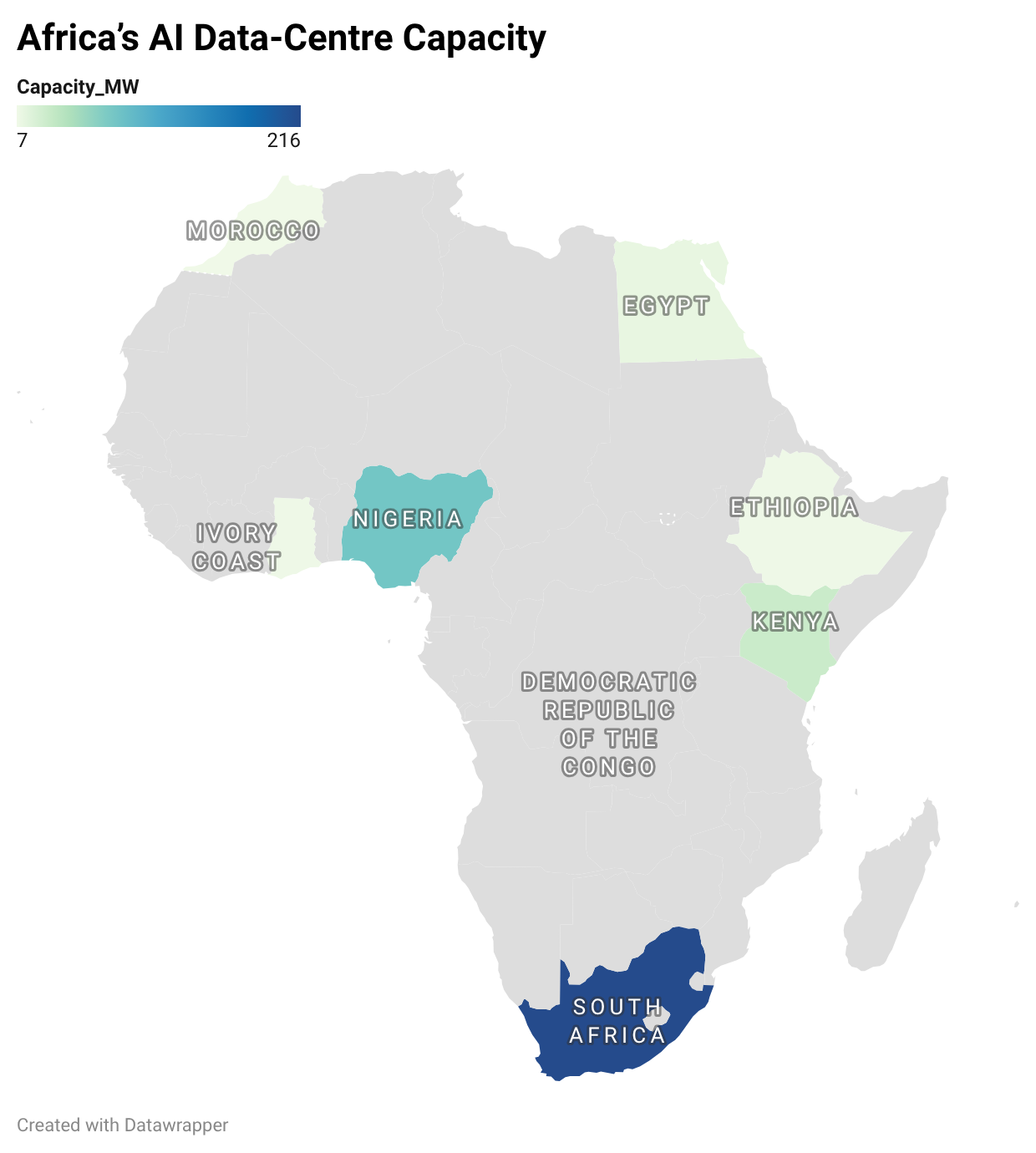
South Africa accounts for more than 60% of Africa’s operational data-centre capacity, but investment is also expanding into Nigeria, Kenya, Egypt, Ghana, Ethiopia and Morocco. For instance, Lagos, Nigeria’s data-centre capacity is forecast to increase from 78.6 MW to more than 218 MW by 2030. In August 2026, MTN Group announced plans to develop 150 MW of AI data-centre capacity in Nigeria and South Africa. The sector will need an estimated USD 10b to USD 20b in new investment to be able to expand its data-centre capacity.
Implications
One of the biggest operational risks for AI data-centre developers in Africa is going to be power supply, and it is already the main barrier to expansion, as electricity is now a bigger constraint than fibre connections. Nigeria’s 6 GW power grid serves about 230 million people, as compared to South Africa’s 48 GW grid which serves 63 million people. While a typical data centre requires around 10-25 MW of power to run, an AI facility can easily require 100 MW or more. In May 2026, a USD 1b Microsoft and G42 data-centre project in Kenya was delayed because the government could not meet the payment guarantees that were requested, and the power that was needed was also a problem. It has not been launched and is still stalled, although officials say it has not been withdrawn and they are still in talks. In view of this, President William Ruto issued a warning that supplying electricity to such a data centre could mean cutting power to half of the country. Many developers are therefore planning to build their own power plants, probably fuelled by solar or gas, and to have a number of different backup systems and connections to different parts of the grid. These additional requirements will make individual projects more expensive and take longer to bring online. Developers with existing, secure power and fibre contracts are likely to win out in the early stages because they can provide a more stable service to customers.
Additionally, government support and policy decisions are also likely to determine which projects proceed. So a new factor in the mix is public pushback. In South Africa, advocacy group Housing Assembly and UK non-profit Foxglove have launched a legal challenge in August 2026 to Equinix’ plans for two huge data centres in Cape Town with 174 MW of power between them. According to Foxglove, the two centres could consume more than 4.4 billion litres of water per year in a city that nearly ran dry in 2018. The South African Human Rights Commission has received over 250 submissions on the issue, and a number of non-profits are calling for a moratorium on new development until an assessment is made of water, land and energy usage. However, the issue is being hotly defended by industry with claims that the issues are being grossly exaggerated. In the meantime, no decision has been made on the matter, and the site is still waiting for development to commence. As noted above, the planned Microsoft-G42 data center in Kenya has encountered a number of hurdles, not least a dispute over government payment guarantees for the project. It seems that the location of a data centre and the amount of water it will use are just as important as the sums of money on the table. Similar issues are expected to be encountered by other large international players in many other African markets with limited government funds. While new electricity tariffs, licensing conditions and investment policy, for example, could make a long-term agreement difficult, governments and developers are likely to prioritise step-by-step development of projects as more investment becomes available. Meanwhile, demand for locally hosted services is expected to rise as data protection requirements increase. Nonetheless, the fact that there is a data-protection law does not automatically mean that all data has to be stored locally.
Also, foreign exchange pressures and higher financing costs are likely to increase costs for operators that rely on imports of semiconductors, servers and other cooling equipment. If local currencies weaken or access to the US dollar becomes limited, it will increase the cost of purchasing equipment and repaying debt. Consequently, the profit margins of companies will decrease, and some investors might delay their investment decisions; smaller local companies with foreign-currency borrowings will face even greater challenges. Nevertheless, the market for AI in Africa is projected to grow from USD 4.5b in 2025 to USD 16.5b by 2030. Nonetheless, not all companies will equally benefit from this growth. Companies with sufficient and consistent power, adequate financing, as well as a stable customer base are likely to be ahead of their competitors, while other projects might experience delays.
Forecast
Short-term (Now - 3 months)
More data centre projects are highly likely to be announced in Nigeria, South Africa and Kenya, but few are expected to open during this period.
Large data-centre projects are likely to face more delays because of power supply problems or disagreements over payment terms, which will mostly affect cloud providers and investors.
Medium-term (3 - 12 months)
More data-centre developers are likely to invest in their own solar or gas power systems to ensure a reliable electricity supply, which will increase the cost of building and operating data centres.
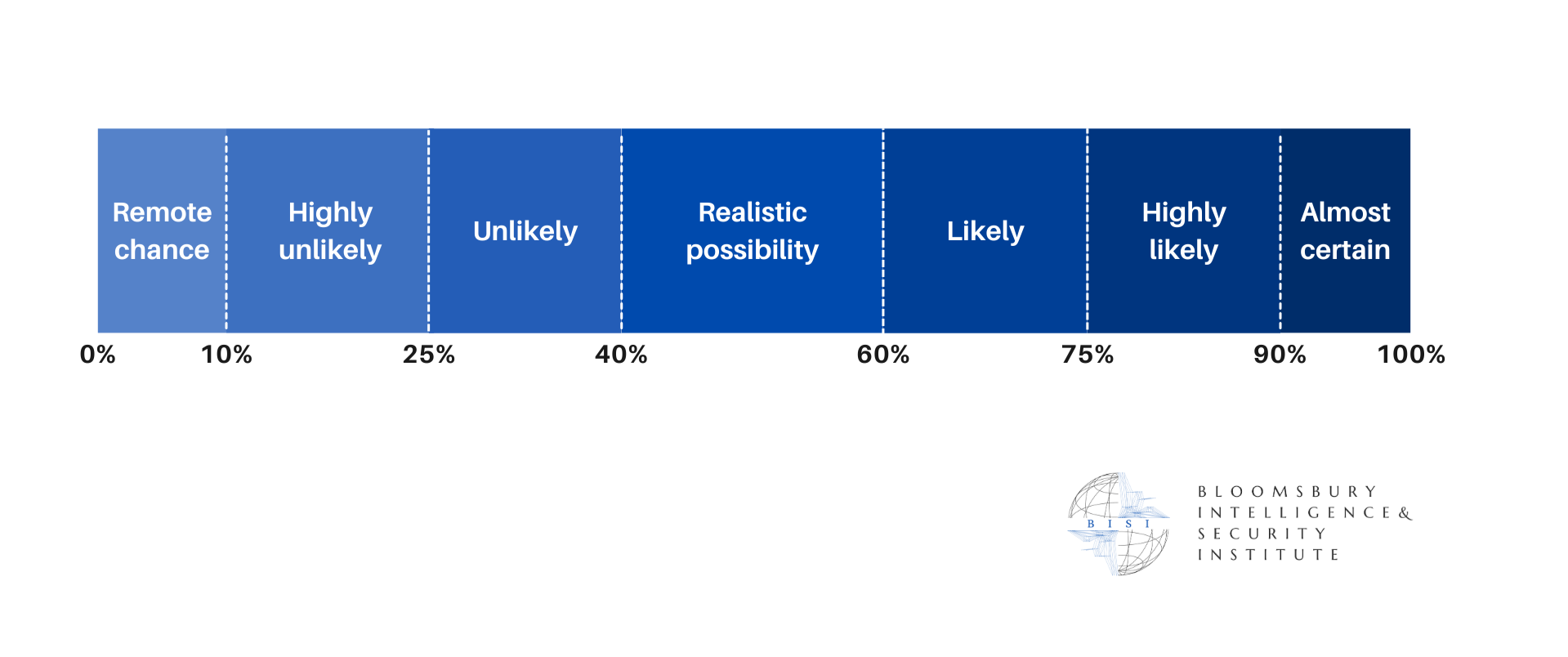
There is a realistic possibility that a weaker local currency will make imported equipment more expensive for data-centre operators in Nigeria and other countries that depend on imports.
Long-term (>1 year)
Africa is highly likely to account for less than 1% of the world's data-centre capacity through 2030, which makes it harder for African businesses to access the computing power they need to run AI systems locally.
There is a realistic possibility that Africa could reach about 1.2GW of data-centre capacity by 2030 if most of the projects that are currently planned are completed.
It is unlikely that a single AI data centre with a capacity of 1GW or more (one site, not the continent’s total) will be up and running in Africa before 2030. For comparison, one such site would be close to the whole continent’s projected 2030 capacity of about 1.2GW.