
The Genesis Mission and the Future of AI-Enabled Research
By Ipek Kara | 8 December 2025

Summary
The Genesis Mission is a federal initiative launched by President Trump to mobilise 17 national labs, federal supercomputers, and private-sector entities to compute into a unified AI-augmented research ecosystem across biotechnology, quantum, fusion, critical materials, space, semiconductors, and microelectronics.
The initiative seeks to shorten scientific discovery timelines, rebuild federal R&D strength, and reduce reliance on foreign supply chains and private monopolies for related critical technologies by accelerating modelling, simulation, and automation.
While promising major advances in strategic sectors, the mission exposes vulnerabilities around concentrated compute access, unclear data and IP rules, and potential security gaps which could widen institutional inequalities and generate political pushback if unresolved.
Context
On November 24, US President Donald Trump signed an Executive Order to launch the Genesis Mission, which aims to expand the productivity and impact of the Federal research capabilities. The mission will be led by the United States Department of Energy (DOE) and coordinated by the Assistant to the President for Science and Technology will deploy 17 national laboratories, supercomputers, private-sector computing capabilities through partnerships, and the federal data repositories, aiming to integrate government, academia, and the private sector.
Priority areas of research will be biotechnology, critical materials, nuclear fission and fusion energy, space exploration, quantum information science, semiconductors, and microelectronics. The federal administration frames the mission as “a historic national effort for a global AI race”, underlining the importance of AI-augmented technologies not only for economic growth but also for national security, energy sovereignty, and technological leadership of the world. In a press call on Monday, science adviser to the president Michael Kratsios called the Genesis Mission “the largest marshalling of federal scientific resources since the Apollo program.”
Implications
Acceleration of innovation in AI-driven modelling, simulation, and automation could reduce research timelines in many fields, such as quantum materials and fusion energy. Additionally, strengthening the domestic R&D infrastructure has the potential to increase the US’s autonomy in the manufacturing of critical technologies such as semiconductors and quantum devices. The mission will be built on a combination of decades of research and investments made by the federal government. Therefore, the old investments will be maximised, and the mission will be in a position to reverse the funding cuts made in the prior years by the current federal government. However, the US’s R&D capacities are mostly concentrated in the hands of a few large private companies and national labs, who will be supplying the computing interface. Therefore, early gains from the mission are likely to widen inequalities between large and small research entities.
The executive order contains high-level security requirements. However, it lacks the public protocols for: data access, third-party vendor vetting, IP ownership & licensing rules, and conditions for classifying derived models. If these problems are not addressed in the near future, the mission will become open to misuse and secrecy issues, which would bring political pushback and reduced public trust for the new funds.
These dynamics position the Genesis Mission both as a unifying and a stress factor for the future of AI-enabled technology governance. While the initiative is promising breakthroughs across many strategic sectors, it also exposes the structural vulnerabilities of the US research ecosystem, including data governance gaps and concentration of R&D capabilities in private entities. The government’s ability to balance scientific access and national security will be a main pillar of success alongside the technical achievements. Genesis’s process will be a defining story for how the other democratic states will pursue frontier technologies under the developing geopolitical competition.
Forecast
Short-term (Now - 3 months)
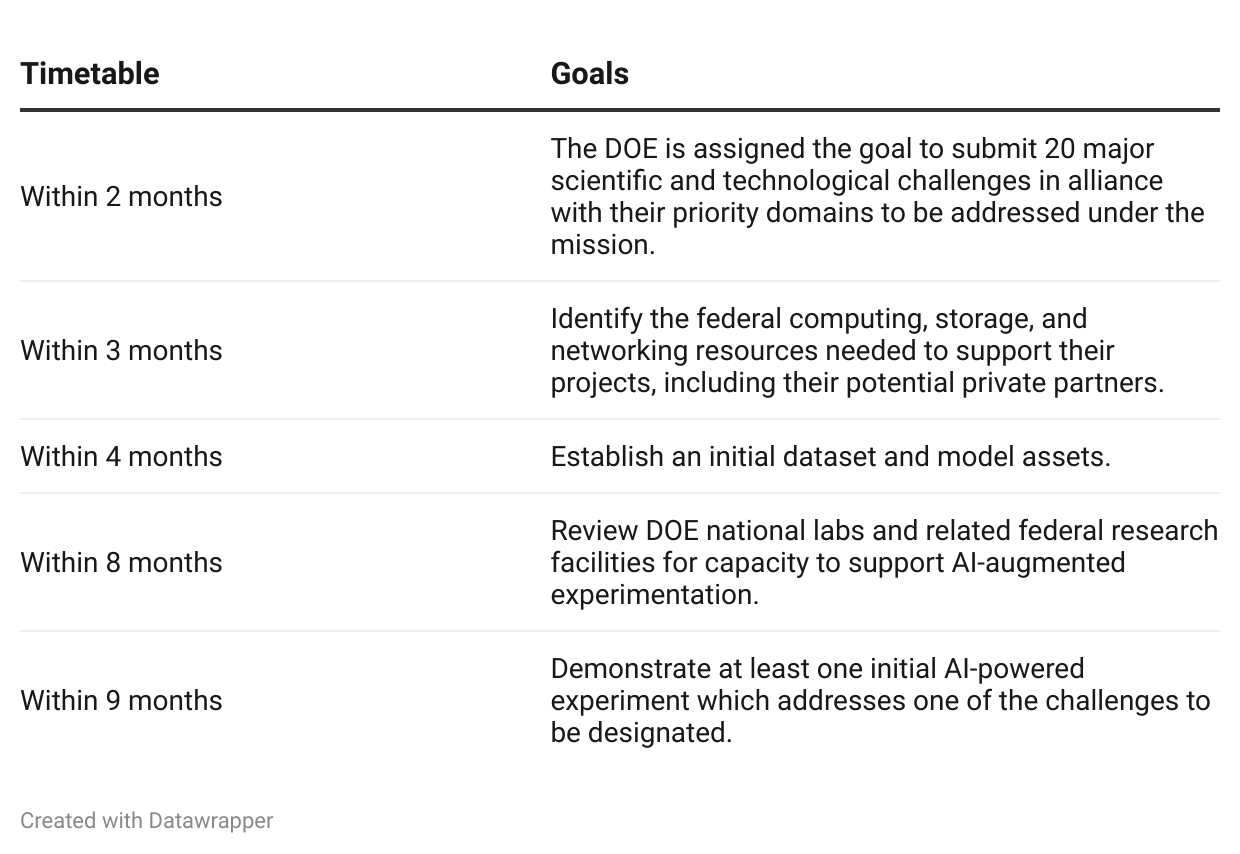
DOE will almost certainly finalise the list of 20 target challenges to work on and begin formal partnerships with major cloud and AI companies based in the US.
Early political momentum is likely to be high, in the case that the current security and privacy gaps are not addressed by the federal government.
Medium-term (3-12 months)
First AI-powered experimental demonstrations are highly likely to start discoveries or solve optimisation problems.
The mission is highly likely to become a key column of federal–private interdependence, with major private firms supplying computation and toolkits, which comes with a realistic possibility of questions around access inequality for smaller research institutions and the start of discussions around the further centralisation of R&D capabilities, intensifying the discussions around data governance and national security implications.
Long-term (>1 year)
If governance issues are effectively addressed, Genesis is likely to evolve into a stable AI-science infrastructure, accelerating breakthroughs and strengthening US technological sovereignty.
Geopolitically, allies and competitors such as the EU and China are likely to adapt their own national AI-augmented research strategies in response, making Genesis a reference point (or cautionary example) in the global tech race.
